
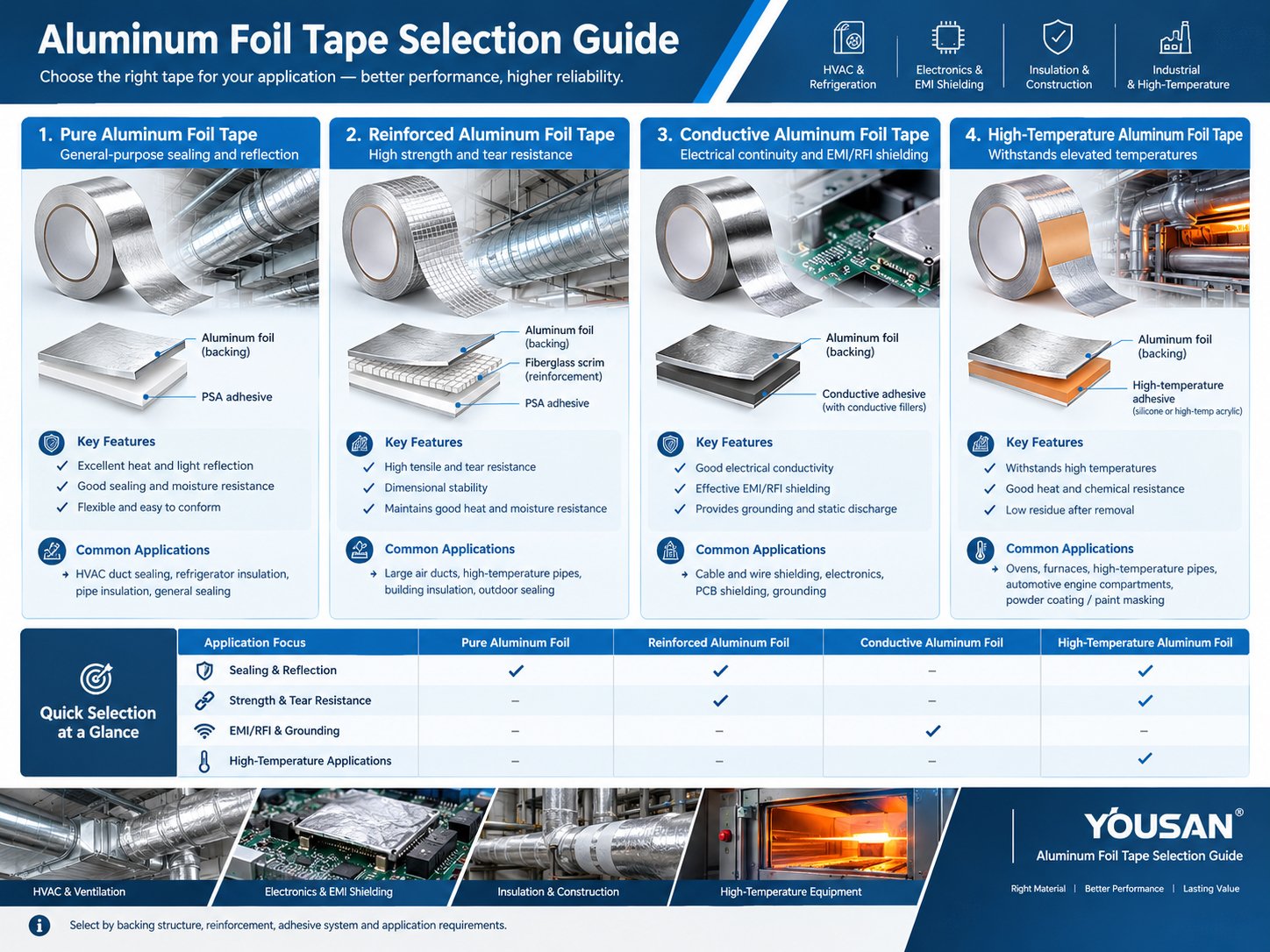
Aluminum foil tape is widely used in HVAC and refrigeration, insulation, electronics, automotive, aerospace, appliance manufacturing, construction, and industrial maintenance. However, not all aluminum foil tapes are designed for the same purpose.
Depending on the backing structure, reinforcement, adhesive system, and functional requirements, aluminum foil tapes can provide very different levels of sealing, heat reflection, mechanical strength, electrical conductivity, EMI/RFI shielding, and temperature resistance.
This guide explains the key differences between pure aluminum foil tape, reinforced aluminum foil tape, conductive aluminum foil tape, and high-temperature aluminum foil tape, helping purchasing teams and engineers select the appropriate construction for their applications.
What Is Aluminum Foil Tape?
Aluminum foil tape generally consists of:
Aluminum foil backing + pressure-sensitive adhesive
Depending on the application, the adhesive system may include:
- Acrylic adhesive
- Rubber-based adhesive
- Silicone adhesive
- Conductive acrylic adhesive
The aluminum foil backing can provide useful properties such as:
- Heat reflection
- Light reflection
- Moisture and vapor barrier performance
- Surface protection
- Thermal conduction
- Metallic shielding
The final performance of the tape depends on the complete construction rather than the aluminum foil alone.
For example, general-purpose aluminum foil tapes and high-temperature silicone-adhesive foil tapes can have significantly different temperature capabilities.
Pure Aluminum Foil Tape
What Is Pure Aluminum Foil Tape?
Pure aluminum foil tape uses an aluminum foil backing without a reinforcing scrim or fabric layer.
Typical construction:
Aluminum Foil + PSA
The adhesive may be acrylic, rubber-based, or another suitable pressure-sensitive adhesive depending on the product.
Examples in the 3M portfolio include 3M™ Aluminum Foil Tape 425, 427, 431, and 439.
Key Features of Pure Aluminum Foil Tape
Heat and Light Reflection
The aluminum surface provides effective reflection of heat and light, making foil tape suitable for selected thermal-management and light-management applications.
Moisture Barrier
A continuous aluminum foil layer can provide useful moisture and vapor barrier performance for suitable sealing applications.
Flexible and Conformable
Thin dead-soft aluminum foil can conform well to curved or irregular surfaces.
Low-Profile Construction
Thin foil tapes can be useful where limited tape thickness and close surface conformity are required.
Easy Handling
Depending on the product construction, some thin aluminum foil tapes can be cut or torn relatively easily during installation.
Important Limitation
Thin aluminum foil can be more susceptible to tearing and puncture than reinforced constructions. Mechanical requirements should therefore be considered before selection.
Common Pure Aluminum Foil Tape Types
Thin Aluminum Foil Tape
Typical characteristics include:
- Thin construction
- Good flexibility
- Easy conformity
- Heat and light reflection
- Sealing capability
Typical applications:
- HVAC duct sealing
- Insulation
- Refrigeration
- Appliance applications
- General industrial sealing
Heavy-Duty Aluminum Foil Tape
A thicker foil construction can provide increased mechanical robustness.
For example, 3M™ Heavy Duty Aluminum Foil Tape 438 uses a thicker aluminum foil backing than thinner foil products and is designed for applications requiring a heavier-duty foil construction.
Potential applications include:
- Heat shielding
- Sealing
- Moisture barriers
- Appliance applications
- Industrial protection
- Selected aerospace applications
Reinforced Aluminum Foil Tape
What Is Reinforced Aluminum Foil Tape?
Reinforced aluminum foil tape combines aluminum foil with a strengthening material such as:
- Fiberglass scrim
- Glass cloth
- Reinforcing fabric
- Other reinforcement structures
The purpose is to improve mechanical performance.
Typical benefits include:
- Higher tensile strength
- Better tear resistance
- Improved puncture resistance
- Better dimensional stability
Reinforced aluminum foil products should be considered when mechanical durability is more important than maximum softness or conformability.
Unidirectional Reinforcement
A reinforcement structure primarily oriented along the tape length can provide greater longitudinal strength.
Potential applications include:
- Long-distance wrapping
- Longitudinal duct seams
- Applications with high machine-direction tension
Bidirectional Reinforcement
A cross-grid reinforcement structure provides more balanced strength in multiple directions.
Potential applications include:
- Large ductwork
- Equipment insulation
- Large-area wrapping
- Applications subject to handling stress
Important Trade-Off
Reinforced foil tape is not automatically better for every application.
Compared with thin dead-soft aluminum foil, reinforced constructions can be:
- Stiffer
- Less conformable
- More difficult to wrap around small diameters
Therefore:
Choose reinforcement according to the mechanical requirement, not simply because higher strength sounds better.
Conductive Aluminum Foil Tape
What Makes Conductive Aluminum Foil Tape Different?
Conductive aluminum foil tape is designed for applications requiring electrical continuity or electromagnetic shielding.
A conductive construction may consist of:
Aluminum Foil + Conductive Adhesive
The key difference is that the adhesive itself can be designed to provide electrical conductivity.
For example, 3M™ Conductive Aluminum Foil Tape 3302 is specifically positioned as a conductive aluminum foil tape for EMI/RFI shielding applications.
Single-Conductive and Conductive-Adhesive Constructions
Aluminum Foil with Non-Conductive Adhesive
The aluminum foil itself is conductive, but the adhesive layer may not provide electrical continuity.
This construction can be considered where the metallic surface itself provides the required function.
Conductive Adhesive Aluminum Foil Tape
When conductivity must pass through the adhesive layer, a conductive adhesive construction is required.
Potential applications include:
- EMI/RFI shielding
- Grounding
- Cable shielding
- Electronic devices
- Electrical equipment
- Static-control applications
How to Select Conductive Aluminum Foil Tape
Do not select a conductive foil tape simply because it contains aluminum.
Check:
- Surface resistance
- Contact resistance
- Adhesive conductivity
- Shielding effectiveness
- Frequency range
- Grounding method
- Test method
- Applicable standards
A shielding value such as 60 dB should not be treated as a universal specification for all conductive foil tapes.
EMI performance depends on the complete system, including frequency, grounding, overlap and tape construction.
High-Temperature Aluminum Foil Tape
What Is High-Temperature Aluminum Foil Tape?
High-temperature aluminum foil tape is designed for applications where the adhesive construction must remain functional at elevated temperatures.
A typical construction may be:
Aluminum Foil + High-Temperature Adhesive
Common adhesive technologies include:
- Silicone
- High-temperature acrylic
For example, 3M™ High Temperature Aluminum Foil Tape 433 uses a silicone adhesive and is specifically designed for high-temperature applications.
The Adhesive Determines Much of the Temperature Performance
One of the most important selection principles is:
Aluminum foil temperature resistance is not the same as finished tape temperature resistance.
The aluminum foil itself can tolerate high temperatures, but the adhesive can:
- Soften
- Flow
- Lose adhesion
- Transfer residue
- Peel from the substrate
Therefore, always review the adhesive system and the manufacturer’s temperature data.
High-Temperature Aluminum Foil Tape Types
Silicone Adhesive Aluminum Foil Tape
Silicone adhesive systems are commonly considered where high-temperature performance is required.
Potential applications include:
- Ovens
- Furnaces
- High-temperature equipment
- Thermal shielding
- High-temperature masking
- Selected aerospace applications
Aluminum Foil + Glass Cloth + High-Temperature Adhesive
This construction combines:
Temperature resistance + reinforcement + tear resistance
It can be considered when both mechanical durability and thermal resistance are required.
However, the exact temperature capability must always be confirmed for the specific product.
The Four Main Aluminum Foil Tape Categories
| Feature | Pure Aluminum Foil | Reinforced Aluminum Foil | Conductive Aluminum Foil | High-Temperature Aluminum Foil |
|---|---|---|---|---|
| Basic construction | Aluminum foil + PSA | Aluminum foil + reinforcement + PSA | Aluminum foil + conductive PSA | Aluminum foil + high-temperature PSA |
| Main function | Sealing, reflection, protection | Mechanical strength and tear resistance | Electrical continuity and EMI/RFI shielding | Elevated-temperature performance |
| Conformability | Generally high | Generally lower | Product dependent | Product dependent |
| Mechanical strength | Product dependent | Generally higher | Product dependent | Product dependent |
| Adhesive conductivity | Not normally guaranteed | Not normally guaranteed | Designed for selected grades | Not normally the primary function |
| High-temperature capability | Product dependent | Product dependent | Product dependent | Specifically engineered |
| Typical applications | HVAC, insulation, appliances | Ductwork, insulation, protection | Electronics, grounding, shielding | Thermal protection, high-temperature equipment |
Important: These are functional categories rather than mutually exclusive classifications. A reinforced foil tape can also be designed for high-temperature applications.
A Better Way to Classify Aluminum Foil Tape
For engineering and procurement, it is more useful to evaluate aluminum foil tape using four dimensions:
1. Backing Structure
- Plain aluminum foil
- Reinforced aluminum foil
- Aluminum + glass cloth
- Aluminum + PET or other composite constructions
2. Reinforcement
- None
- Fiberglass
- Glass cloth
- Scrim
- Other reinforcement
3. Adhesive System
- Acrylic
- Rubber
- Silicone
- Conductive acrylic
4. Functional Requirement
- Sealing
- Heat reflection
- Moisture barrier
- Mechanical reinforcement
- EMI/RFI shielding
- Grounding
- High-temperature masking
- Thermal protection
This approach is more accurate than treating every aluminum foil tape as belonging to only one category.
How to Select Aluminum Foil Tape by Application
HVAC Duct Sealing
Focus on:
- Adhesion
- Sealing performance
- Conformability
- Moisture resistance
- Temperature resistance
- Applicable HVAC requirements
A general aluminum foil tape may be suitable for some applications, while specific HVAC certifications may be required for others.
Large Ductwork
When the application involves large surfaces or significant mechanical handling:
Consider reinforced aluminum foil constructions.
Important parameters include:
- Tensile strength
- Tear resistance
- Puncture resistance
- Dimensional stability
Refrigeration and Appliances
Evaluate:
- Adhesion
- Conformability
- Thermal performance
- Moisture resistance
- Surface compatibility
Product selection should be based on the actual component and environmental conditions.
EMI/RFI Shielding
Prioritize:
- Conductive adhesive
- Electrical continuity
- Shielding effectiveness
- Frequency range
- Grounding method
A conventional aluminum foil tape should not automatically be considered an EMI shielding tape.
High-Temperature Masking
Consider:
- Process temperature
- Exposure duration
- Adhesive chemistry
- Removal conditions
- Residue requirements
- Substrate compatibility
The tape should be selected according to the actual process rather than the nominal temperature of the foil.
Aerospace Applications
Aerospace applications may require additional consideration of:
- Flammability
- Traceability
- Material certification
- Customer qualification
- Applicable aerospace specifications
A product suitable for general industrial use should not automatically be considered qualified for an aerospace application.
Five Common Aluminum Foil Tape Selection Mistakes
Mistake 1: Selecting Tape Only by Foil Thickness
Two products with the same foil thickness can have very different performance.
Always compare:
- Adhesive type
- Total thickness
- Liner
- Tensile strength
- Temperature resistance
- Surface compatibility
Mistake 2: Assuming All Aluminum Foil Tape Is Conductive Through the Adhesive
The aluminum backing may be electrically conductive, but the adhesive may not be.
For grounding or EMI/RFI applications, verify the adhesive’s electrical properties.
Mistake 3: Assuming Reinforcement Automatically Means High Temperature
Reinforcement primarily improves mechanical performance.
A fiberglass-reinforced tape does not automatically have a high-temperature adhesive.
Mistake 4: Looking Only at the Maximum Temperature
Always distinguish between:
- Continuous temperature
- Short-term exposure
- Exposure duration
- Applied load
- Substrate
- Removal conditions
A tape’s maximum published temperature should never be interpreted as a universal continuous-use rating.
Mistake 5: Assuming the Aluminum Foil Determines the Entire Product’s Performance
The finished tape is a system composed of:
Backing + adhesive + liner + substrate + application conditions
All of these factors can affect final performance.
Quick Aluminum Foil Tape Selection Chart
| Application | Recommended Starting Category | Main Parameters |
|---|---|---|
| HVAC duct sealing | Pure aluminum foil | Adhesion, sealing, temperature, certification |
| Insulation wrapping | Pure or reinforced foil | Conformability, barrier properties, strength |
| Large ductwork | Reinforced foil | Tensile and tear resistance |
| Refrigeration | Aluminum foil tape | Adhesion, thermal performance |
| Heat reflection | Aluminum foil tape | Reflective surface and thermal requirements |
| EMI/RFI shielding | Conductive aluminum foil | Conductivity, shielding effectiveness |
| Cable shielding | Conductive adhesive foil | Electrical continuity |
| PCB shielding | Thin conductive foil | Thickness, conductivity, shielding |
| High-temperature masking | High-temperature foil | Adhesive chemistry, temperature, removal |
| Welding-area protection | High-temperature/reinforced foil | Temperature and mechanical resistance |
| Aerospace | Qualified aluminum foil tape | Certification and traceability |
| Precision die-cutting | Linered aluminum foil | Liner, converting performance, tolerance |
Examples from the 3M Aluminum Foil Tape Portfolio
3M™ Aluminum Foil Tape 425 / 427
These products are positioned as general-purpose aluminum foil tapes.
3M 427 includes an easy-release liner and is suitable for applications where handling and converting are important.
3M™ Aluminum Foil Tape 431 / 439
These are thinner aluminum foil tape constructions.
3M 439 is the linered version of 3M 431 and is particularly relevant to converting and die-cutting.
3M™ Heavy Duty Aluminum Foil Tape 438
3M 438 uses a thicker aluminum foil backing and is positioned for heavy-duty applications.
3M™ High Temperature Aluminum Foil Tape 433 / 433L
These products use a silicone adhesive system and are designed for high-temperature applications.
3M™ Conductive Aluminum Foil Tape 3302
This product is specifically designed for conductive applications and EMI/RFI shielding.
3M™ EMI Aluminum Foil Shielding Tape 1170
This is a dedicated aluminum foil shielding product for EMI applications.
This product-family approach helps distinguish general-purpose foil, heavy-duty foil, high-temperature foil and conductive/EMI foil rather than treating them as interchangeable products.
What Information Should You Provide When Requesting a Quotation?
For an accurate aluminum foil tape quotation, provide:
Product Type
- General-purpose aluminum foil
- Reinforced aluminum foil
- Conductive aluminum foil
- High-temperature aluminum foil
Backing
- Foil thickness
- Reinforcement
- Surface treatment
Adhesive
- Acrylic
- Rubber
- Silicone
- Conductive acrylic
Dimensions
- Width
- Roll length
- Core size
- Liner requirements
Application
- HVAC
- Insulation
- Electronics
- EMI/RFI shielding
- High-temperature masking
- Aerospace
- Appliance
Performance Requirements
- Continuous temperature
- Short-term temperature
- Peel adhesion
- Tensile strength
- Tear resistance
- Electrical resistance
- Shielding effectiveness
- Chemical resistance
- Removal requirements
Certifications
Depending on the application:
- UL
- FAR
- SAE
- HVAC standards
- Customer-specific specifications
Conclusion
Aluminum foil tape selection should start with the application requirement, not simply the tape’s appearance or thickness.
A practical selection logic is:
Sealing and heat reflection → Pure aluminum foil tape
High mechanical strength → Reinforced aluminum foil tape
EMI/RFI shielding and electrical continuity → Conductive aluminum foil tape
Elevated temperatures → High-temperature aluminum foil tape
However, these categories can overlap. The most reliable approach is to evaluate:
backing structure + reinforcement + adhesive system + temperature + mechanical requirements + electrical requirements + certification
For industrial customers, Yousan can support aluminum foil tape selection, custom slitting, rewinding, laminating, die-cutting and precision converting according to the selected material and application requirements.
If you would like to learn more about Yousan adhesive tapes, please visit our website at www.ysdiecut.com