
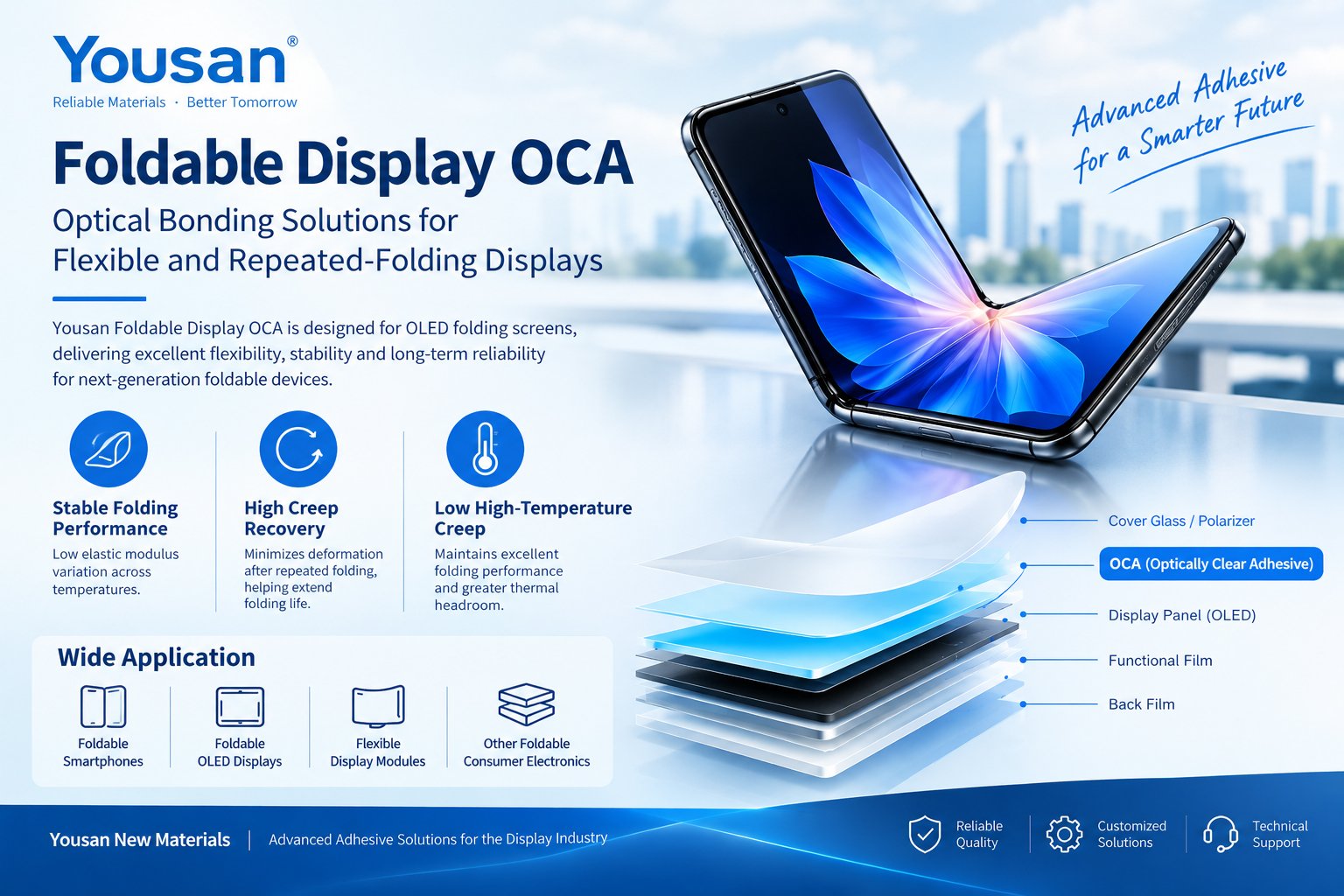
As foldable smartphones and flexible OLED devices continue to develop, display components must withstand mechanical deformation that does not occur in conventional rigid displays.
A foldable display can experience repeated folding and bending during everyday use. This places additional requirements on the Optically Clear Adhesive (OCA) used within the display module.
In addition to optical bonding performance, foldable display OCA needs to accommodate repeated mechanical stress while maintaining suitable flexibility and long-term reliability.
Yousan has developed OCA specifically for foldable displays, focusing on low elastic modulus variation, high creep recovery and low high-temperature creep variation. These characteristics are intended to support stable folding performance and long-term reliability in foldable display modules.
What Is Foldable Display OCA?
Foldable Display OCA is an optical clear adhesive designed for bonding components within flexible and foldable display modules.
Unlike a conventional flat display, a folding screen repeatedly changes its shape during operation. The adhesive therefore needs to accommodate mechanical deformation while maintaining the required optical and structural properties.
Key considerations for foldable display OCA include:
- Optical transparency
- Adhesion
- Flexibility
- Elastic modulus behavior
- Creep resistance
- Creep recovery
- Fatigue resistance
- Temperature-dependent mechanical stability
- Long-term module reliability
Yousan‘s OLED OCA portfolio includes a dedicated OCA for Foldable Display, alongside solutions for full lamination, curved screens and other display structures.
Why Is OCA Important in Foldable Displays?
The OCA layer performs an optical bonding function, but in a foldable display it also forms part of a mechanically dynamic multilayer structure.
During repeated folding, the adhesive can be subjected to:
- Bending
- Tensile stress
- Compression
- Repeated deformation
- Temperature variation
- Long-term mechanical fatigue
If the adhesive’s mechanical properties change significantly with temperature or if permanent deformation accumulates after repeated loading, the overall display module may experience additional mechanical stress.
This is why modulus stability, creep recovery and high-temperature creep behavior are important considerations when evaluating OCA for folding screens.
Yousan specifically identifies repeated folding and long-term fatigue resistance as major challenges for foldable display OCA.
Yousan Foldable Display OCA
Yousan describes its foldable-display OCA as a solution developed for the repeated folding and bending requirements of folding screens.
According to Yousan, its foldable display OCA focuses on three key characteristics:
Low Elastic Modulus Variation
The adhesive is designed to maintain more stable elastic behavior across different temperatures.
High Creep Recovery Rate
High creep recovery helps the adhesive recover after deformation caused by repeated mechanical loading.
Low High-Temperature Creep Variation Rate
Controlled creep variation at elevated temperatures helps maintain folding performance and supports higher thermal limits for foldable displays.
Yousan‘s public consumer-electronics portfolio currently lists OCA for Foldable Screen, including P-DB606, P-DB607, P-DB608 and P-DB610, with published optical and adhesive parameters for these products.
Key Advantages of Foldable Display OCA
Stable Folding Performance Across Temperature Changes
The mechanical properties of adhesive materials can vary with temperature.
For a foldable display, significant changes in elastic modulus may influence how the adhesive responds when the device is opened and closed.
Yousan states that its foldable-display OCA has low elastic modulus variation, helping provide stable folding performance across different temperatures.
This characteristic can support:
- More consistent flexibility
- Stable mechanical response
- Better adaptation to temperature changes
- More predictable folding behavior
High Creep Recovery
Creep occurs when a material undergoes time-dependent deformation under sustained stress.
For a foldable display, repeated mechanical loading makes recovery behavior particularly important.
Yousan highlights a high creep recovery rate for its foldable-display OCA, with the objective of reducing the effects of accumulated deformation and supporting longer folding durability.
Potential benefits include:
- Improved recovery after deformation
- Reduced permanent deformation
- More stable adhesive behavior
- Support for repeated folding applications
Low High-Temperature Creep Variation
Elevated temperatures can affect the deformation behavior of polymeric adhesive materials.
Yousan identifies low high-temperature creep variation as another characteristic of its foldable-display OCA.
According to Yousan, this helps maintain folding performance under elevated-temperature conditions while supporting greater thermal limits and improved heat-dissipation tolerance in foldable display designs.
The appropriate temperature range and test conditions should be determined for each specific OCA grade and display architecture.
High Tensile Break Strength and Fatigue Resistance
Yousan identifies high tensile break strength and long-term fatigue resistance as important requirements for foldable-display OCA because the adhesive layer must withstand repeated folding and bending throughout the module’s service life.
These properties can be evaluated together with:
- Folding behavior
- Creep recovery
- Adhesion
- Temperature stability
- Long-term reliability
This combined evaluation is more representative of a foldable display application than optical properties alone.
Optical Performance of Foldable Screen OCA
Mechanical reliability is only one part of OCA selection. Optical performance remains fundamental for display applications.
Yousan‘s publicly listed P-DB606, P-DB607, P-DB608 and P-DB610 foldable-screen OCA products have the following published values:
| Property | Published Value |
|---|---|
| Adhesive | Soft |
| Thickness | 0.15~0.25 mm |
| 180° Peel Strength[gf/25,SUS] | ≥1300~2000 gf/25 mm |
| Refractive index | 1.47–1.49 |
| Transmittance | >90% |
| Haze | <1% |
| Yellow index (b*) | <0.5 |
These values are published by Yousan for its listed foldable-screen OCA products and should not automatically be applied to every Yousan OCA grade.
Before mass production, the exact grade, thickness and optical requirements should be confirmed with the latest technical documentation.
Foldable OCA and Display Architecture
Different foldable display architectures may require different adhesive characteristics.
The relevant structure can influence:
- OCA thickness
- Required softness
- Stress distribution
- Gap filling
- Folding radius
- Optical requirements
- Lamination process
- Long-term reliability
Yousan publicly describes its OCA portfolio across multiple display architectures, including full lamination, curved displays, blind-hole displays and foldable screens.
For specific applications described as On-Cell or Under-Display, the appropriate OCA grade should be selected based on the actual display stack and Yousan‘s current technical recommendations rather than assuming that all foldable architectures use the same OCA.
On-Cell and Under-Display Foldable Applications
Foldable display designs may incorporate different touch and component architectures.
When selecting OCA for an On-Cell or Under-Display structure, engineers should evaluate:
- Display stack configuration
- Optical requirements
- Adhesive thickness
- Mechanical deformation
- Folding radius
- Temperature range
- Creep and recovery
- Lamination process
- Long-term reliability
Yousan‘s public materials confirm that it provides OCA solutions for various display architectures, while the exact suitability of an individual grade should be confirmed according to the customer’s display structure.
Applications of Foldable Display OCA
Foldable Smartphones
Foldable smartphones are one of the primary applications for flexible optical bonding materials.
The OCA needs to accommodate frequent opening and closing of the display module while maintaining optical and mechanical performance.
Foldable OLED Displays
OCA can be used within OLED display module structures where optical transparency, bonding performance and mechanical flexibility are required.
Yousan describes its OCA portfolio as supporting OLED display modules and specifically includes foldable-display OCA.
Flexible Display Modules
Flexible display architectures can also require adhesive materials capable of accommodating bending and mechanical deformation.
Other Foldable Consumer Electronics
The same material-selection considerations can be evaluated for other flexible or foldable display devices, depending on the device structure and required reliability.
How to Select OCA for Foldable Displays
Evaluate the Display Structure
Before choosing an OCA, identify:
- Display type
- Touch architecture
- Cover material
- Polarizer structure
- Functional films
- Adhesive layer positions
- Folding configuration
Consider Folding Requirements
Important mechanical parameters may include:
- Folding radius
- Folding direction
- Folding frequency
- Tensile deformation
- Compression
- Long-term fatigue
The actual acceptance criteria should be defined by the device manufacturer.
Evaluate Temperature Effects
Measure adhesive behavior across the expected operating and reliability-test temperature range.
Particular attention should be paid to:
- Elastic modulus variation
- Creep
- Creep recovery
- High-temperature deformation
Evaluate Optical Performance
Important parameters include:
- Transmittance
- Haze
- Refractive index
- Yellowing
- Adhesion
- Optical uniformity
Evaluate Lamination Process
The OCA should also be assessed for:
- Processability
- Lamination compatibility
- Bubble behavior
- Step coverage
- Rework requirements
- Surface compatibility
The appropriate process depends on the complete display structure.
Foldable Display OCA Testing
For development and qualification, a comprehensive OCA evaluation can include:
Optical Testing
- Light transmittance
- Haze
- Refractive index
- Yellow index
Adhesion Testing
- Peel strength
- Adhesion after aging
- Adhesion to different display materials
Mechanical Testing
- Elastic modulus
- Creep
- Creep recovery
- Tensile break strength
- Fatigue resistance
Environmental Testing
- High-temperature aging
- Low-temperature exposure
- Temperature cycling
- Humidity exposure
Folding Testing
- Repeated folding
- Folding at different temperatures
- Folding under different radii
- Adhesive deformation
- Optical defect inspection
The specific test method and acceptance criteria should be determined according to the display module design.
Why Yousan Foldable Display OCA?
Yousan has developed a dedicated OCA portfolio for OLED display modules and identifies foldable display OCA as a specific solution category.
Its foldable-display OCA development focuses on:
- Low elastic modulus variation
- High creep recovery
- Low high-temperature creep variation
- High tensile break strength
- Long-term fatigue resistance
- Optical bonding performance
Yousan also states that its OLED display-module OCA solutions have been applied in the industry and that it provides customized solutions and technical support.
Foldable Display OCA vs. Conventional Display OCA
Foldable and conventional display applications share fundamental optical requirements, but their mechanical challenges can differ.
| Evaluation Factor | Conventional Display | Foldable Display |
|---|---|---|
| Optical transparency | Important | Important |
| Haze | Important | Important |
| Adhesion | Important | Important |
| Flexibility | Application-dependent | Critical consideration |
| Modulus stability | Important | Particularly important |
| Creep recovery | Application-dependent | Important |
| Repeated bending | Limited or application-dependent | Core requirement |
| Fatigue resistance | Important | Particularly important |
| High-temperature creep | Important | Particularly important |
This does not mean every foldable display requires exactly the same OCA specification. The adhesive should be selected according to the complete module design.
Frequently Asked Questions
What is foldable display OCA?
Foldable display OCA is an optical clear adhesive designed for bonding components in flexible and folding display modules while accommodating repeated mechanical deformation.
Why is creep recovery important for foldable display OCA?
Repeated folding can cause time-dependent deformation in polymeric adhesive materials. High creep recovery helps the material recover after deformation and supports stable mechanical behavior.
Why does elastic modulus variation matter?
Adhesive mechanical properties can change with temperature. Lower elastic modulus variation can help maintain more consistent folding behavior across temperature conditions.
What is high-temperature creep in OCA?
High-temperature creep is time-dependent deformation that occurs under stress at elevated temperatures. Controlling this behavior can help support stable folding performance in thermally demanding conditions.
Is Yousan OCA suitable for foldable OLED displays?
Yousan publicly identifies dedicated OCA for Foldable Display / OCA for Foldable Screen within its OLED display-material portfolio, including the P-DB606, P-DB607, P-DB608 and P-DB610 products listed on its consumer-electronics site.
What is the thickness of Yousan foldable-screen OCA?
The publicly listed P-DB606, P-DB607, P-DB608 and P-DB610 products are shown at 0.15~0.25 mm in Yousan‘s product information.
What is the optical transmittance of Yousan foldable-screen OCA?
Yousan‘s published information for P-DB606, P-DB607, P-DB608 and P-DB610 specifies more than 90% transmittance, with haze below 1%.
Does every foldable display use the same OCA?
No. OCA selection depends on the display architecture, materials, folding configuration, lamination process and reliability requirements.
Can OCA be used in On-Cell or Under-Display structures?
OCA selection can be evaluated for different display architectures, including On-Cell and Under-Display configurations, but the appropriate grade must be confirmed against the actual display stack and technical requirements.
How should foldable display OCA be tested?
Testing should combine optical, adhesion, mechanical, environmental and repeated-folding evaluations rather than relying on a single performance parameter.
Conclusion
The adhesive layer is a critical material in a foldable display because it must perform its optical bonding function while accommodating repeated mechanical deformation.
Yousan’s Foldable Display OCA is designed specifically around these challenges, with a focus on low elastic modulus variation, high creep recovery, low high-temperature creep variation, high tensile break strength and long-term fatigue resistance.
Yousan‘s publicly listed foldable-screen OCA products, including P-DB606, P-DB607, P-DB608 and P-DB610, are specified with a 0.15~0.25 mm thickness, more than 90% optical transmittance, less than 1% haze and a refractive index of 1.47–1.49.
For foldable smartphones and other flexible display applications, the appropriate OCA should be selected through a combination of optical, mechanical, environmental and folding reliability testing.
If you would like to learn more about Yousan adhesive tapes, please visit our website at www.ysdiecut.com