
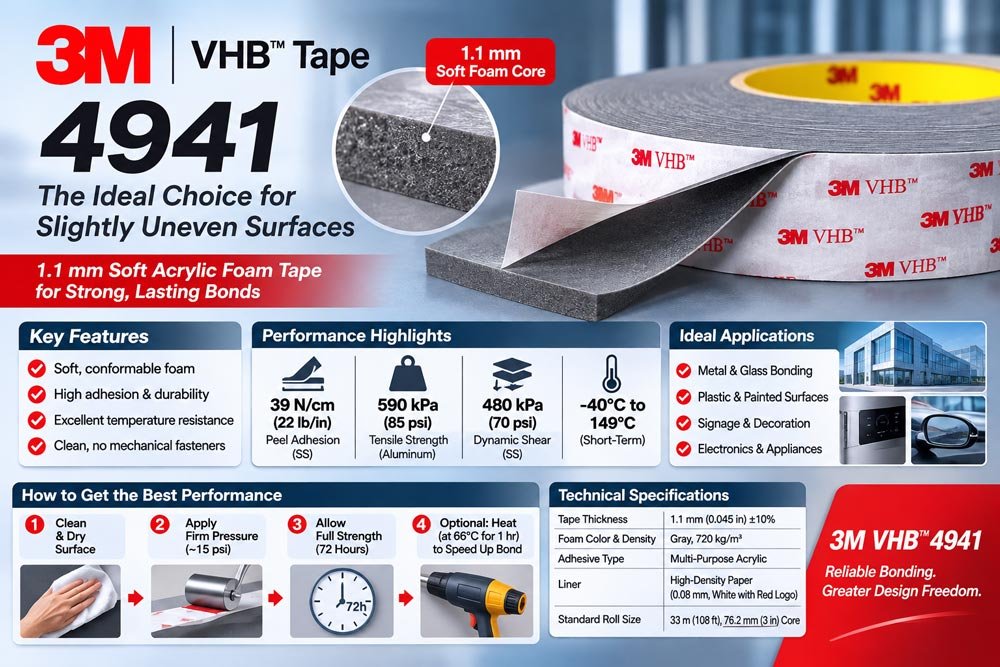
Product: 3M™ VHB™ Tape 4941
Category: Double-Sided Acrylic Foam Tape
Thickness: 1.1 mm (0.045 in)
Color: Gray
Adhesive: Multi-Purpose Acrylic
Foam Type: Conformable Acrylic Foam
Introduction: Choosing the Right VHB Tape for Uneven Surfaces
When bonding two materials together, surface flatness is just as important as adhesive strength.
In real manufacturing environments, metal panels may have slight curvature, painted surfaces may have an orange-peel texture, and assembled components may not fit together perfectly. A rigid or insufficiently conformable adhesive tape may struggle to establish consistent contact across the bonding area.
This is where 3M™ VHB™ Tape 4941 becomes a useful option.
With its 1.1 mm conformable acrylic foam core and multi-purpose acrylic adhesive, 3M 4941 provides a balance of bonding strength, flexibility, and surface contact. It is designed to bond a broad range of high and medium surface energy materials, including metals, glass, painted surfaces, plastics, and plasticized vinyl.
In this guide, Yousan New Materials explains the construction, technical properties, application conditions, and selection considerations of 3M VHB 4941 to help engineers and purchasing teams determine whether it is suitable for their bonding projects.
1. What Is 3M VHB 4941?
3M VHB 4941 is a gray, double-sided acrylic foam tape with a nominal thickness of 1.1 mm.
It belongs to the 3M 4941 family, which uses multi-purpose acrylic adhesive on both sides of a conformable acrylic foam core.
Its main construction and product characteristics include:
| Property | Specification |
|---|---|
| Product Name | 3M™ VHB™ Tape 4941 |
| Product Type | Double-Sided Acrylic Foam Tape |
| Color | Gray |
| Total Tape Thickness | 1.1 mm (0.045 in) |
| Thickness Tolerance | ±10% |
| Adhesive Type | Multi-Purpose Acrylic |
| Foam Type | Conformable Acrylic Foam |
| Density | 720 kg/m³ |
| Release Liner | Densified Kraft Paper |
| Liner Thickness | 0.08 mm |
| Standard Roll Length | 32.9 m (36 yd) |
| Core Diameter | 76.2 mm (3 in) |
The density value is a typical value for the foam with adhesive, as specified in the 3M technical data sheet.
Why Does Conformable Foam Matter?
The conformable acrylic foam core helps the tape maintain contact between surfaces that are slightly mismatched.
This is useful when bonding components with:
-
Slight surface curvature
-
Minor surface irregularities
-
Painted or coated finishes
-
Different material expansion characteristics
-
Small dimensional variations between components
However, conformability does not mean that the tape can fill large gaps or compensate for major surface defects. Proper surface preparation, contact pressure, and joint design remain essential.
2. Key Technical Performance of 3M VHB 4941
The following values are taken from the 3M September 2024 Technical Data Sheet. They are typical laboratory results, not guaranteed specification limits.
2.1 90° Peel Adhesion: 39 N/cm
| Test Parameter | Condition |
|---|---|
| Test Method | ASTM D3330 |
| Substrate | Stainless Steel |
| Dwell Time | 72 hours |
| Test Temperature | 23°C |
| Typical Result | 39 N/cm (22 lb/in) |
This test measures the force required to peel the tape from a stainless-steel surface at a 90-degree angle.
The result demonstrates the tape’s peel adhesion under the specified laboratory conditions. Actual performance can vary with the substrate, surface preparation, application pressure, and bonding time.
2.2 Normal Tensile Strength: 590 kPa
| Test Parameter | Condition |
|---|---|
| Test Method | ASTM D897 |
| Substrate | Aluminum |
| Bonding Area | 1 in² |
| Dwell Time | 72 hours |
| Typical Result | 590 kPa (85 psi) |
Normal tensile strength measures resistance to forces pulling the bonded substrates apart perpendicular to the bonding surface.
This property is relevant to applications involving panel attachment, decorative components, and other assemblies exposed to tensile loading.
2.3 Dynamic Overlap Shear Strength: 480 kPa
| Test Parameter | Condition |
|---|---|
| Test Method | ASTM D1002 / ISO 4587 |
| Substrate | Stainless Steel |
| Bonding Area | 1 in² |
| Dwell Time | 72 hours |
| Typical Result | 480 kPa (70 psi) |
Dynamic overlap shear testing evaluates the force required to separate two overlapping bonded surfaces under a controlled loading rate.
This property is particularly relevant when designing joints exposed to loads acting parallel to the bonding surface.
2.4 Static Shear and Temperature Resistance
The 3M TDS provides the following static shear test results:
| Test Temperature | Applied Load | Test Duration |
|---|---|---|
| 23°C | 1,000 g | 10,000 minutes |
| 66°C | 500 g | 10,000 minutes |
| 93°C | 500 g | 10,000 minutes |
The test uses a stainless-steel substrate and a bonding area of 0.5 in².
3M also specifies:
-
Long-term temperature resistance: 93°C (200°F)
-
Short-term temperature resistance: 149°C (300°F)
The short-term temperature result is based on four-hour conditioning at the specified temperature under a 100 g static load, followed by evaluation of room-temperature dynamic shear properties.
These temperature ratings should not be interpreted as universal operating limits for every application. Actual performance depends on loading, substrate materials, bond geometry, and exposure conditions.
3. Why 3M VHB 4941 Works Well on Slightly Uneven Surfaces
The main selection advantage of 4941 is its balance of foam conformability and adhesive performance.
3.1 Conformable Acrylic Foam Core
The 1.1 mm acrylic foam core helps accommodate minor surface variations and provides contact between slightly mismatched substrates.
This makes it useful for applications involving curved panels, painted components, and assembled parts with small dimensional differences.
3.2 Bonding to Different Materials
The multi-purpose acrylic adhesive is designed for high and medium surface energy materials, including:
-
Stainless steel and aluminum
-
Glass
-
Painted metals
-
Powder-coated surfaces
-
Many plastics
-
Plasticized vinyl
For difficult-to-bond plastics such as untreated polypropylene (PP) and polyethylene (PE), direct bonding should not be assumed to be reliable. Surface treatment, an adhesion promoter, or alternative adhesive selection may be required.
3.3 Resistance to Plasticizer Migration
Plasticized vinyl can release plasticizer components over time. These substances may migrate into adhesive layers and affect long-term bonding performance.
The 3M 4941 family offers good plasticizer resistance and adhesion to many vinyl formulations.
However, vinyl formulations vary considerably. 3M recommends evaluating the specific vinyl material to confirm long-term performance.
For demanding applications, accelerated aging testing can help identify potential bonding issues.
4. Proper Application: How to Achieve Reliable Bond Strength
Even a high-performance VHB tape can underperform when application conditions are not properly controlled.
4.1 Surface Preparation
Before applying 3M VHB 4941:
-
Remove dust, oil, grease, and loose contamination.
-
Clean most substrates using a 70/30 mixture of isopropyl alcohol (IPA) and water, where appropriate.
-
Allow the surface to dry completely.
-
Consider abrasion or an adhesion promoter for difficult substrates.
-
Seal porous materials where necessary before bonding.
Always check material compatibility and follow the appropriate safety instructions when using cleaning solvents.
4.2 Application Temperature
3M recommends an ideal application temperature range of:
21°C to 38°C (70°F to 100°F).
The minimum application temperature specified for 3M 4941 is 15°C (60°F).
Applying the tape below the recommended temperature range can reduce adhesive flow and initial bonding performance.
4.3 Apply Sufficient Pressure
Bond strength depends on the amount of adhesive-to-surface contact.
3M recommends applying sufficient pressure to achieve approximately:
100 kPa (15 psi).
A roller or platen can be used to help achieve consistent pressure.
When bonding two rigid components, additional final pressure may be needed to ensure proper contact across the joint.
4.4 Allow Bond Strength to Build
Pressure-sensitive acrylic adhesives develop bond strength gradually as the adhesive flows onto the substrate.
At room temperature, the general bond development rate is approximately:
| Time After Application | Bond Strength Development |
|---|---|
| 20 minutes | 50% |
| 24 hours | 90% |
| 72 hours | 100% |
These figures are general guidance. Actual bond development depends on the tape, substrate, temperature, and application conditions.
For certain applications, elevated-temperature exposure, such as 66°C (150°F) for one hour, may accelerate adhesive wet-out. This should be evaluated for the specific materials and assembly.
5. Typical Applications of 3M VHB 4941
3M VHB 4941 is suitable for permanent bonding applications requiring a combination of strength, conformability, and a clean appearance.
Common applications include:
Metal Panel Bonding
Attaching metal panels to frames, stiffeners, and other structural components without visible mechanical fasteners.
Appliance Assembly
Bonding decorative panels, trims, and housings in household and commercial appliances.
Signage and Display Assembly
Attaching signs, decorative elements, and display components to metal, glass, or painted surfaces.
Transportation Components
Bonding selected interior and exterior trim components, subject to application-specific engineering evaluation.
Glass and Painted Surface Bonding
Creating smooth, nearly invisible bonds between compatible glass, painted metal, and plastic components.
Dissimilar Material Bonding
Joining different materials, such as metal to plastic or glass to painted metal, where conventional mechanical fastening may be undesirable.
6. 3M 4941 vs. 4941F: What Is the Difference?
One of the most common selection questions concerns 3M 4941 and 4941F.
Both products belong to the 4941 family and share the same nominal thickness, gray conformable acrylic foam construction, and multi-purpose acrylic adhesive system.
The primary difference is the release liner.
| Property | 3M 4941 | 3M 4941F |
|---|---|---|
| Foam Color | Gray | Gray |
| Total Thickness | 1.1 mm | 1.1 mm |
| Adhesive Type | Multi-Purpose Acrylic | Multi-Purpose Acrylic |
| Foam Type | Conformable Acrylic Foam | Conformable Acrylic Foam |
| Release Liner | Densified Kraft Paper | Polyethylene Film |
| Liner Thickness | 0.08 mm | 0.13 mm |
| Liner Color | White, printed | Red, printed |
When Should You Choose 4941?
The paper liner version is a common option for standard roll applications and converting processes where a paper release liner is suitable.
When Should You Choose 4941F?
The film liner version may be considered for applications requiring a polyethylene release liner, including certain die-cutting and automated converting processes.
The most suitable version depends on the converting equipment, part geometry, liner handling, and waste-removal requirements.
The liner difference should not be treated as a change in the adhesive performance specification.
7. Other Products in the 3M 4941 Family
The 4941 family includes several thickness options.
| Product | Nominal Thickness | Color |
|---|---|---|
| 4926 | 0.4 mm | Gray |
| 4936 / 4936F | 0.6 mm | Gray |
| 4941 / 4941F | 1.1 mm | Gray |
| 4956 / 4956F | 1.6 mm | Gray |
| 4991 | 2.3 mm | Gray |
These products use the multi-purpose acrylic adhesive and conformable foam construction associated with the 4941 family.
They are not interchangeable solely on the basis of thickness. Engineers should evaluate joint design, gap variation, applied loads, and surface conditions before selecting an alternative.
8. Storage and Shelf Life
According to the 3M technical data sheet:
-
Shelf life: 24 months from the date of manufacture.
-
Storage temperature: 4°C to 38°C.
-
Relative humidity: 0–95%.
-
Optimum storage conditions: 22°C and 50% relative humidity.
Store the tape in its original packaging whenever possible and protect it from contamination, excessive heat, and direct environmental exposure.
The manufacturing date can typically be identified from the lot number printed on the roll core or outer packaging.
3M recommends using the tape before the stated shelf-life date whenever possible.
9. Why Source 3M VHB 4941 from Yousan New Materials?
Selecting the right adhesive tape is only part of a successful bonding project. Converting accuracy, roll dimensions, liner handling, and delivery consistency are also important.
Yousan New Materials provides industrial adhesive tape sourcing and converting solutions for customers in electronics, automotive, appliances, construction, and other manufacturing industries.
Our capabilities include:
-
Custom Slitting: Converting jumbo rolls into customer-specified widths.
-
Die Cutting: Producing custom adhesive components according to drawings and dimensions.
-
Rewinding: Preparing rolls to meet application and production requirements.
-
Lamination and Converting: Supporting customized adhesive material constructions, subject to technical evaluation.
-
Technical Support: Helping customers review tape selection, substrate compatibility, and converting requirements.
With experience in industrial adhesive materials and converting processes, Yousan supports customers from material selection to customized tape processing.
Contact our team to discuss 3M VHB 4941 sourcing, custom slit rolls, and die-cut adhesive components.
10. Frequently Asked Questions
Q1: What is the thickness of 3M VHB 4941?
3M VHB 4941 has a nominal total thickness of 1.1 mm (0.045 in), with a thickness tolerance of ±10%.
Q2: Is 3M VHB 4941 suitable for uneven surfaces?
It is suitable for surfaces with slight irregularities or mismatches because its conformable acrylic foam core helps maintain contact between bonded substrates. It is not designed to fill large gaps or compensate for major surface defects.
Q3: What materials can 3M 4941 bond?
It bonds to a broad range of high and medium surface energy materials, including metals, glass, many paints and plastics, and plasticized vinyl.
Q4: Can 3M VHB 4941 bond PVC?
Yes. The 4941 family offers good adhesion to many plasticized vinyl formulations and good plasticizer resistance. However, PVC formulations vary, so application testing is recommended.
Q5: Can 3M 4941 bond PP or PE?
Untreated polypropylene and polyethylene are low surface energy materials and may be difficult to bond. Surface treatment, an adhesion promoter, or another adhesive solution may be necessary.
Q6: What is the temperature resistance of 3M 4941?
The typical long-term temperature resistance is 93°C (200°F), while the short-term temperature resistance is 149°C (300°F) under the specified test conditions.
Q7: How long does 3M VHB 4941 take to reach full bond strength?
At room temperature, approximately 50% of ultimate bond strength is achieved after 20 minutes, 90% after 24 hours, and 100% after 72 hours.
Q8: What is the difference between 4941 and 4941F?
The main difference is the release liner. 4941 uses a densified kraft paper liner, while 4941F uses a polyethylene film liner. Both have a nominal thickness of 1.1 mm.
Q9: Can 3M VHB 4941 replace screws or rivets?
It can replace mechanical fasteners in properly designed applications. However, joint design, load direction, substrate compatibility, environmental conditions, and safety requirements must be evaluated before replacing mechanical fasteners.
Q10: What is the shelf life of 3M VHB 4941?
The stated shelf life is 24 months from the date of manufacture when stored under the recommended conditions.
If you would like to learn more about Yousan adhesive tapes, please visit our website at www.ysdiecut.com