
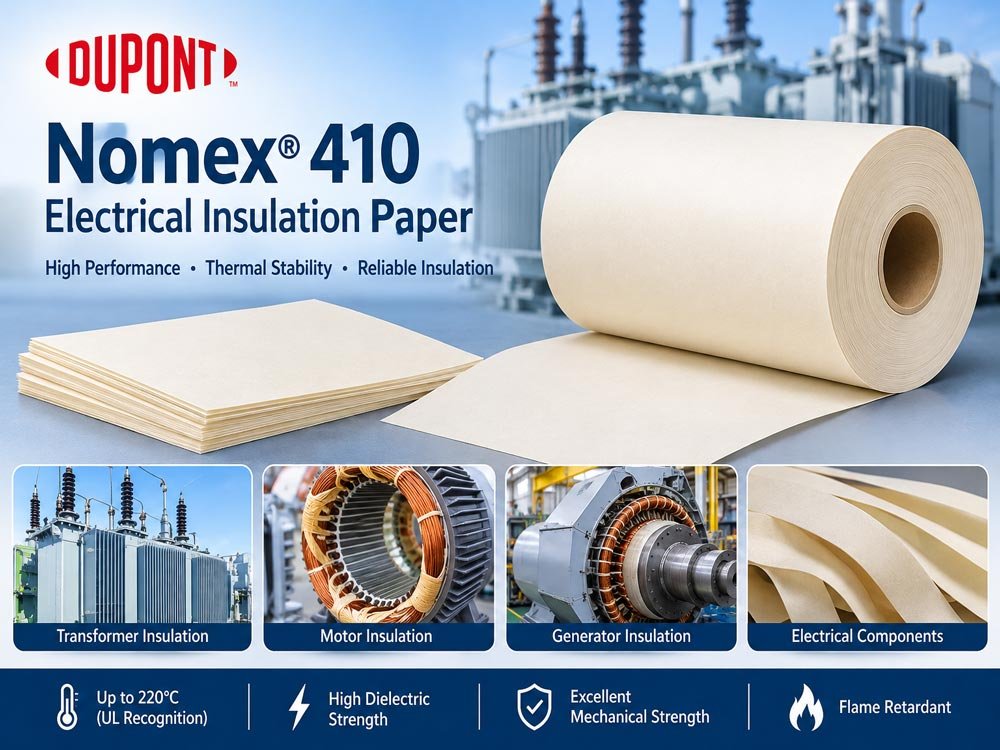
DuPont™ Nomex 410 is a high-performance electrical insulation paper widely used in transformers, electric motors, generators, and other electrical equipment. Commonly referred to as T410 or Nomex 410 insulation paper, this material is manufactured from aromatic polyamide (aramid) fibers and offers an excellent combination of dielectric strength, thermal stability, mechanical toughness, and flexibility.
As the original Nomex paper product, Nomex 410 has been used in electrical insulation applications for decades. Its calendered construction provides a uniform sheet structure and reliable electrical insulation performance across a range of operating conditions.
Available in thicknesses from 0.05 mm to 0.76 mm (2–30 mil), Nomex 410 can be selected for different insulation requirements, from thin slot liners and phase insulation to thicker barriers and structural insulation components.
For manufacturers of transformers, motors, and electrical assemblies, Nomex 410 provides a dependable insulation solution for demanding thermal and electrical environments.
What Is T410 Insulation Material?
T410 generally refers to DuPont Nomex 410, a calendered aramid electrical insulation paper.
Unlike conventional cellulose-based insulation paper, Nomex 410 is based on aromatic polyamide technology. Its structure combines aramid fibers and fibrids to produce a strong, flexible, and electrically insulating sheet.
The material is designed to provide:
-
High inherent dielectric strength.
-
Excellent thermal aging performance.
-
Good mechanical strength and tear resistance.
-
Flexibility for winding and forming operations.
-
Compatibility with many electrical varnishes, adhesives, and transformer fluids.
-
Good resistance to moisture-related changes in electrical properties.
Nomex 410 is particularly useful in applications where electrical insulation must maintain its mechanical and dielectric properties over extended operating periods.
Key Features and Benefits of DuPont Nomex 410
1. High Dielectric Strength
Nomex 410 provides strong electrical insulation performance. Its dielectric strength varies with material thickness and test conditions.
According to DuPont’s technical data sheet, typical AC rapid-rise dielectric strength ranges from approximately 18 to 34 kV/mm across the listed thicknesses.
This property makes Nomex 410 suitable for electrical barriers, winding insulation, and other insulating components.
2. Excellent Thermal Stability
Nomex 410 is recognized by Underwriters Laboratories (UL) as a 220°C insulation material based on its long-term thermal aging performance.
Its thermal stability makes it suitable for electrical equipment operating under demanding temperature conditions.
The actual permissible operating temperature depends on the complete insulation system, equipment design, and applicable standards.
3. Mechanical Strength and Durability
The calendered aramid structure provides good tensile strength, tear resistance, and mechanical toughness.
These characteristics help the material withstand handling, winding, cutting, folding, and assembly processes during electrical equipment manufacturing.
4. Flexibility and Conformability
Nomex 410 is available in multiple thicknesses, allowing manufacturers to select suitable grades for different geometries and insulation designs.
Thinner grades are particularly useful for applications requiring flexibility, while thicker grades provide additional mechanical support and insulation thickness.
5. Moisture and Chemical Compatibility
Nomex 410 maintains relatively stable electrical properties under varying humidity conditions.
It is also compatible with many electrical varnishes, adhesives, transformer oils, silicone fluids, synthetic esters, and other electrical equipment fluids.
However, exposure to certain industrial solvents can cause temporary softening or swelling.
6. Flame Resistance
Nomex 410 offers excellent inherent fire resistance and does not melt like conventional thermoplastic films.
Its fire performance has also been evaluated under recognized railway fire safety and other fire-testing standards.
Specific fire certifications and compliance requirements should be checked against the applicable product documentation.
Technical Specifications of Nomex 410
The following table summarizes representative properties published by DuPont.
| Property | Typical Information |
|---|---|
| Brand | DuPont |
| Product Name | Nomex 410 |
| Common Designation | T410 |
| Material Type | Aromatic Polyamide (Aramid) Insulation Paper |
| Manufacturing Process | Calendered |
| Available Thickness | 0.05–0.76 mm |
| Thickness Range | 2–30 mil |
| Dielectric Strength | Approximately 18–34 kV/mm, AC rapid-rise |
| Thermal Recognition | 220°C insulation recognition by UL |
| Mechanical Properties | High tensile strength and tear resistance |
| Moisture Performance | Relatively minor effect on electrical properties |
| Chemical Compatibility | Compatible with many electrical varnishes, adhesives, and transformer fluids |
| Typical Forms | Sheets and rolls, subject to supplier availability |
Important: All dielectric strength values are typical short-term test results, not continuous operating voltage ratings. DuPont recommends that continuous electrical stress in dry-type transformer applications should not exceed 1.6 kV/mm (40 V/mil) to help minimize partial discharge risk.
Available Thicknesses of Nomex 410
DuPont Nomex 410 is available in multiple nominal thicknesses to meet different electrical and mechanical insulation requirements.
| Nominal Thickness (mm) | Nominal Thickness (mil) |
|---|---|
| 0.05 | 2 |
| 0.08 | 3 |
| 0.13 | 5 |
| 0.18 | 7 |
| 0.25 | 10 |
| 0.30 | 12 |
| 0.38 | 15 |
| 0.51 | 20 |
| 0.61 | 24 |
| 0.76 | 30 |
The appropriate thickness depends on the required dielectric performance, mechanical design, available installation space, and electrical equipment configuration.
For example:
-
0.05–0.13 mm: Thin electrical barriers and flexible insulation components.
-
0.18–0.30 mm: Transformer winding insulation, slot liners, and phase insulation.
-
0.38–0.76 mm: Thicker barriers, insulation spacers, and structural insulation components.
These are general application examples rather than mandatory thickness assignments. Final selection should follow the equipment manufacturer’s design requirements.
Applications of Nomex 410 Insulation Paper
Transformer Insulation
Nomex 410 is used in oil-filled and dry-type transformers for winding insulation, layer insulation, barriers, spacers, and other electrical insulating components.
Its thermal stability and compatibility with various transformer fluids make it suitable for demanding transformer applications.
Electric Motor Insulation
In electric motors, Nomex 410 can be used as slot insulation, phase insulation, and winding separators.
It provides electrical separation between conductors and other motor components while maintaining mechanical integrity during manufacturing and operation.
Generator Insulation
Nomex 410 is suitable for selected insulation components in generators and other rotating electrical machines.
Its mechanical toughness and dielectric performance support reliable insulation system construction.
EV Motor and Automotive Electrical Systems
Electric vehicle motors and other automotive electrical systems require insulation materials that can withstand thermal, electrical, and mechanical stresses.
Nomex 410 can be incorporated into suitable motor insulation designs, subject to system-level compatibility and qualification.
Electrical Components and Assemblies
Other applications include:
-
Electrical barriers and separators.
-
Insulation spacers.
-
Coil and winding insulation.
-
Terminal and conductor insulation components.
-
Laminated electrical insulation structures.
-
Precision-cut electrical insulation parts.
Nomex 410 vs. Conventional Electrical Insulation Paper
Different electrical insulation materials serve different performance and cost requirements.
| Comparison | Nomex 410 | Conventional Cellulose Insulation Paper |
|---|---|---|
| Base Material | Aromatic Polyamide | Cellulose |
| Thermal Performance | High thermal stability | Generally lower thermal endurance |
| Dielectric Performance | High inherent dielectric strength | Depends on grade and construction |
| Mechanical Strength | Good toughness and tear resistance | Depends on paper grade |
| Flexibility | Available in multiple flexible grades | Generally flexible |
| Typical Applications | High-performance electrical insulation | General electrical and transformer insulation |
Nomex 410 is often selected when thermal endurance, mechanical durability, and reliable electrical insulation are important design considerations.
Nomex 410 vs. Other Nomex Grades
Nomex products are available in different constructions for different electrical insulation applications.
-
Nomex 410: Calendered aramid insulation paper, widely used in electrical sheet insulation applications.
-
Nomex 411: A less-calendered aramid paper grade with a different structure and performance profile.
-
Nomex 414: A specialized aramid paper grade used in selected electrical insulation applications.
-
Nomex 416: A specialized grade with different physical and electrical characteristics.
These grades should not be considered interchangeable. Material selection should be based on the original equipment manufacturer’s specifications and the relevant DuPont technical documentation.
How to Select the Right Nomex 410 Material
Choosing the correct Nomex 410 grade requires consideration of several factors:
1. Thickness
Determine the required nominal thickness based on the electrical design, available space, and mechanical requirements.
2. Dielectric Requirements
Check the required insulation performance under the actual operating conditions. Do not use short-term dielectric strength as a continuous working voltage rating.
3. Thermal Requirements
Evaluate the operating temperature and the thermal classification of the complete insulation system.
4. Mechanical Requirements
Consider tensile strength, tear resistance, flexibility, and the material’s ability to withstand winding or forming operations.
5. Roll or Sheet Format
Choose between roll material and sheet material depending on the converting process and manufacturing equipment.
6. Processing Requirements
For customized components, consider slitting, precision cutting, die-cutting, laminating, and other converting requirements.
Custom Converting of Nomex 410 Insulation Material
In addition to standard roll and sheet materials, Nomex 410 can be processed into customized electrical insulation components.
Depending on material thickness and drawing requirements, converting options may include:
-
Precision slitting to customized widths.
-
Sheet cutting to specified dimensions.
-
Die-cut insulation gaskets and separators.
-
Custom-shaped transformer insulation parts.
-
Motor slot liners and phase insulation components.
-
Laminated insulation assemblies.
-
Customized packaging and roll formats.
For accurate processing, manufacturers should provide the required material thickness, dimensions, tolerances, drawing files, and application details.
Why Choose Nomex 410 for Electrical Insulation?
DuPont Nomex 410 combines high dielectric strength, thermal stability, mechanical toughness, and flexibility in one established electrical insulation material.
Its wide thickness range allows it to be used in various electrical equipment designs, while its compatibility with many varnishes, adhesives, and transformer fluids supports integration into different insulation systems.
For transformer manufacturers, motor producers, generator manufacturers, and electrical component suppliers, Nomex 410 offers a proven material platform for demanding insulation applications.
Frequently Asked Questions About Nomex 410
Q1: What is DuPont Nomex 410?
DuPont Nomex 410 is a calendered aromatic polyamide (aramid) electrical insulation paper designed for transformers, motors, generators, and other electrical equipment.
Q2: Is T410 the same as Nomex 410?
T410 is commonly used as a commercial designation for Nomex 410. For procurement, confirm the original DuPont product name, grade, thickness, and documentation.
Q3: What is the temperature rating of Nomex 410?
DuPont documents Nomex 410 as a 220°C insulation recognized by UL based on long-term thermal aging performance. This does not mean every finished electrical assembly can operate continuously at 220°C.
Q4: What thicknesses are available?
The current DuPont technical data sheet lists nominal thicknesses from 0.05 mm to 0.76 mm (2–30 mil).
Q5: What is the dielectric strength of Nomex 410?
Typical AC rapid-rise dielectric strength ranges from approximately 18 to 34 kV/mm, depending on thickness. These are short-term test values, not continuous working voltage ratings.
Q6: Can Nomex 410 be used in transformers?
Yes. It is widely used for transformer winding insulation, layer insulation, barriers, spacers, and other electrical insulation components.
Q7: Is Nomex 410 suitable for electric motors?
Yes. Suitable applications include slot liners, phase insulation, winding separators, and other motor insulation components, subject to the motor insulation system design.
Q8: Is Nomex 410 compatible with transformer oil?
DuPont reports compatibility with mineral oil, silicone oil, natural esters, and synthetic esters used in transformer applications.
Q9: Can Nomex 410 be die-cut?
Yes. Nomex 410 can be converted into customized insulation components using suitable cutting and die-cutting processes. Processing conditions depend on the thickness and geometry.
Q10: What is the difference between Nomex 410 and ordinary insulating paper?
Nomex 410 is an aramid-based insulation paper with high thermal endurance and mechanical toughness. Conventional cellulose insulation paper has different material characteristics and is generally selected for different operating requirements.
Conclusion
DuPont Nomex 410 is a high-performance aramid electrical insulation paper designed for applications requiring reliable dielectric performance, thermal stability, mechanical strength, and flexibility.
With nominal thicknesses ranging from 0.05 mm to 0.76 mm, it supports a broad range of transformer, motor, generator, and electrical component insulation designs.
For manufacturers seeking dependable electrical insulation materials, Nomex 410 remains an established solution for demanding industrial applications.
Looking for Nomex 410 insulation paper or customized electrical insulation components? Contact Yousan New Materials to discuss material thickness, roll widths, sheet sizes, die-cutting requirements, and project specifications.
If you would like to learn more about Yousan adhesive tapes, please visit our website at www.ysdiecut.com