
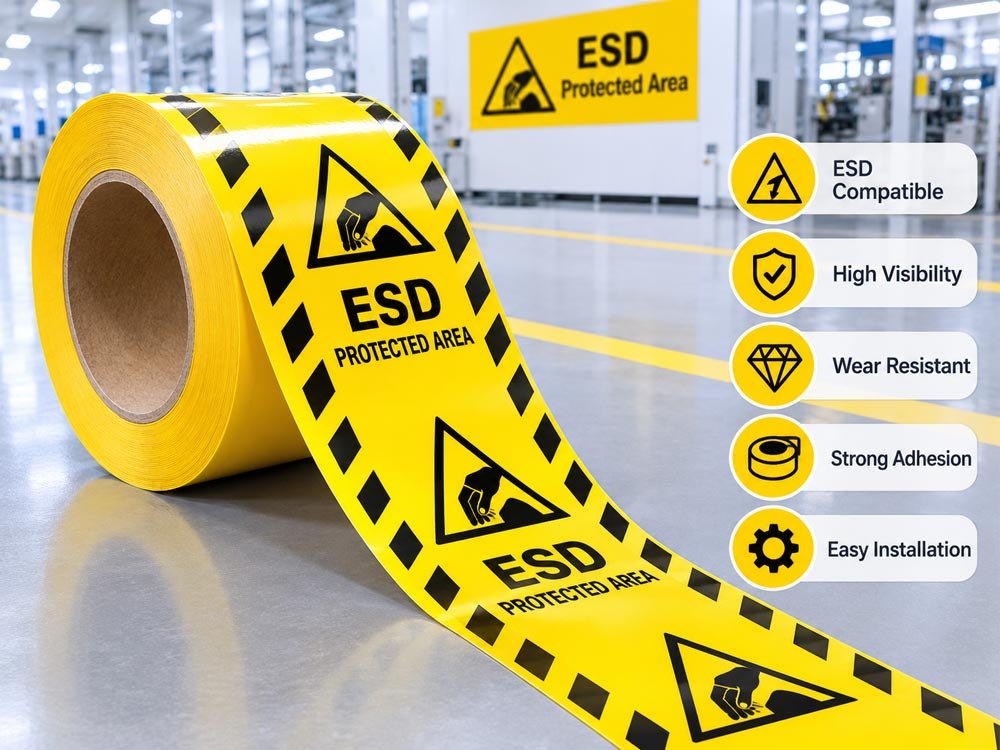
In electronics manufacturing facilities, semiconductor production plants, and industrial environments, effective floor marking is essential for workplace organization, safety management, and electrostatic discharge (ESD) control.
ESD anti-static floor marking tape is designed for identifying designated work areas, electrostatic protected areas (EPAs), production zones, and pedestrian walkways. Heavy-duty yellow floor marking tape offers high visibility and helps maintain clear floor identification in busy industrial environments.
Compared with conventional floor marking solutions, ESD-compatible floor marking tape can be selected with specific electrical properties to meet the requirements of electrostatic controlled environments. Its adhesive performance, backing material, and surface durability also play important roles in long-term industrial applications.
Yousan provides industrial adhesive tape converting and customization solutions to support different floor marking and ESD-related application requirements.
What Is ESD Anti-Static Floor Marking Tape?
ESD anti-static floor marking tape is a pressure-sensitive adhesive tape used to identify and organize designated areas in facilities where electrostatic discharge control is important.
It can be applied to industrial floors to mark ESD protected areas, equipment boundaries, production lines, material storage zones, and designated pedestrian routes.
Depending on the product construction, ESD floor marking tape may feature static-dissipative or conductive properties. Some products are designed primarily for visual identification, while others are engineered to provide specific electrical resistance characteristics.
These two functions should not be confused. A conventional yellow floor marking tape with an ESD warning symbol does not automatically provide static-dissipative performance.
For applications requiring electrical protection, users should verify the tape’s electrical properties and compatibility with the facility’s ESD control system.
Key Features of Heavy-Duty Yellow Floor Marking Tape
1. High-Visibility Yellow Identification
Yellow is widely used in industrial floor marking because it provides clear visual identification against many common floor surfaces.
Yellow floor marking tape can help distinguish production areas, storage locations, equipment boundaries, and pedestrian walkways.
Custom printing, including warning symbols and text, may also be available depending on the selected product construction.
2. ESD-Compatible Material Options
For electronics manufacturing and other ESD-controlled environments, floor marking tape can be selected with appropriate static-dissipative or conductive material properties.
Depending on the design, electrical performance may be provided by the backing material, adhesive layer, or both.
Surface resistance and other relevant electrical characteristics should be verified through product-specific test data before use.
3. Wear-Resistant Surface
Industrial floors are exposed to frequent foot traffic, material handling, cleaning operations, and mechanical abrasion.
Heavy-duty floor marking tape can incorporate durable backing materials and protective surface layers to help maintain visibility and adhesion during regular operations.
Actual abrasion resistance depends on the tape construction, flooring conditions, and traffic intensity.
4. Reliable Adhesion
A suitable pressure-sensitive adhesive helps the tape bond to compatible floor surfaces.
Depending on the adhesive formulation, the tape may be suitable for properly prepared epoxy-coated floors, smooth concrete, PVC flooring, and other industrial substrates.
Surface cleanliness and installation conditions are important factors affecting adhesive performance.
5. Convenient Installation
Self-adhesive floor marking tape provides a convenient alternative to painted floor markings.
It can be applied without specialized painting equipment and is useful for facilities that need flexible floor identification or periodic marking replacement.
Removal performance depends on the adhesive system, substrate, application duration, and environmental conditions.
Types of ESD Floor Marking Tape
Different industrial applications require different floor marking solutions.
ESD Warning Floor Marking Tape
ESD warning tape is primarily used to identify electrostatic protected areas and communicate ESD-related warnings.
It may feature yellow backgrounds, black warning symbols, or printed ESD messages.
Its primary purpose is visual identification. Unless supported by appropriate test data, it should not be considered an electrically dissipative product.
Static-Dissipative Floor Marking Tape
Static-dissipative floor marking tape is designed with electrical properties intended to help dissipate electrostatic charge.
It may be used in designated electronic manufacturing environments where controlled electrical resistance is required.
The actual resistance range and testing conditions should be confirmed through the manufacturer’s technical documentation.
Conductive Floor Marking Tape
Conductive floor marking tape uses materials designed to provide a conductive electrical path.
Its use depends on the facility’s ESD grounding design and electrical requirements.
Conductive and static-dissipative tapes are not interchangeable. The appropriate type should be selected according to the application and ESD control plan.
Applications of ESD Anti-Static Floor Marking Tape
Electronics Manufacturing Facilities
Electronics factories use floor marking tape to identify production areas, assembly stations, component storage zones, and designated ESD-controlled workspaces.
Semiconductor Manufacturing
Semiconductor production facilities require carefully managed work environments. ESD floor marking tape can help visually identify designated zones and organize material movement routes.
For cleanroom applications, material cleanliness, particle generation, and adhesive residue must also be evaluated.
PCB Assembly Workshops
Printed circuit board assembly facilities can use yellow floor marking tape to distinguish ESD protected areas, inspection stations, production lines, and storage locations.
ESD Protected Areas (EPAs)
Floor marking tape helps identify the boundaries of electrostatic protected areas.
It should be used as part of a comprehensive ESD control program that may include grounded workstations, personnel grounding systems, ESD flooring, and appropriate handling procedures.
Industrial Warehouses and Factories
Heavy-duty yellow floor marking tape can also be used to identify storage areas, pedestrian walkways, equipment zones, and material handling boundaries.
For areas exposed to forklift traffic, the tape must be specifically evaluated for the expected mechanical loading and abrasion conditions.
ESD Floor Marking Tape vs. Ordinary Floor Marking Tape
| Feature | ESD Floor Marking Tape | Ordinary Floor Marking Tape |
|---|---|---|
| Main purpose | Floor identification with specified ESD-related properties | General floor identification |
| Electrical performance | May be static-dissipative or conductive | Usually not specified |
| Color options | Yellow and other available colors | Multiple colors |
| Surface durability | Depends on material construction | Depends on product grade |
| Typical applications | Electronics and ESD-controlled facilities | Warehouses and industrial workshops |
| ESD suitability | Requires electrical performance verification | Not assumed suitable |
Selecting the correct product requires evaluating both its physical performance and electrical characteristics.
How to Choose the Right ESD Floor Marking Tape
Before purchasing ESD anti-static floor marking tape, consider the following factors.
1. Electrical Resistance Requirements
Determine whether the application requires a static-dissipative, conductive, or identification-only tape.
Check the specified surface resistance, volume resistance, or other relevant electrical parameters according to the facility’s ESD control requirements.
2. Backing Material
Common floor marking tape constructions may use PVC, PET film, or other polymer materials.
The choice of backing affects flexibility, surface durability, conformability, and mechanical performance.
For applications requiring additional abrasion protection, a suitable protective film or laminated construction may be considered.
3. Adhesive Performance
The adhesive should be compatible with the floor substrate.
Important considerations include initial tack, adhesion strength, aging performance, temperature resistance, and residue behavior after removal.
4. Abrasion and Wear Resistance
For busy industrial environments, evaluate the tape’s resistance to foot traffic, cleaning, and mechanical wear.
Heavy-duty applications may require thicker constructions or protective surface layers.
5. Environmental Compatibility
Consider operating temperature, humidity, moisture exposure, cleaning chemicals, and other environmental conditions.
For cleanroom or sensitive electronic production areas, particle generation and outgassing requirements should also be reviewed.
6. Tape Dimensions and Customization
Select suitable widths, roll lengths, thicknesses, and colors according to the facility’s floor marking design.
Custom slitting and printing can help meet specific industrial identification requirements.
Technical Specifications
The following table outlines common specification categories for ESD anti-static floor marking tape. Actual values depend on the selected product construction.
| Parameter | Specification |
|---|---|
| Product Name | ESD Anti-Static Floor Marking Tape |
| Color | Yellow |
| Backing Material | PVC, PET, or other specified polymer film |
| Adhesive Type | Pressure-Sensitive Adhesive |
| Adhesive Side | Single-Sided |
| Surface Finish | Smooth or protective laminated finish |
| Electrical Properties | Static-dissipative, conductive, or identification-only, depending on product |
| Width | Customizable |
| Roll Length | Customizable |
| Thickness | Based on product construction |
| Printing | Optional, depending on product design |
| Application | Industrial floor marking and ESD area identification |
Note: This is a general product specification framework, not a certified technical data sheet. Electrical resistance, thickness, adhesion, and abrasion performance must be confirmed using actual product test data.
Why Choose Yousan for Industrial Adhesive Tape Solutions?
Yousan New Materials specializes in industrial adhesive tape materials, converting, and customized adhesive solutions for different manufacturing applications.
With capabilities in adhesive technology, polymer film research, coating, slitting, and precision die-cutting, Yousan supports customers seeking customized industrial tape products.
Our capabilities include:
-
Customized adhesive tape widths and roll lengths.
-
Industrial film and adhesive material converting.
-
Precision slitting and die-cutting services.
-
Material selection based on application requirements.
-
OEM and ODM manufacturing support.
-
Customized adhesive solutions for electronics, automotive, electrical, medical, and industrial applications.
For ESD floor marking projects, we can discuss the required backing materials, adhesive properties, dimensions, and electrical performance specifications to help identify an appropriate product solution.
Contact Yousan to discuss your requirements for yellow ESD floor marking tape and customized industrial adhesive tape products.
Frequently Asked Questions
1. What is ESD anti-static floor marking tape used for?
It is used to identify ESD protected areas, production zones, equipment boundaries, and designated walkways in electronics manufacturing facilities and other industrial environments.
2. Is all yellow floor marking tape anti-static?
No. Yellow is a visual identification color. Anti-static or static-dissipative performance depends on the material construction and verified electrical properties.
3. What is the difference between ESD warning tape and anti-static floor tape?
ESD warning tape primarily provides visual identification of electrostatic protected areas. Anti-static or static-dissipative floor tape has specified electrical properties designed to help control electrostatic charge.
4. Can ESD floor marking tape be used in electronics factories?
Yes, provided the selected tape meets the facility’s electrical performance, adhesive, durability, and environmental requirements.
5. Can ESD floor marking tape be applied to epoxy floors?
Many industrial adhesive tapes can bond to properly prepared epoxy-coated floors. However, substrate compatibility should be confirmed through an adhesion test before full installation.
6. Is ESD floor marking tape suitable for forklift traffic?
Not all products are suitable for forklift traffic. Heavy-duty applications require specific evaluation of abrasion resistance, adhesive performance, tape thickness, and mechanical loading.
7. Does ESD floor marking tape replace ESD flooring?
No. Floor marking tape is used primarily for visual identification and, where specified, localized electrical functions. It does not replace a properly designed and grounded ESD flooring system.
8. Can floor marking tape be customized?
Yes. Depending on material availability and product construction, industrial floor marking tape can be customized in width, roll length, color, printing, and converting format.
Conclusion
ESD anti-static floor marking tape provides a practical solution for identifying designated work areas and organizing industrial facilities where electrostatic discharge control is important.
Heavy-duty yellow floor marking tape combines high-visibility identification with application-specific adhesive and surface durability requirements.
When selecting an ESD floor marking solution, buyers should carefully evaluate electrical resistance, backing material, adhesive compatibility, abrasion resistance, and operating conditions.
Looking for yellow ESD floor marking tape or customized industrial adhesive tape solutions? Contact Yousan to discuss your application and material requirements.
If you would like to learn more about Yousan adhesive tapes, please visit our website at www.ysdiecut.com