
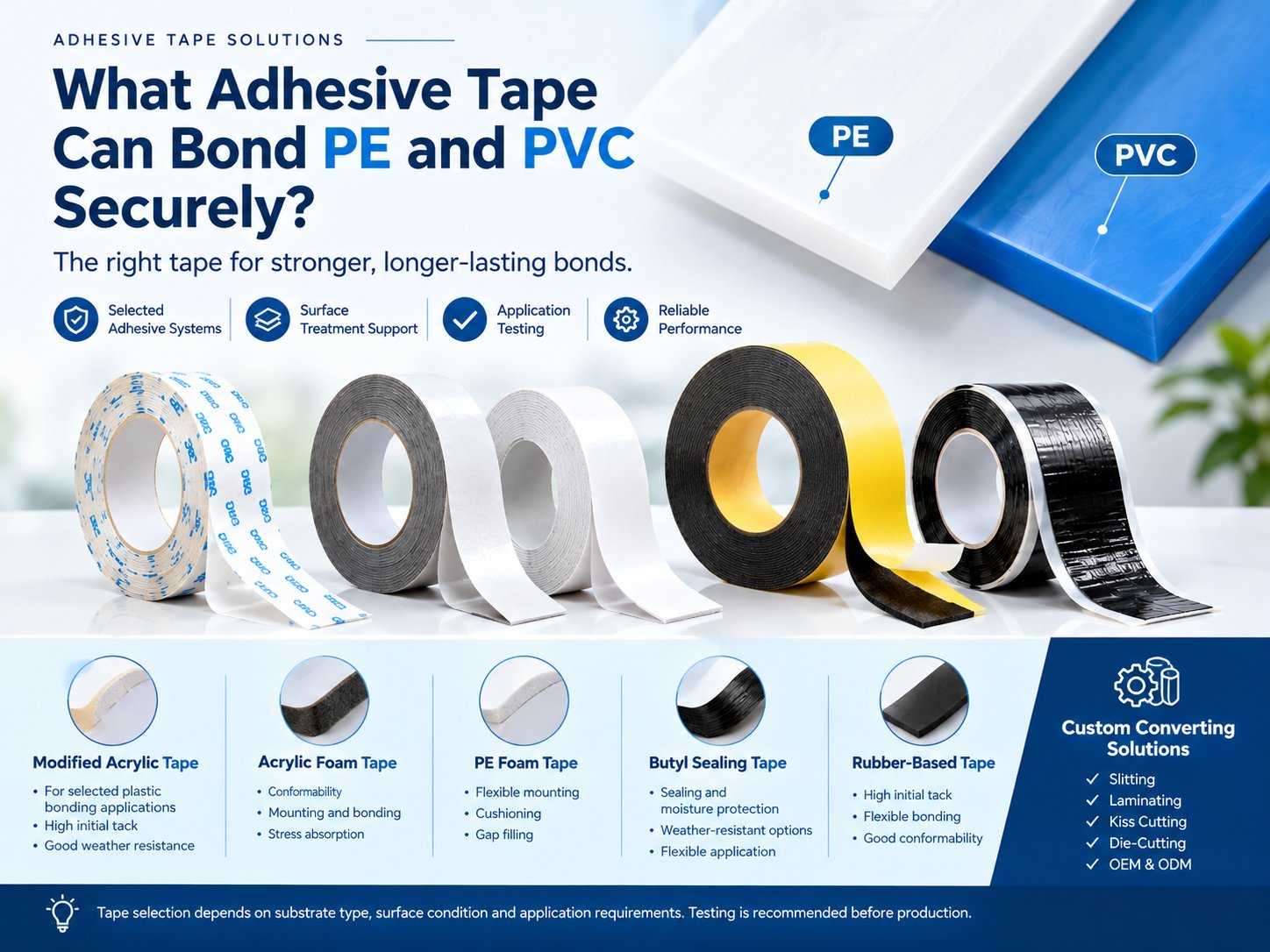
Bonding polyethylene (PE) and polyvinyl chloride (PVC) can be challenging because these plastics have different surface characteristics, flexibility and chemical compositions.
The right adhesive tape depends on several factors, including:
- Whether the substrate is PE, PVC or a combination of both
- Rigid or flexible plastic construction
- Surface energy and surface treatment
- Required bonding strength
- Indoor or outdoor application
- Temperature and humidity exposure
- Whether the tape is used for mounting, sealing or lamination
For many applications, a specialized acrylic adhesive tape, modified acrylic foam tape or rubber-based sealing tape may be considered. However, PE—especially untreated HDPE and LDPE—usually requires more careful adhesive selection and testing than PVC.
Important: No single adhesive tape is guaranteed to bond every type of PE and PVC. Final suitability must be confirmed through application-specific testing.
1. Why Is PE Difficult to Bond?
Polyethylene is a non-polar plastic with relatively low surface energy. This makes it difficult for many conventional adhesives to wet and adhere to the surface.
Common PE materials include:
- HDPE (High-Density Polyethylene)
- LDPE (Low-Density Polyethylene)
- LLDPE (Linear Low-Density Polyethylene)
- PE films
- PE sheets
- PE protective films
- PE packaging materials
Untreated PE may cause the adhesive to form insufficient contact with the substrate, resulting in:
- Low initial adhesion
- Poor peel strength
- Edge lifting
- Adhesive failure
- Bond failure after temperature or humidity exposure
For demanding PE applications, a suitable adhesive formulation and, in some cases, surface treatment are required.
2. Is PVC Easier to Bond Than PE?
In general, PVC is easier to bond than PE because its surface characteristics allow a wider range of adhesive technologies to achieve sufficient adhesion.
However, PVC comes in different forms:
Rigid PVC
Examples include:
- PVC sheets
- PVC profiles
- PVC panels
- Pipes and fittings
- Decorative components
Rigid PVC can often be bonded using acrylic adhesives, solvent cements or structural adhesive systems, depending on the application.
Flexible PVC
Examples include:
- PVC films
- Flexible sheets
- Tarpaulin materials
- Soft PVC products
- Vinyl materials
Flexible PVC may contain plasticizers. Plasticizer migration can negatively affect long-term adhesive performance, so compatibility testing is important.
A tape that bonds well to rigid PVC may not perform equally well on flexible PVC.
3. What Adhesive Tape Is Suitable for PE and PVC?
The following adhesive tape categories can be considered depending on the application.
3.1 Modified Acrylic Adhesive Tape
Modified acrylic adhesive tapes are commonly considered for difficult plastic substrates, especially when higher adhesion and environmental resistance are required.
Potential advantages include:
- High initial tack
- Good long-term adhesion
- Resistance to ageing
- Suitable performance on selected low-surface-energy materials
- Compatibility with industrial mounting applications
For untreated PE, however, the adhesive formulation must be specifically designed for the substrate. A standard acrylic tape should not automatically be considered suitable.
3.2 Acrylic Foam Tape
Acrylic foam tapes are commonly used for mounting and bonding applications involving:
- Plastic components
- Decorative panels
- Automotive trim
- Metal-to-plastic assembly
- Building materials
- Signage and nameplates
Their foam core can provide:
- Conformability
- Stress relaxation
- Gap compensation
- Vibration absorption
- Improved contact on slightly uneven surfaces
Acrylic foam tape may be suitable for PVC and selected PE applications, but product selection should be based on the actual substrate and adhesive technology.
For PE, look for a product specifically qualified for low-surface-energy substrates rather than selecting a conventional foam tape only by thickness or adhesive strength.
3.3 Double-Sided PE Foam Tape
PE foam tape may be considered for:
- Mounting
- Sealing
- Cushioning
- Profile attachment
- Decorative component assembly
- Indoor and outdoor applications
Potential benefits include flexibility, cushioning and gap filling.
However, the PE foam backing and the adhesive layer have different functions. The fact that a tape contains PE foam does not mean that its adhesive will automatically bond well to a PE substrate.
Important selection factors include:
- Acrylic or rubber-based adhesive
- Adhesive tack
- Foam density
- Foam thickness
- Surface energy of the substrate
- Temperature resistance
- Outdoor exposure requirements
3.4 Butyl Sealing Tape
Butyl-based sealing tape may be suitable when the primary requirement is sealing rather than structural mounting.
Typical applications include:
- Moisture sealing
- Construction joints
- Plastic sheet sealing
- Vapor barrier applications
- Flexible material sealing
- Weatherproofing applications
Butyl tape is not automatically the best solution for every PE-to-PVC bonding application. The required peel strength, shear resistance, temperature range and long-term durability must be evaluated.
For load-bearing or safety-critical bonding, a sealing tape should not be treated as a structural adhesive without validation.
3.5 Rubber-Based Adhesive Tape
Rubber-based adhesive tapes may provide high initial tack and good adhesion to certain flexible materials.
They can be considered for:
- Temporary fixation
- Flexible material mounting
- Packaging
- General-purpose bonding
- Selected plastic and rubber applications
However, rubber-based adhesives may have limitations involving:
- UV exposure
- High temperatures
- Long-term ageing
- Plasticizer migration
- Chemical resistance
The adhesive type should be selected according to the application environment.
4. PE-to-PVC Bonding: Which Tape Should You Choose?
| Application | Tape Category to Evaluate | Key Considerations |
|---|---|---|
| PE film to PVC film | Specialized double-sided adhesive tape | Flexibility, plasticizer compatibility and peel strength |
| PE sheet to rigid PVC | Modified acrylic or specialized mounting tape | PE surface energy and substrate rigidity |
| Flexible PVC to PE | Flexible adhesive tape or sealing tape | Movement, plasticizer migration and elongation |
| PE packaging material | High-tack packaging or sealing tape | Surface contamination and sealing requirements |
| PE protective film to PVC | Removable or low-residue tape | Clean removal and adhesive transfer |
| PE/PVC profile mounting | Acrylic foam or PE foam tape | Surface preparation, shear and environmental resistance |
| PE vapor barrier to PVC | Butyl or specialized sealing tape | Moisture resistance and joint durability |
| Permanent industrial bonding | Specialized acrylic or structural adhesive system | Application testing and long-term performance |
This table is a preliminary selection guide. It does not replace product-specific compatibility testing.
5. Surface Preparation for PE and PVC
Correct surface preparation can significantly influence adhesive performance.
Step 1: Clean the Surface
Remove:
- Dust
- Oil
- Grease
- Release agents
- Moisture
- Processing residues
Use a cleaning method compatible with the plastic. Some solvents may damage or stress-crack certain plastics, so a small-area compatibility test is recommended.
Step 2: Check the Surface Energy
Untreated PE generally has low surface energy. If the adhesive does not wet the surface properly, bonding strength may be insufficient.
Depending on the application, surface treatment may include:
- Corona treatment
- Plasma treatment
- Flame treatment
- Suitable adhesion promoter or primer
The treatment method must be selected according to the PE grade, surface condition and production process.
Step 3: Apply Uniform Pressure
After applying the tape:
- Use firm and consistent pressure.
- Ensure full contact between the adhesive and substrate.
- Avoid air pockets and wrinkles.
- Prevent contamination of the exposed adhesive.
Step 4: Allow Bond Development
Some adhesive tapes develop higher adhesion over time. Avoid applying excessive loads immediately after installation unless the product documentation confirms the required performance.
6. What Factors Affect PE and PVC Tape Adhesion?
Surface Energy
Low-surface-energy PE is usually more difficult to bond than many PVC surfaces.
Plasticizer Migration
Flexible PVC may contain plasticizers that migrate into the adhesive layer and reduce long-term performance.
Surface Contamination
Oil, dust, mold-release agents and processing residues can reduce adhesive contact.
Substrate Flexibility
A rigid substrate and a flexible substrate may expand, contract or deform differently. The adhesive should accommodate the expected movement.
Bonding Area
A larger bonding area may improve load distribution, but it cannot compensate for an adhesive that is incompatible with the substrate.
Temperature and Humidity
Environmental conditions can affect tack, peel adhesion, shear strength and ageing performance.
Bonding Stress
The application should distinguish between:
- Peel loads
- Shear loads
- Tensile loads
- Impact loads
- Repeated vibration
- Permanent static loads
The appropriate tape should be selected according to the actual load type.
7. Common Mistakes When Bonding PE and PVC
Mistake 1: Using Any Double-Sided Tape
Not every double-sided tape is designed for PE. A general-purpose tissue or non-woven tape may perform well on paper or metal but fail on untreated PE.
Mistake 2: Selecting Tape Only by Thickness
A thicker tape is not necessarily stronger. Adhesive chemistry, substrate compatibility and load conditions are equally important.
Mistake 3: Ignoring Flexible PVC Plasticizers
Plasticizer migration can affect long-term adhesion. Flexible PVC should be tested under actual service conditions.
Mistake 4: Applying Tape to a Contaminated Surface
Dust, oil and release agents can cause premature adhesive failure.
Mistake 5: Skipping Application Testing
Small laboratory tests may not represent actual production conditions. Testing should include the expected temperature, humidity, load and ageing requirements.
8. How to Select the Right PE and PVC Adhesive Tape
Before selecting a product, provide the following information:
- Substrate: PE, HDPE, LDPE, PVC or flexible PVC
- Bonding combination: PE-to-PE, PVC-to-PVC or PE-to-PVC
- Surface condition: Untreated, corona-treated, plasma-treated or coated
- Tape construction: Single-sided, double-sided, foam or transfer adhesive
- Required thickness: For example, 0.1 mm, 0.5 mm or 1 mm
- Bonding area: Flat, curved, textured or irregular
- Operating temperature: Minimum and maximum temperature
- Indoor or outdoor use
- Required service life
- Bonding load: Peel, shear, tensile or vibration
- Removal requirements: Permanent or removable
- Required roll size or die-cut shape
This information helps suppliers recommend a more appropriate adhesive construction and avoid unsuitable substitutions.
9. Yousan Adhesive Tape and Converting Solutions
Yousan provides adhesive tape converting and customized processing solutions for industrial applications.
Depending on the substrate and project requirements, tape solutions may be evaluated for:
- PE and PVC film bonding
- Plastic component mounting
- Foam lamination
- Profile and trim attachment
- Sealing and cushioning
- Industrial assembly
- Custom adhesive components
Available converting capabilities may include:
- Roll slitting
- Laminating
- Kiss cutting
- Precision die-cutting
- Custom adhesive shapes
- OEM and ODM converting
The appropriate tape should be selected based on technical requirements rather than brand name, thickness or adhesive tack alone.
Yousan can review your substrate, dimensions, application conditions and performance requirements to help identify a suitable tape construction for testing.
10. Frequently Asked Questions
What is the best tape for bonding PE to PVC?
There is no universal best tape. A specialized modified acrylic tape, acrylic foam tape or sealing tape may be considered depending on the substrate, load and environment. Untreated PE generally requires special attention because of its low surface energy.
Can ordinary double-sided tape bond PE?
Some ordinary double-sided tapes may provide temporary adhesion, but they may not offer reliable long-term bonding to untreated PE. Product-specific testing is recommended.
Can VHB tape bond PE and PVC?
Some acrylic foam tapes may bond selected plastic substrates effectively. However, not all VHB-type tapes are suitable for untreated PE. Check the product’s substrate compatibility and conduct application testing.
Is PVC tape suitable for bonding PE?
A tape designed for PVC is not automatically suitable for PE. The adhesive must be compatible with both substrates, particularly when bonding PE to PVC.
Can PE and PVC be bonded permanently?
Permanent bonding may be possible with a suitable adhesive system, surface preparation and design. The final solution depends on the plastic grade, flexibility, surface condition and required service life.
How can PE adhesion be improved?
Possible approaches include selecting a specialized adhesive, applying suitable surface treatment and optimizing cleaning and application pressure. The selected process should be validated for the specific PE material.
Can Yousan provide custom PE and PVC adhesive tape?
Yousan can review requirements for custom slitting, laminating and die-cut adhesive components. The final tape construction should be confirmed through technical evaluation and application testing.
Conclusion
Selecting an adhesive tape for PE and PVC requires more than choosing a high-tack or thick double-sided tape.
The most important considerations are:
- PE surface energy
- PVC type and plasticizer content
- Adhesive chemistry
- Surface preparation
- Temperature and humidity
- Required bonding load
- Long-term application performance
For simple mounting, acrylic foam or specialized double-sided tape may be considered. For flexible sealing applications, butyl or other flexible adhesive systems may be more appropriate. For demanding PE bonding, specialized adhesive formulations and surface treatment may be necessary.
The most reliable approach is to identify the exact PE and PVC materials, define the application requirements and validate the selected tape through testing before mass production.
If you would like to learn more about Yousan adhesive tapes, please visit our website at www.ysdiecut.com