
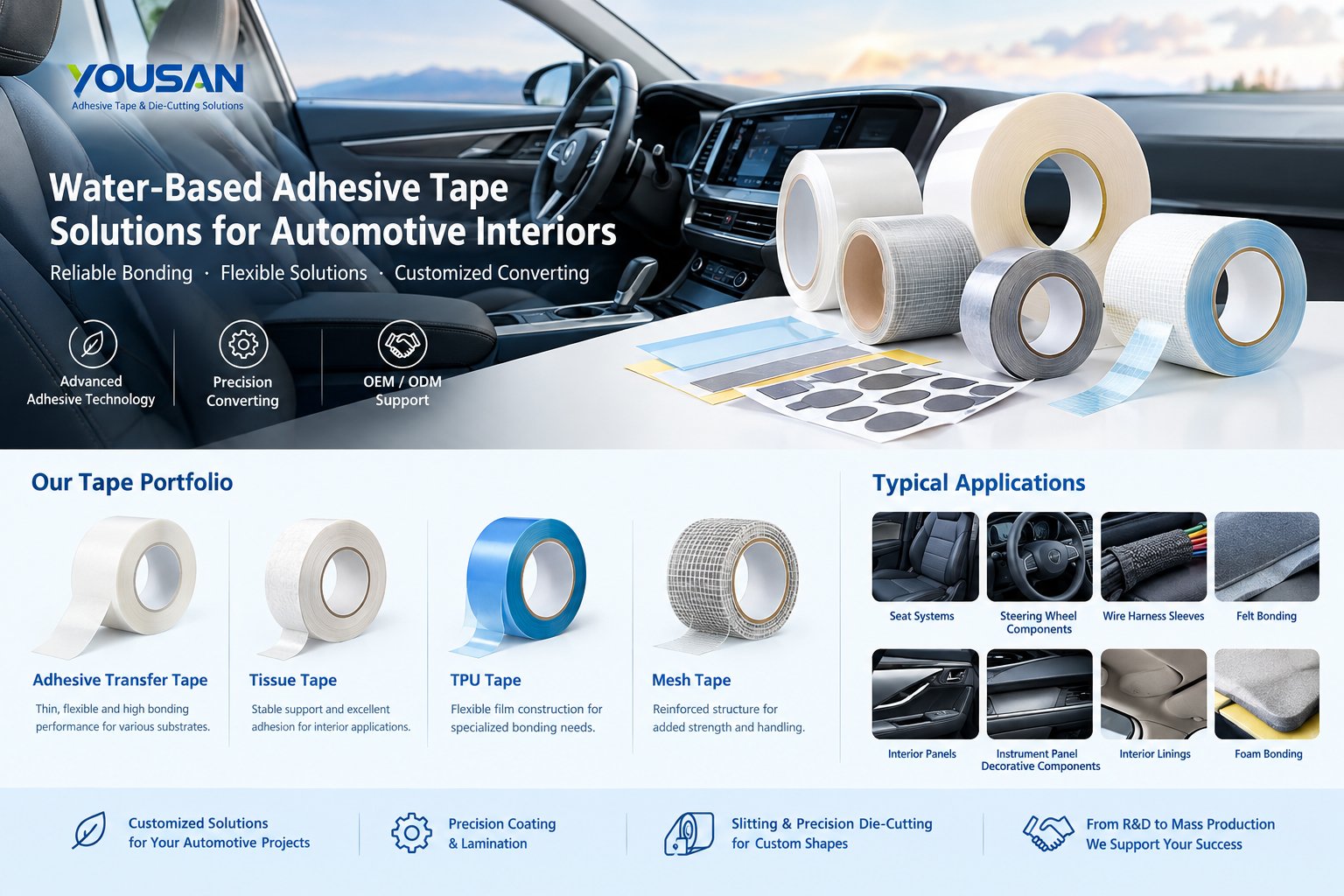
As automotive interiors continue to evolve toward lightweight, functional, and more material-efficient designs, adhesive tapes are increasingly used for bonding, mounting, cushioning, and component assembly.
Yousan develops adhesive tape solutions that can be evaluated for selected automotive interior applications, with a focus on water-based adhesive technologies, flexible tape constructions, and precision converting.
Our tape portfolio includes adhesive transfer tapes, tissue tapes, TPU tapes, and mesh tapes. Depending on the adhesive system and construction, these tapes can be considered for bonding applications involving felt, foam, textiles, films, plastics, and other interior materials.
Typical application areas include seat systems, steering wheel components, wire harness sleeves, felt bonding, interior panels, instrument panel decorative components, interior linings, and foam bonding.
What Are Water-Based Adhesive Tape Solutions?
Water-based adhesive tapes use an adhesive system in which water serves as the primary medium during adhesive preparation or coating.
Compared with solvent-based adhesive systems, water-based technologies can provide an alternative approach for projects where manufacturers are considering adhesive systems with different environmental and processing requirements.
However, adhesive performance depends on the specific formulation, coating weight, carrier, substrate, and application conditions. Therefore, the final tape construction should be selected and validated according to the actual automotive application.
Automotive Interior Adhesive Tape Constructions
Different automotive interior applications require different tape constructions. Yousan can evaluate several adhesive tape formats depending on the substrate combination and bonding requirements.
Adhesive Transfer Tape
Adhesive transfer tape consists primarily of an adhesive layer without a conventional carrier.
Its thin and flexible construction can be considered for selected automotive interior bonding applications, including:
- Felt bonding
- Foam bonding
- Textile attachment
- Interior lining
- Film bonding
- Decorative material assembly
The appropriate adhesive formulation and coat weight should be determined according to the substrates and required bonding performance.
Tissue Adhesive Tape
Tissue tape uses a thin tissue carrier coated with adhesive.
The carrier provides support during handling while maintaining a flexible tape construction.
Potential automotive interior applications include:
- Felt-to-substrate bonding
- Textile bonding
- Foam attachment
- Interior lining
- Decorative material bonding
- Lightweight component assembly
TPU Adhesive Tape
TPU adhesive tape uses a thermoplastic polyurethane film structure.
Its flexible film construction can be considered for applications requiring a thin and conformable bonding layer.
Potential applications include:
- Textile bonding
- Flexible interior components
- Film-to-substrate bonding
- Interior lining
- Decorative material attachment
Specific TPU construction, adhesive properties, and environmental performance should be evaluated according to the application.
Mesh Adhesive Tape
Mesh adhesive tape incorporates a mesh carrier into the adhesive construction.
The reinforced carrier can provide handling and structural support for selected bonding applications.
Potential applications include:
- Felt attachment
- Textile bonding
- Foam bonding
- Interior material assembly
- Flexible component fixation
Custom converting can be considered when specific widths, shapes, or application formats are required.
Automotive Interior Applications
Seat System Bonding
Automotive seats can incorporate textiles, felt, foam, films, and other flexible materials.
Adhesive tape can be evaluated for selected applications involving:
- Felt attachment
- Foam bonding
- Textile assembly
- Interior lining
- Component positioning
The tape construction should be tested against the actual seat materials and assembly conditions.
Steering Wheel Components
Steering wheel systems can contain multiple flexible and decorative materials.
For selected non-structural interior bonding applications, adhesive tape may be evaluated for:
- Textile materials
- Foam components
- Covering materials
- Decorative layers
- Component attachment
The final adhesive solution should be qualified for the specific substrate and environmental requirements.
Wire Harness Sleeves
Adhesive tape solutions can also be considered for selected wire harness sleeve and wrapping applications.
Depending on the construction, requirements may include:
- Flexibility
- Controlled adhesion
- Conformability
- Reliable wrapping
- Compatibility with sleeve materials
Tape selection should be based on the actual wire harness construction and assembly process.
Automotive Felt Bonding
Felt is commonly incorporated into automotive interiors for lining, protection, acoustic management, and finishing applications.
Adhesive tape can be evaluated for bonding felt to compatible substrates such as plastics, foams, films, textiles, and other interior materials.
For felt bonding, important factors include:
- Felt density and surface structure
- Substrate type
- Required peel adhesion
- Bonding area
- Assembly pressure
- Temperature and humidity exposure
Interior Panel Assembly
Interior panels may combine plastics, textiles, films, foam, felt, and decorative materials.
Adhesive tapes can provide a thin bonding interface for selected panel assembly applications, including:
- Decorative material attachment
- Foam bonding
- Textile bonding
- Lining attachment
- Component fixation
For complex panel assemblies, tape thickness and adhesive placement should be considered together with the component geometry.
Instrument Panel Decorative Components
Decorative components around the instrument panel may require accurate positioning and controlled bonding.
Tape solutions can be evaluated for applications involving:
- Decorative films
- Textiles
- Foam
- Felt
- Trim materials
- Lightweight decorative components
Where the tape is used near visible surfaces, the construction should also be evaluated for appearance, edge behavior, and dimensional requirements.
Interior Linings
Automotive interior linings may include textile, nonwoven, felt, foam, and film materials.
Adhesive transfer tapes, tissue tapes, TPU tapes, and mesh tapes can be evaluated for selected lining applications depending on the required bonding performance and assembly process.
Foam Bonding
Foam bonding is an important application area for automotive interiors.
Foams may need to be bonded to:
- Textiles
- Felt
- Plastics
- Films
- Nonwoven materials
- Other foam materials
Adhesive selection should consider the foam type, surface structure, compression, substrate compatibility, and required bond performance.
Key Factors for Selecting Automotive Interior Adhesive Tape
Choosing an automotive interior adhesive tape requires evaluation of the complete bonding system rather than adhesive strength alone.
1. Substrate Compatibility
Common automotive interior substrates include:
- Felt
- Foam
- Textile
- Nonwoven materials
- Plastic
- Film
- Decorative materials
The selected tape should be tested on the actual substrate combination.
2. Adhesive Chemistry
The adhesive chemistry affects tack, peel adhesion, holding performance, flexibility, and environmental behavior.
For water-based adhesive projects, the formulation and coating process should be selected according to the required application performance.
3. Tape Thickness
Tape thickness can affect:
- Bond-line thickness
- Conformability
- Component positioning
- Edge profile
- Gap filling
The appropriate thickness should be determined by the component design and bonding area.
4. Flexibility and Conformability
Automotive interior components can have curved or irregular surfaces.
A flexible tape construction may help accommodate certain surface geometries, but the actual application should be tested before production approval.
5. Assembly Process
The adhesive tape should be compatible with the customer’s assembly method.
Important considerations include:
- Manual or automated application
- Liner removal
- Application pressure
- Positioning accuracy
- Bonding time
- Component handling
Precision Converting for Automotive Interior Tape
Automotive interior projects often require customized adhesive components rather than standard tape rolls.
Yousan provides precision converting capabilities including:
- Precision slitting
- Laminating
- Kiss-cutting
- Precision die-cutting
- Custom widths
- Custom shapes
- Custom roll formats
- Adhesive component converting
These capabilities allow adhesive tapes to be converted into application-specific components based on customer drawings and production requirements.
Custom Die-Cut Automotive Adhesive Components
For applications involving complex component geometries, adhesive tape can be converted into precision die-cut parts.
Typical requirements may include:
- Custom dimensions
- Rounded corners
- Holes and openings
- Multiple adhesive zones
- Kiss-cut liner constructions
- Roll or sheet presentation
Before mass production, the die-cut construction should be evaluated for dimensional tolerance, liner release, adhesive edge behavior, and application efficiency.
Why Choose Yousan?
Yousan combines adhesive technology with precision converting capabilities to support customized industrial and automotive bonding projects.
Our capabilities include:
- Polymer and PSA technology
- Adhesive development
- Precision coating
- Film research
- Lamination
- Slitting
- Precision die-cutting
- Custom adhesive components
- OEM and ODM support
For automotive interior projects, Yousan can work with customers to evaluate the appropriate adhesive construction, carrier, thickness, dimensions, and converting format.
How to Select the Right Automotive Interior Adhesive Tape
When requesting a technical evaluation, customers should provide as much of the following information as possible:
- Application – What component will be bonded?
- Substrates – What materials need to be bonded?
- Tape type – Transfer, tissue, TPU, mesh, or another construction?
- Dimensions – Required width, thickness, length, or die-cut shape.
- Assembly method – Manual or automated?
- Environmental conditions – Temperature, humidity, and other exposure conditions.
- Performance requirements – Peel adhesion, holding power, flexibility, or other requirements.
- Production volume – Prototype, pilot production, or mass production.
- Converting format – Roll, sheet, kiss-cut, or die-cut component.
This information helps the technical team determine a suitable adhesive tape construction for further testing.
FAQ
What is water-based adhesive tape?
Water-based adhesive tape uses a water-based adhesive system or coating process. Its final performance depends on the adhesive formulation, carrier, coating weight, substrate, and application conditions.
What types of adhesive tape does Yousan provide for automotive interior applications?
Yousan’s portfolio includes adhesive transfer tapes, tissue tapes, TPU tapes, and mesh tapes. Specific adhesive systems and constructions should be selected according to the application.
Can water-based adhesive tape be used for automotive interiors?
Water-based adhesive tape can be evaluated for selected automotive interior bonding applications. Suitability depends on the substrate combination, required adhesion, environmental conditions, and assembly process.
Can these tapes bond automotive foam and felt?
Yes, foam and felt bonding are potential application areas. The actual adhesive construction should be tested against the specific foam, felt, and mating substrate.
Can Yousan customize automotive adhesive tape?
Yes. Yousan provides slitting, laminating, kiss-cutting, precision die-cutting, and other converting services for customized adhesive components.
Can Yousan provide die-cut automotive interior adhesive parts?
Yes. Depending on the design and material construction, Yousan can convert adhesive tapes into customized die-cut parts according to customer drawings and dimensional requirements.
Does Yousan support OEM and ODM automotive adhesive tape projects?
Yes. Yousan supports customized adhesive development and converting for OEM and ODM projects.
Conclusion
Water-based adhesive tape technologies provide an additional option for automotive interior bonding applications where manufacturers are evaluating different adhesive systems and tape constructions.
Yousan offers adhesive transfer tapes, tissue tapes, TPU tapes, and mesh tapes, which can be evaluated for selected applications involving felt, foam, textiles, films, plastics, interior panels, linings, and decorative components.
With capabilities in polymer and PSA technology, precision coating, lamination, slitting, and precision die-cutting, Yousan can support automotive customers from tape selection and technical evaluation through customized converting and production.
For a specific automotive interior application, provide the substrate, component dimensions, assembly process, performance requirements, and estimated volume so the appropriate tape construction can be evaluated.
If you would like to learn more about Yousan adhesive tapes, please visit our website at www.ysdiecut.com