
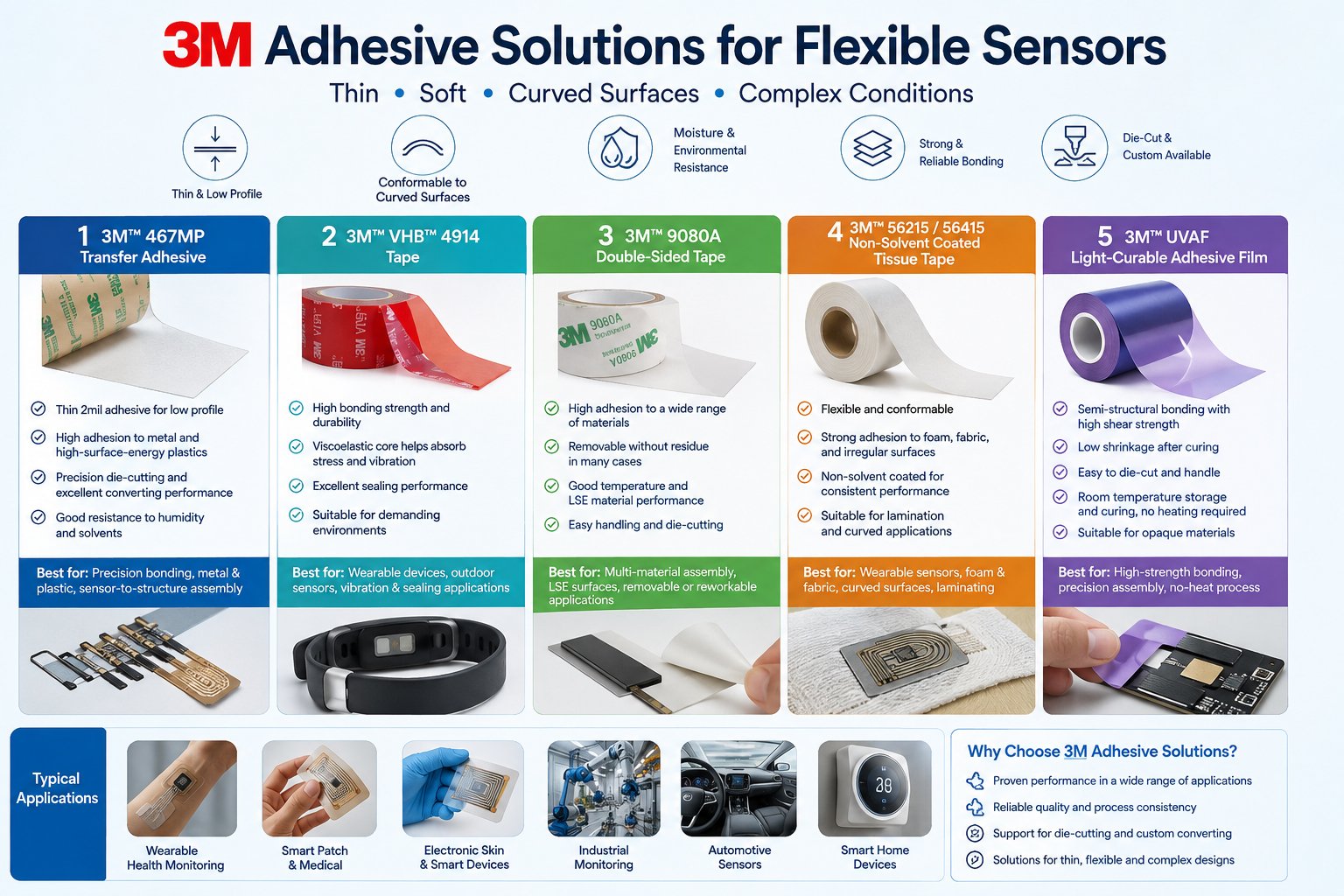
Flexible sensors are transforming wearable electronics, smart patches, electronic skins, industrial monitoring systems, automotive interiors, and smart home devices. But as flexible sensor technology moves from prototypes to mass production, one challenge becomes increasingly important: how to keep the sensor securely bonded under real-world conditions.
A flexible sensor adhesive must do more than simply stick two surfaces together. Depending on the application, it may need to accommodate thin substrates, curved surfaces, low-surface-energy plastics, moisture, vibration, repeated mechanical stress, or demanding converting processes such as precision die cutting.
That is why there is no single best adhesive tape for every flexible sensor application.
Instead, the right solution depends on the substrate, bonding area, required strength, flexibility, environmental conditions, assembly process, and whether the adhesive needs to be removable or permanent.
In this guide, we compare five 3M adhesive solutions that can be considered for different flexible sensor bonding requirements, including 3M™ 467MP Transfer Adhesive, 3M™ VHB™ 4914 Tape, 3M™ 9080A Double-Sided Tape, 3M™ 56215/56415 Non-Solvent Coated Tissue Tape, and 3M™ UVAF Light-Curable Adhesive Film.
What Is the Best Adhesive for Flexible Sensors?
There is no universal “best” adhesive for flexible sensors.
The appropriate adhesive depends on what the sensor needs to withstand.
For example:
- Precision bonding to metal or high-surface-energy plastics: a thin transfer adhesive such as 3M™ 467MP may be worth evaluating.
- Structural bonding, sealing, vibration resistance and long-term durability: 3M™ VHB™ 4914 can be considered.
- General-purpose bonding across multiple substrates: 3M™ 9080A may be suitable for certain assembly requirements.
- Foam, fabric, curved or irregular surfaces: 3M™ 56215/56415 can be evaluated where conformability and converting performance are important.
- Higher-strength semi-structural bonding and controlled curing: 3M™ UVAF provides an alternative to conventional pressure-sensitive adhesive tapes.
The key is to match the adhesive technology to the sensor structure and final application, rather than selecting a tape based only on its nominal adhesion strength.
5 3M Adhesive Solutions for Flexible Sensor Applications
1. 3M™ 467MP Transfer Adhesive
Best for: Precision bonding, metal and high-surface-energy plastics
When a flexible sensor needs to be attached to a metal housing, high-surface-energy plastic, or another relatively smooth substrate, a thin transfer adhesive can provide an efficient bonding solution.
3M™ 467MP Transfer Adhesive uses a thin adhesive layer without a traditional foam or film carrier, making it particularly relevant to applications where the adhesive layer needs to remain thin and conform closely to the assembly.
Key advantages
- Thin adhesive construction
- High adhesion to many high-surface-energy substrates
- Suitable for precision converting and die-cutting
- Good dimensional stability when converted with an appropriate liner
- Suitable for applications requiring a low-profile adhesive interface
Typical flexible sensor applications
3M™ 467MP can be evaluated for:
- Flexible sensor attachment
- Sensor-to-metal bonding
- Sensor-to-plastic bonding
- Printed electronics
- Graphic sensor components
- Precision die-cut adhesive patterns
- Thin electronic assemblies
When should you consider 467MP?
Choose this type of solution when low adhesive thickness, precise positioning and strong bonding to suitable substrates are more important than thick foam-like cushioning.
For complex geometries, the adhesive can also be converted into custom die-cut shapes to match the sensor design.
2. 3M™ VHB™ 4914 Tape
Best for: Durable bonding, sealing and vibration management
Some flexible sensor assemblies operate in environments where mechanical durability is more important than simply minimizing adhesive thickness.
Examples include:
- Wearable electronics
- Industrial sensor modules
- Outdoor monitoring equipment
- Automotive electronics
- Smart devices
In these applications, a thicker viscoelastic adhesive can help distribute stress and accommodate movement between bonded components.
3M™ VHB™ 4914 Tape is therefore worth considering when the assembly requires a more substantial bonding interface.
Key advantages
- High-performance bonding
- Viscoelastic construction
- Stress distribution
- Vibration and movement accommodation
- Suitable for bonding and sealing applications
- Available for converting into customized shapes
Typical applications
- Wearable sensor modules
- Industrial monitoring devices
- Automotive sensor assemblies
- Electronic housings
- Sensor covers and enclosures
- Components requiring additional sealing
When should you consider VHB 4914?
Consider VHB 4914 when the assembly needs durability, stress management and environmental resistance, and the available bonding space can accommodate a thicker adhesive construction.
For ultra-thin flexible sensors, however, a thinner adhesive may be more appropriate.
3. 3M™ 9080A Double-Sided Tissue Tape
Best for: General assembly and multi-material bonding
Flexible sensor products may combine several different materials, including:
- PET
- Plastic
- Metal
- Foam
- Fabric
- Printed films
In these situations, the adhesive must provide reliable bonding across the specific substrates used in the assembly.
3M™ 9080A Double-Sided Tissue Tape can be evaluated for general-purpose bonding applications where a tissue carrier provides convenient handling and converting characteristics.
Key advantages
- Double-sided adhesive construction
- Convenient handling during assembly
- Suitable for a range of substrates
- Useful for converting and die-cutting applications
- Available for various industrial assembly applications
Typical applications
- Flexible sensor assembly
- Film-to-plastic bonding
- Sensor component mounting
- General electronic assembly
- Multi-material bonding
- Die-cut adhesive components
When should you consider 9080A?
This type of tape can be considered when the application involves multiple common substrates and the assembly process benefits from a conventional double-sided tissue tape.
For critical applications, actual substrate testing is recommended before final material selection.
4. 3M™ 56215 / 56415 Non-Solvent Coated Tissue Tape
Best for: Foam, fabric, curved and irregular surfaces
Flexible electronics are not always installed on flat rigid surfaces.
Wearable products and flexible interfaces may involve:
- Fabric
- Foam
- Textiles
- Flexible films
- Curved housings
- Irregular surfaces
In these applications, the ability of an adhesive construction to conform to the surface can become just as important as nominal adhesion.
3M™ 56215 and 56415 Non-Solvent Coated Tissue Tapes can be considered for applications where flexible bonding and efficient converting are required.
Key advantages
- Flexible adhesive construction
- Suitable for a variety of substrates
- Useful for curved or irregular assemblies
- Suitable for converting and lamination
- Can be evaluated for wearable and flexible electronic applications
Typical applications
- Wearable sensors
- Flexible patches
- Textile-integrated electronics
- Foam-to-film bonding
- Curved sensor assemblies
- Laminated flexible components
When should you consider 56215/56415?
Consider these products when the sensor assembly involves flexible, porous, textured or irregular substrates and the adhesive needs to maintain contact across the bonding interface.
5. 3M™ UVAF Light-Curable Adhesive Film
Best for: Higher-strength semi-structural bonding
Some flexible sensor assemblies eventually require more than conventional pressure-sensitive adhesive performance.
For example, the adhesive may need to provide:
- Higher mechanical strength
- Strong shear resistance
- Controlled bonding
- Low shrinkage after curing
- Precision placement
- Compatibility with automated converting
In these situations, 3M™ UVAF Light-Curable Adhesive Film provides a different adhesive technology compared with conventional pressure-sensitive tapes.
Key advantages
- Semi-structural bonding capability
- High shear strength potential
- Low shrinkage after curing
- Film format for controlled application
- Can be converted into custom shapes
- Suitable for applications where liquid adhesive processing is undesirable
Typical applications
- Flexible electronics
- Sensor assemblies
- Precision electronic components
- Semi-structural bonding
- Custom die-cut adhesive components
- Assemblies where controlled curing is required
When should you consider UVAF?
UVAF can be considered when a project requires higher-strength bonding and more controlled adhesive performance than a conventional pressure-sensitive tape can provide.
The curing process and optical/material compatibility should be evaluated carefully during development.
Flexible Sensor Adhesive Comparison
| Adhesive Solution | Best Suited For | Relative Profile | Converting | Typical Applications |
|---|---|---|---|---|
| 3M™ 467MP | Precision bonding | Very thin | Excellent | Sensors, films, metal/plastic |
| 3M™ VHB™ 4914 | Durable bonding & sealing | Thicker | Excellent | Wearables, industrial, automotive |
| 3M™ 9080A | General assembly | Thin/medium | Excellent | Electronics, multi-material assembly |
| 3M™ 56215/56415 | Flexible/irregular substrates | Flexible | Excellent | Wearables, foam, fabric, curved surfaces |
| 3M™ UVAF | Semi-structural bonding | Film | Suitable for die cutting | Flexible electronics, precision assemblies |
Important: Product selection should be validated against the actual substrate, temperature, humidity, mechanical load, surface preparation, dwell time and production process.
How to Choose the Right Adhesive for a Flexible Sensor
Instead of asking:
“Which 3M tape has the strongest adhesion?”
a better question is:
“Which adhesive construction matches my sensor, substrate and operating environment?”
Consider these seven factors.
1. Sensor Thickness
The thinner the sensor, the more important the adhesive thickness and flexibility can become.
A thick foam tape may provide excellent stress absorption but could change the overall profile of a thin sensor assembly.
For ultra-thin constructions, transfer adhesives or thin double-sided tapes may be preferable.
2. Substrate Material
Always identify both surfaces.
For example:
Sensor side
- PET
- PI
- TPU
- Printed circuit
- Flexible PCB
Application side
- Aluminum
- Stainless steel
- ABS
- PC
- Acrylic
- Glass
- Foam
- Fabric
The same adhesive may perform very differently on different substrates.
3. Surface Energy
Low-surface-energy plastics can be challenging to bond.
Examples include certain grades of:
- PP
- PE
- TPO
- Other LSE plastics
If an LSE substrate is involved, adhesive selection and surface preparation should be evaluated specifically rather than assuming a general-purpose tape will perform adequately.
4. Curved Surfaces
For curved sensor assemblies, consider:
- Adhesive thickness
- Flexibility
- Conformability
- Edge lifting
- Initial tack
- Long-term holding power
A rigid or excessively thick construction may create unnecessary stress at the edge of a curved component.
5. Shear and Peel Forces
Flexible sensors can experience repeated mechanical loads.
For example:
Wearable device
→ bending + stretching
Industrial sensor
→ vibration + shear
Battery-related assembly
→ repeated component removal + peel
Switch-related assembly
→ repeated local mechanical force
Therefore, testing should consider the actual load direction and frequency, not just static adhesion.
6. Temperature and Humidity
Flexible sensor applications can experience:
- High temperature
- Temperature cycling
- High humidity
- Sweat
- Condensation
- Outdoor exposure
The adhesive should therefore be evaluated under the actual environmental conditions expected during product use.
7. Die-Cutting and Mass Production
A tape that performs well manually may not necessarily be the easiest material to mass-produce.
For high-volume flexible sensor manufacturing, consider:
- Kiss cutting
- Rotary die cutting
- Slitting
- Lamination
- Liner selection
- Registration accuracy
- Waste removal
- Automated dispensing
- Part-to-part consistency
This is where a specialized tape converter can add significant value.
Why Die-Cut Adhesive Is Important for Flexible Sensors
Flexible sensors often contain multiple small components or functional zones.
Instead of using a full sheet of adhesive, a custom die-cut adhesive can provide adhesive only where it is required.
For example:
Sensor + adhesive + liner
can be converted into:
One custom-shaped adhesive component
This can improve:
- Material utilization
- Assembly speed
- Positioning accuracy
- Repeatability
- Clean handling
- Automated assembly
Custom die-cut adhesive components are especially useful when the sensor contains holes, terminals, connectors, windows or multiple bonding zones.
Common Flexible Sensor Adhesive Problems
Why does my flexible sensor keep peeling at the edges?
Possible causes include:
- Excessive substrate curvature
- Insufficient contact area
- Surface contamination
- Inadequate pressure during application
- Incorrect adhesive thickness
- High peel stress
- Incompatible substrate
A more aggressive adhesive is not always the only solution.
Reducing peel stress through better adhesive geometry can sometimes be equally important.
Why does the adhesive fail on plastic?
The plastic may have a low surface energy or contain additives that interfere with bonding.
Possible approaches include:
- Selecting an adhesive designed for the substrate
- Cleaning the surface
- Using an appropriate adhesion promoter where permitted
- Increasing contact area
- Testing after environmental conditioning
Why does the sensor detach after humidity exposure?
Moisture can affect both the adhesive and the substrate interface.
For humidity-sensitive applications, test:
Initial adhesion → humidity exposure → re-test adhesion
rather than evaluating the tape only under dry laboratory conditions.
Flexible Sensor Adhesive Selection Guide
A simple starting point is:
Need a very thin adhesive?
→ Consider 3M™ 467MP
Need structural-style bonding and stress management?
→ Consider 3M™ VHB™ 4914
Need general-purpose double-sided assembly?
→ Consider 3M™ 9080A
Need flexible bonding to foam, fabric or irregular surfaces?
→ Consider 3M™ 56215/56415
Need higher-strength semi-structural bonding?
→ Consider 3M™ UVAF
This is only a starting point. Final selection should always be based on actual application testing.
Custom Die-Cut Adhesive Solutions for Flexible Sensors
At Yousan New Materials, adhesive selection is only one part of the solution.
For flexible sensor manufacturers, we can also support:
- Custom adhesive die cutting
- Kiss-cut adhesive components
- Precision lamination
- Multi-layer adhesive structures
- Film and liner lamination
- Roll-to-roll converting
- Custom shapes and dimensions
- Prototype samples
- High-volume production
A typical development process can be:
Application analysis → Material recommendation → Sample → Die-cut prototype → Functional testing → Design optimization → Mass production
This approach helps customers evaluate both adhesive performance and manufacturability before moving into high-volume production.
Frequently Asked Questions
What is the best 3M tape for flexible sensors?
There is no single best option. 3M™ 467MP, 3M™ VHB™ 4914, 3M™ 9080A, 3M™ 56215/56415 and 3M™ UVAF address different bonding requirements. The correct choice depends on the substrate, thickness, mechanical load, environmental conditions and manufacturing process.
Can 3M adhesive tapes be die-cut for flexible sensors?
Yes. Many adhesive tapes and films can be converted into custom die-cut shapes depending on their construction and processing requirements. Die-cutting can be useful for precision sensor assembly.
Which adhesive is suitable for curved flexible sensors?
The appropriate solution depends on the curvature, substrate and required holding force. Flexible tissue tapes and certain thin adhesive constructions can be evaluated for curved surfaces, while thicker VHB constructions may be useful where additional stress absorption is needed.
Can flexible sensor adhesives bond to plastic?
Yes, but performance depends heavily on the specific plastic. High-surface-energy plastics and low-surface-energy plastics may require different adhesive approaches.
How do I select adhesive thickness?
Consider the sensor thickness, surface roughness, curvature, required flexibility, gap filling and mechanical load. Thinner is not always better; thicker adhesive constructions can sometimes provide better stress management.
Can Yousan provide custom adhesive samples?
Yes. If you provide the sensor drawing, substrate information, dimensions and expected quantity, a suitable adhesive construction can be evaluated and converted into prototype samples.
Conclusion: Flexible Sensors Need Application-Specific Adhesive Solutions
The success of a flexible sensor depends on more than the sensor itself.
The adhesive interface must also survive the conditions that the finished product will experience.
A successful flexible sensor bonding solution should balance:
Thinness + Flexibility + Adhesion + Durability + Manufacturability
For precision bonding, 3M™ 467MP may be a strong candidate.
For durable bonding and stress management, 3M™ VHB™ 4914 can be evaluated.
For general assembly, 3M™ 9080A provides another option.
For flexible, foam, fabric and irregular substrates, 3M™ 56215/56415 may be worth considering.
And for higher-strength semi-structural applications, 3M™ UVAF offers a different adhesive technology.
Ultimately, the right adhesive is not simply the one with the highest adhesion value. It is the one that delivers the right combination of bonding performance, flexibility, environmental resistance, processing efficiency and long-term reliability for the specific sensor design.
Need a custom adhesive solution for your flexible sensor? Send us your drawing, substrate information, required thickness and annual volume. Yousan New Materials can help evaluate the adhesive material and develop a precision die-cut solution for your application.
If you would like to learn more about Yousan adhesive tapes, please visit our website at www.ysdiecut.com