
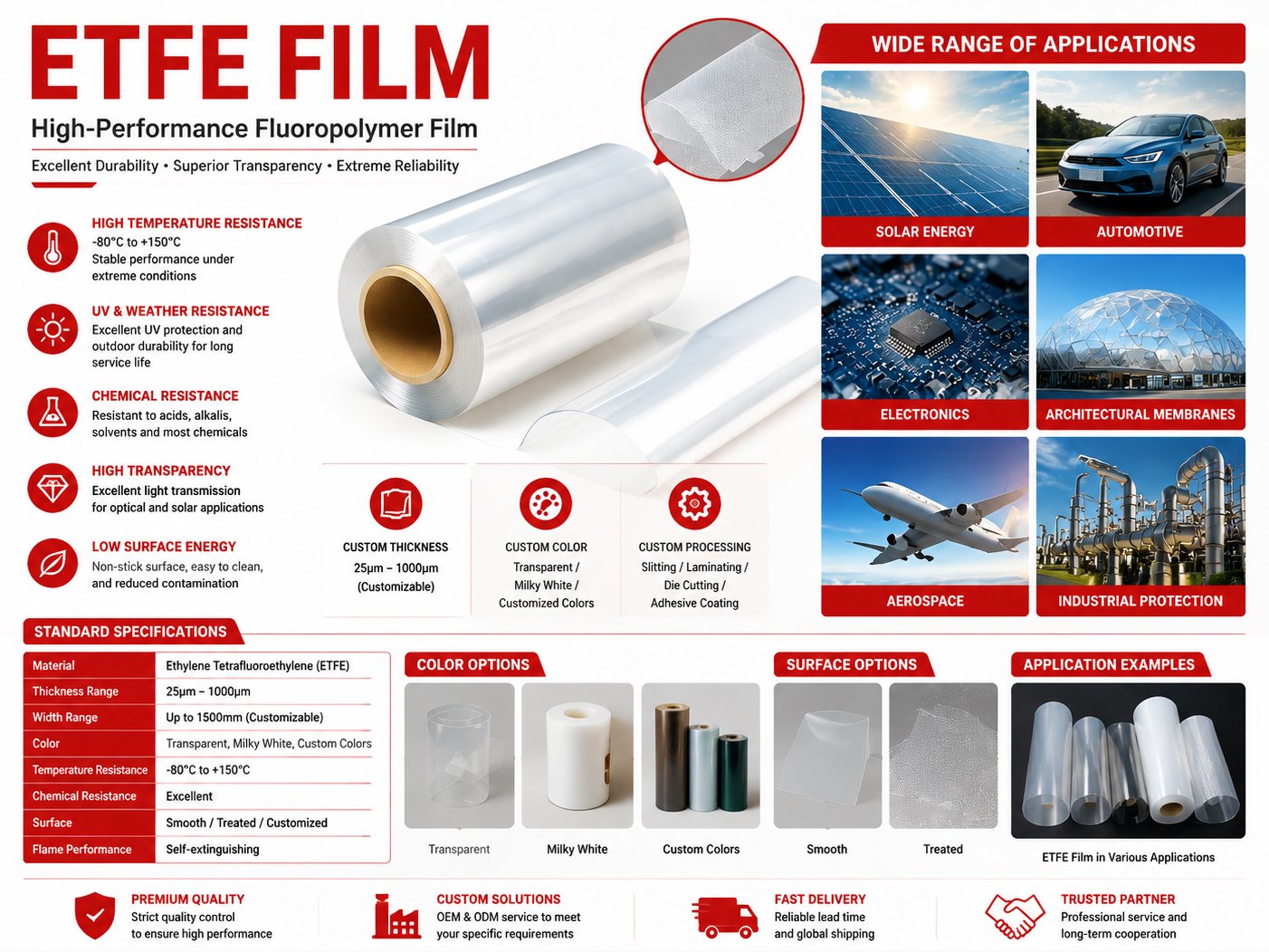
ETFE Film (Ethylene Tetrafluoroethylene Film) is a high-performance fluoropolymer film made from ethylene and tetrafluoroethylene copolymer. It combines excellent chemical resistance, high-temperature stability, UV resistance, lightweight properties, and outstanding mechanical strength, making it an ideal material for demanding industrial applications.
Compared with traditional plastic films, ETFE film provides superior durability and long-term performance in harsh environments. It is widely used in photovoltaic modules, automotive components, aerospace applications, electronic insulation, architectural membrane structures, and industrial protective solutions.
Guangdong Yousan New Materials provides customized ETFE film solutions with different thicknesses, widths, colors, and surface treatments to meet specific application requirements.
What Is ETFE Film?
ETFE stands for Ethylene Tetrafluoroethylene, a fluoropolymer developed for applications requiring high performance under extreme conditions.
ETFE film offers a unique balance between:
- Fluoropolymer chemical resistance
- Excellent mechanical toughness
- High transparency
- Low surface energy
- Weather resistance
- Long service life
Unlike PTFE, ETFE can be processed into thin films while maintaining strong mechanical properties and flexibility.
Features of ETFE Film
1. Excellent High Temperature Resistance
ETFE film maintains stable performance under elevated temperatures and extreme environmental conditions.
Typical characteristics:
- Continuous operating temperature: approximately -80°C to +150°C (depending on grade)
- Excellent thermal stability
- Resistance to thermal aging
This makes ETFE suitable for:
- High-temperature insulation
- Solar applications
- Automotive environments
- Industrial protection
2. Outstanding UV and Weather Resistance
ETFE film has excellent resistance against:
- UV radiation
- Outdoor exposure
- Weather aging
- Moisture
It maintains physical properties after long-term outdoor use, making it suitable for architectural and solar applications.
3. High Transparency & Light Transmission
Transparent ETFE film provides excellent light transmission, making it valuable for applications requiring natural lighting or optical performance.
Applications include:
- Solar panels
- Greenhouse films
- Architectural roofs
- LED protection
4. Chemical Resistance
ETFE film provides excellent resistance against:
- Acids
- Alkalis
- Solvents
- Corrosive chemicals
This makes it suitable for chemical processing and industrial environments.
5. Non-Stick Surface & Easy Cleaning
Due to its low surface energy:
- Dust accumulation is reduced
- Surface cleaning is easier
- Contamination resistance is improved
This property is especially useful for outdoor applications.
Technical Specifications of ETFE Film
| Property | Typical Value |
|---|---|
| Material | Ethylene Tetrafluoroethylene (ETFE) |
| Thickness Range | 25μm – 1000μm |
| Color | Transparent, Milky White, Custom Colors |
| Surface | Smooth / Treated / Customized |
| Temperature Resistance | Approx. -80°C to +150°C |
| Chemical Resistance | Excellent |
| UV Resistance | Excellent |
| Electrical Insulation | Excellent |
| Flame Performance | Self-extinguishing characteristics |
Specifications can vary depending on material grade and application requirements.
ETFE Film Applications
1. Solar Energy Industry
ETFE film is widely used in photovoltaic applications because of its:
- UV resistance
- Lightweight structure
- High transparency
- Weather durability
Applications:
- Solar panel protective film
- Flexible solar modules
- Solar concentrator systems
2. Automotive Industry
Automotive manufacturers use ETFE film for:
- Wire insulation
- Battery components
- Sensor protection
- High-temperature protection parts
Benefits:
- Heat resistance
- Chemical stability
- Long-term reliability
3. Electronics & Electrical Insulation
ETFE film is suitable for electronic applications requiring:
- High dielectric strength
- Thin insulation layers
- Heat resistance
Applications:
- Wire wrapping
- Flexible circuits
- Electrical components
4. Aerospace Applications
Due to its lightweight and durability, ETFE film is used in aerospace environments requiring:
- Radiation resistance
- Extreme temperature performance
- Chemical stability
5. Architectural Membrane Structures
ETFE architectural films are used in:
- Stadium roofs
- Building facades
- Greenhouses
- Large-span structures
Famous projects using ETFE include Allianz Arena and Beijing National Aquatics Center.
ETFE Film Available Options
Guangdong Yousan provides:
Thickness Options
- 25μm
- 50μm
- 100μm
- 150μm
- 250μm
- 500μm
- Customized thickness
Color Options
- Transparent ETFE Film
- Milky White ETFE Film
- Customized colors
Processing Options
- Slitting
- Laminating
- Die cutting
- Adhesive coating
- Custom converting
Why Choose Yousan ETFE Film Solutions?
Professional Material Conversion Capability
Yousan specializes in:
- Industrial film converting
- Precision die cutting
- Adhesive lamination
- Customized material solutions
Customized Manufacturing
We support:
- OEM requirements
- Custom dimensions
- Special thickness
- Application-specific solutions
Reliable Quality Control
Our production systems support strict quality management for industrial applications.
How to Select the Right ETFE Film?
Before selecting ETFE film, consider:
1. Application Environment
- Indoor or outdoor?
- Temperature exposure?
- Chemical exposure?
2. Thickness Requirement
Thicker films provide:
- Higher mechanical strength
- Better durability
Thinner films provide:
- Better flexibility
- Lower weight
3. Optical Requirements
Consider:
- Transparency
- Light diffusion
- Color requirements
4. Surface Treatment
Choose according to:
- Adhesion requirements
- Printing requirements
- Lamination needs
FAQ About ETFE Film
Q1: What is ETFE film used for?
ETFE film is used in solar energy, automotive, electronics, aerospace, architectural membranes, and industrial protection applications.
Q2: Is ETFE film heat resistant?
Yes. ETFE film provides excellent thermal stability and can withstand high-temperature environments depending on the grade.
Q3: What is the difference between ETFE and PTFE film?
ETFE provides better mechanical strength and easier processing, while PTFE offers higher chemical resistance in some extreme applications.
Q4: Can ETFE film be customized?
Yes. ETFE film can be customized in:
- Thickness
- Width
- Color
- Surface treatment
- Die-cut shape
Q5: Is ETFE film suitable for outdoor use?
Yes. ETFE has excellent UV resistance and weather durability, making it suitable for long-term outdoor applications.
Conclusion
ETFE Film is a premium fluoropolymer material that combines lightweight design, excellent temperature resistance, UV durability, chemical resistance, and mechanical strength.
From solar modules and automotive components to electronics, aerospace, and architectural structures, ETFE film provides reliable performance where conventional films cannot meet demanding requirements.
For customized ETFE Film solutions, ETFE sheets, and precision converted ETFE materials, Guangdong Yousan New Materials offers professional manufacturing support for global industrial customers.
If you would like to learn more about Yousan adhesive tapes, please visit our website at www.ysdiecut.com