
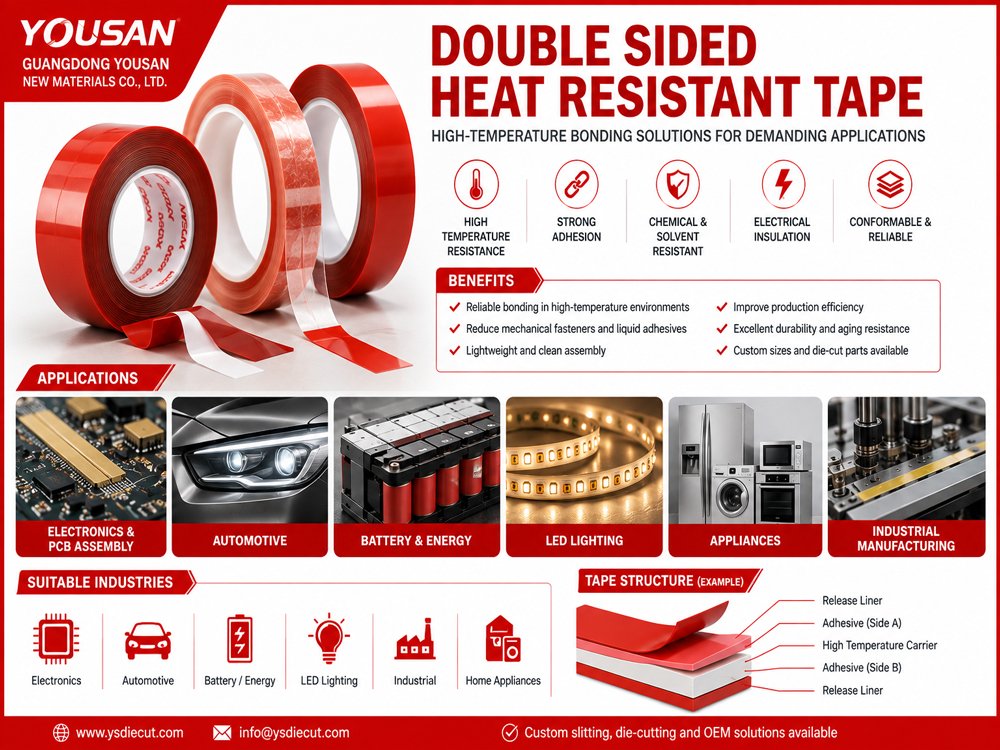
Double sided heat resistant tape is a pressure-sensitive adhesive tape designed to bond two surfaces where reliable adhesion and elevated-temperature performance are required. Unlike conventional double sided tape, heat resistant double sided tape is engineered with specialized carriers and adhesive systems to maintain bonding performance under higher temperatures.
Depending on the application, double sided heat resistant tapes can use polyimide (PI), PET, fiberglass, non-woven tissue, silicone foam, or other high-performance carriers. Adhesive options may include acrylic, silicone, rubber, or other specialty formulations.
These tapes are widely used for electronics assembly, automotive components, appliances, LED lighting, insulation, PCB manufacturing, battery applications, signage, and industrial assembly.
What Is Double Sided Heat Resistant Tape?
Double sided heat resistant tape has adhesive on both sides, allowing it to bond two substrates without mechanical fasteners. Its primary advantage is the combination of double-sided bonding and temperature resistance.
Depending on the construction, a heat resistant double sided tape can provide:
- High-temperature resistance
- Strong initial tack
- Long-term adhesion
- Excellent shear resistance
- Chemical resistance
- Electrical insulation
- Clean and precise bonding
- Conformability to irregular surfaces
The right product depends on the operating temperature, substrate, bonding surface, application time, and required removal performance.
Key Features
1. High Temperature Resistance
Specialized adhesive systems can withstand significantly higher temperatures than standard general-purpose double sided tapes.
2. Strong Double-Sided Adhesion
Both sides are coated with adhesive, providing efficient bonding between different substrates without screws, clips, or liquid adhesives.
3. Multiple Carrier Options
Depending on the application, tapes can be manufactured using:
- Polyimide film
- PET film
- Fiberglass
- Non-woven tissue
- Foam
- Other specialty films
4. Excellent Conformability
Certain constructions can conform to curved, uneven, or slightly irregular surfaces.
5. Chemical and Environmental Resistance
Selected high-temperature adhesive systems can offer resistance to solvents, oils, moisture, and other environmental conditions.
6. Electrical Insulation
Polyimide and other electrically insulating carriers can be suitable for electrical and electronic assembly applications.
7. Precision Converting
Heat resistant double sided tape can be supplied in slit rolls, sheets, strips, or precision die-cut parts.
Benefits of Double Sided Heat Resistant Tape
Reliable Bonding in High-Temperature Environments
The adhesive system is selected to maintain bonding performance when exposed to elevated temperatures.
Cleaner Assembly
Double sided tape eliminates the mess, curing time, and dispensing equipment associated with many liquid adhesives.
Reduced Mechanical Fasteners
Tape bonding can reduce the need for screws, rivets, clips, and other mechanical fastening methods.
Lightweight Construction
Adhesive bonding adds minimal weight compared with traditional mechanical fastening methods.
Improved Appearance
Because the adhesive is hidden between the substrates, the finished assembly can have a cleaner appearance.
Efficient Manufacturing
Pre-cut tape and die-cut adhesive components can simplify assembly and improve production consistency.
Technical Specifications
| Property | Typical Options |
|---|---|
| Product Type | Double Sided Heat Resistant Tape |
| Carrier | PI, PET, Fiberglass, Tissue, Foam |
| Adhesive | Acrylic, Silicone, Rubber, Specialty Adhesive |
| Color | Transparent, Amber, White, Black, etc. |
| Thickness | Application dependent |
| Width | Slit rolls or custom widths |
| Length | Standard or customized |
| Temperature Resistance | Application dependent |
| Liner | PET, Paper, or customized release liner |
| Format | Rolls, sheets, strips, die-cut parts |
| Processing | Slitting, laminating, die-cutting |
| Customization | OEM / Custom converting available |
Important: Temperature resistance varies significantly by adhesive and carrier construction. Always select the tape according to the actual continuous and peak operating temperatures.
Common Types of Heat Resistant Double Sided Tape
Polyimide Double Sided Tape
Polyimide double sided tape is designed for demanding electrical and electronic applications where high-temperature resistance and dimensional stability are important.
Typical applications:
- PCB assembly
- Electronics
- Transformer insulation
- LED components
- Battery components
- High-temperature masking and bonding
PET Double Sided Heat Resistant Tape
PET provides good dimensional stability and mechanical strength. It is suitable for applications requiring a thin, clean, and strong double-sided adhesive construction.
Typical applications:
- Electronics
- Appliances
- Automotive components
- Nameplates
- General industrial assembly
Fiberglass Double Sided Tape
Fiberglass reinforcement provides high tensile strength and dimensional stability, making this construction suitable for demanding industrial bonding applications.
Silicone Adhesive Double Sided Tape
Silicone adhesive systems are useful when bonding to challenging substrates or when high-temperature performance is required.
They can be particularly useful for applications involving silicone rubber, low-surface-energy materials, and elevated-temperature environments.
Heat Resistant Double Sided Foam Tape
Foam carriers provide thickness, cushioning, and gap-filling capabilities while maintaining double-sided adhesion.
Applications
Electronics
- Component mounting
- PCB assembly
- Display assembly
- Electronic module bonding
- Insulation
- Heat-resistant component attachment
Automotive
- Interior component mounting
- Emblem and trim attachment
- Wire and cable management
- Sensor component assembly
- Insulation materials
Battery & Energy
- Battery component fixation
- Insulation
- Thermal management component assembly
- Electrical protection
LED Lighting
- LED strip installation
- Heat-resistant component mounting
- Lighting module assembly
- Reflector and component fixation
Appliances
- Control panel assembly
- Component mounting
- Insulation
- Nameplate attachment
Industrial Manufacturing
- Metal bonding
- Insulation
- Component mounting
- Temporary fixation
- Die-cut adhesive components
Compatible Materials
Double sided heat resistant tape can be engineered for bonding to a wide range of substrates, including:
- Aluminum
- Stainless steel
- Steel
- Copper
- PET
- Polycarbonate (PC)
- ABS
- Acrylic
- Glass
- Ceramics
- Painted surfaces
- Polyimide films
- Silicone materials
- Various plastics
Surface preparation is critical. Oil, dust, moisture, oxidation, and release agents can significantly reduce adhesive performance.
How to Choose the Right Double Sided Heat Resistant Tape
Choosing the right tape requires more than simply asking for the highest temperature rating.
1. Determine the Operating Temperature
Identify:
- Continuous operating temperature
- Maximum peak temperature
- Duration of heat exposure
- Heating and cooling cycles
2. Identify the Substrates
Different adhesives perform differently on:
- Metals
- Plastics
- Glass
- Silicone
- Painted surfaces
- Powder-coated surfaces
3. Select the Adhesive
Acrylic: Good general-purpose performance and aging resistance.
Silicone: Suitable for high-temperature applications and difficult substrates.
Rubber: Often provides strong initial tack but may have lower temperature resistance depending on the formulation.
4. Select the Carrier
The carrier affects:
- Dimensional stability
- Tensile strength
- Electrical properties
- Thickness
- Conformability
5. Consider Thickness
Thin tapes are ideal for precise assembly, while thicker foam constructions can provide cushioning and gap filling.
6. Consider Die-Cutting Requirements
For mass production, custom die-cut tape components can improve assembly efficiency and consistency.
Installation Guide
Step 1: Clean the Surface
Remove dust, oil, grease, moisture, and contaminants.
Step 2: Dry the Surface
Ensure the substrate is completely dry before application.
Step 3: Apply the Tape
Apply the tape evenly without excessive stretching.
Step 4: Apply Pressure
Press the tape firmly against the substrate to maximize adhesive contact.
Step 5: Remove the Release Liner
Remove the liner immediately before bonding the second substrate.
Step 6: Bond the Second Surface
Align the components carefully and apply uniform pressure.
Step 7: Allow Adhesion to Develop
Many pressure-sensitive adhesives develop higher bond strength over time. Follow the recommended dwell time for the selected product before exposing the assembly to maximum load or temperature.
Double Sided Heat Resistant Tape vs. Standard Double Sided Tape
| Feature | Heat Resistant Double Sided Tape | Standard Double Sided Tape |
|---|---|---|
| High-temperature performance | Excellent for selected grades | Limited |
| Adhesive options | Acrylic, silicone, specialty | Usually general-purpose |
| Carrier options | PI, PET, fiberglass, foam, etc. | Tissue/PET/foam |
| Electronics applications | Excellent for selected grades | Limited |
| Automotive applications | Suitable for selected grades | Application dependent |
| Cost | Generally higher | Generally lower |
| High-temperature bonding | Designed for this purpose | Not always suitable |
Do not select a tape solely based on its maximum temperature rating. Adhesion, shear strength, substrate compatibility, and exposure time are equally important.
Why Choose Yousan?
Guangdong Yousan New Materials Co., Ltd. provides customized adhesive tape and converting solutions for industrial applications.
Our capabilities include:
- Double sided adhesive tape
- High-temperature adhesive tape
- Polyimide tape
- PET tape
- Silicone adhesive solutions
- Foam tape
- Precision slitting
- Laminating
- Die-cutting
- Custom adhesive components
- OEM and private-label solutions
Yousan can help customers select the appropriate carrier, adhesive, thickness, width, liner, and converting format according to the actual application.
For high-volume manufacturing, custom die-cut double sided heat resistant tape can also be produced to match specific component dimensions.
FAQ
What is double sided heat resistant tape?
It is an adhesive tape coated with adhesive on both sides and designed to maintain reliable bonding performance under elevated temperatures.
What temperature can double sided heat resistant tape withstand?
There is no single temperature rating for all products. Performance depends on the adhesive, carrier, exposure duration, and application conditions. Some specialty constructions are designed for continuous high-temperature service, while others are intended for short-term exposure.
What is the best adhesive for high-temperature applications?
Silicone and specialized acrylic adhesives are common choices. The best option depends on the substrate, temperature profile, required adhesion, and environmental conditions.
Is polyimide tape heat resistant?
Yes. Polyimide is widely used for high-temperature electrical and electronic applications. However, the overall temperature performance of an adhesive tape also depends on its adhesive system.
Can double sided heat resistant tape bond metal?
Yes. Many acrylic and silicone adhesive systems can bond aluminum, stainless steel, copper, and other metals when the surface is properly prepared.
Can it be used on plastic?
Yes, but plastic compatibility varies. Some plastics have low surface energy and may require a specially formulated adhesive or surface treatment.
Can heat resistant double sided tape be die-cut?
Yes. Depending on the construction, it can be converted into custom shapes, strips, washers, gaskets, and other precision adhesive components.
How do I select the right product?
Provide the substrate, operating temperature, tape thickness, required width, application, bonding area, and expected load. These details allow the appropriate adhesive and carrier to be selected.
If you would like to learn more about Yousan adhesive tapes, please visit our website at www.ysdiecut.com