
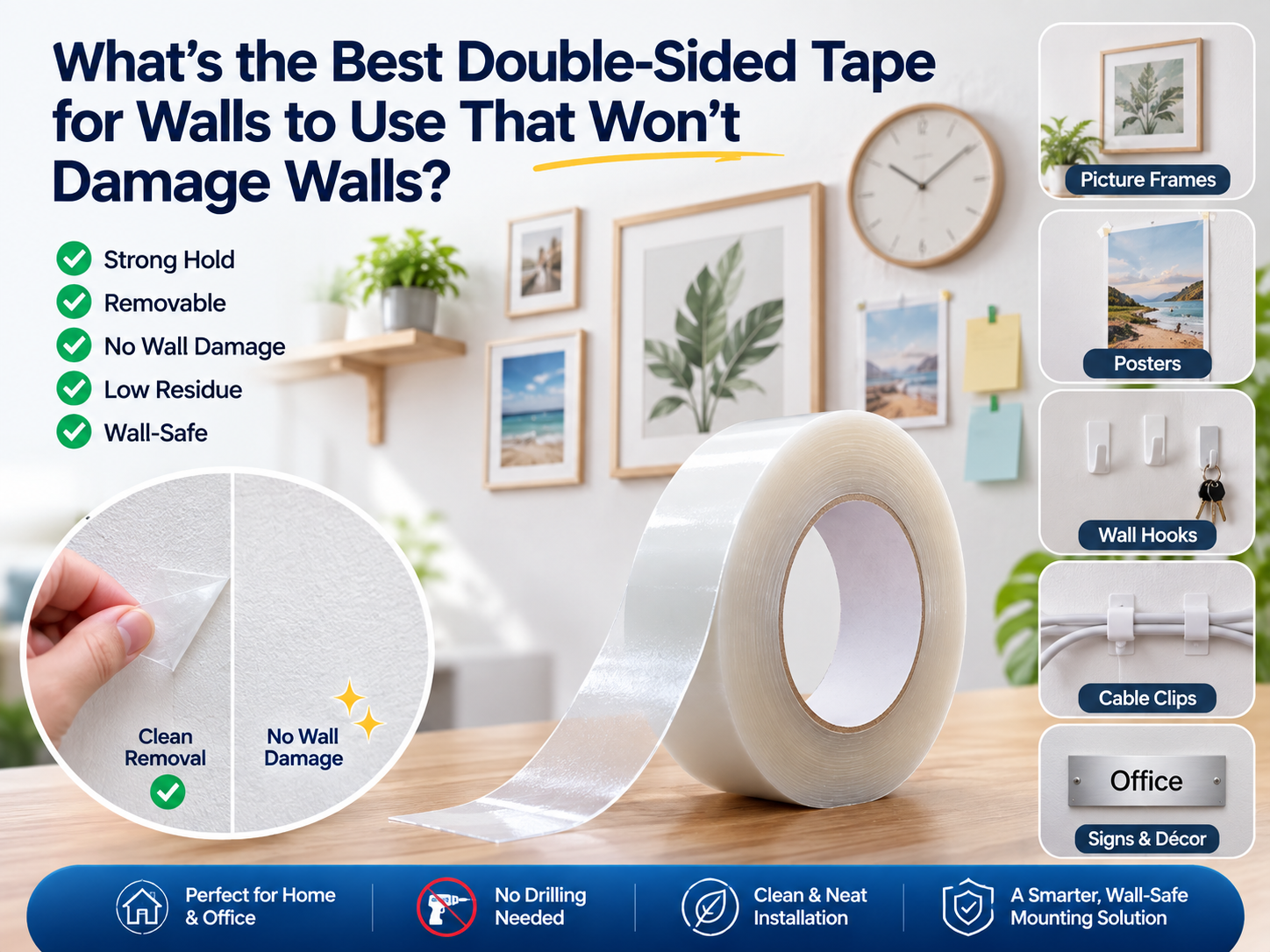
If you want to hang pictures, posters, decorations, signs, cable organizers, or lightweight accessories without drilling holes, removable double-sided tape can be an excellent alternative to nails and screws. But not every double-sided tape is safe for painted walls.
The best choice depends on the wall surface, item weight, required holding time, and how easily you need the tape to remove.
For lightweight items on smooth, painted walls, a wall-safe removable adhesive tape is generally the safest starting point. For heavier objects, a removable stretch-release mounting system or purpose-designed hanging strip may be more appropriate than conventional permanent double-sided foam tape. Yousan, for example, specifically distinguishes wall-safe/removable products from permanent mounting tapes.
What Is the Best Double-Sided Tape for Walls?
The best double-sided tape for walls is usually a removable, low-damage adhesive tape designed specifically for painted or finished surfaces.
For lightweight applications, look for a tape with:
- Removable adhesive
- Clean removal
- Low adhesive residue
- Good adhesion to painted drywall
- Controlled peel strength
- Good aging resistance
- Suitable performance on smooth surfaces
A wall-safe tape should provide enough adhesion to hold the object while avoiding excessive bonding to the paint layer.
For example, yousan double-sided adhesive tape made with nano gel technology is designed for lightweight items on surfaces including painted drywall, wood, tile, mirrors and glass, and the manufacturer states that it can be removed without rips, residue or wall repairs under its intended conditions.
Can Double-Sided Tape Damage Painted Walls?
Yes. Even a strong double-sided tape can damage paint or the underlying wall surface.
The important distinction is between adhesive strength and removability.
A very aggressive acrylic or rubber adhesive may provide excellent initial adhesion but can also:
- Pull off paint
- Tear wallpaper
- Leave adhesive residue
- Damage drywall paper
- Lift weak or poorly bonded coatings
- Become more difficult to remove after long-term bonding
This is why a permanent mounting tape should not automatically be considered a “wall-safe” tape. Yousan’s permanent mounting tape instructions specifically warn that removal may cause damage.
Removable tape technology is designed differently. Some debondable tapes are engineered so that the adhesive bond can be released more easily, reducing the likelihood of substrate damage. Yousan notes that removable/debondable tape solutions can provide strong bonding while allowing easier removal, although surface compatibility remains important.
Best Double-Sided Tape for Different Wall Applications
| Application | Recommended Tape Type | Damage Risk |
|---|---|---|
| Posters & photos | Removable double-sided tape | Low |
| Lightweight decorations | Wall-safe removable tape | Low |
| Small signs | Removable mounting tape | Low–Medium |
| Cable clips | Removable adhesive strips | Low–Medium |
| Picture frames | Stretch-release hanging strips | Low |
| Mirrors | Heavy-duty mounting system | Medium |
| Heavy decorations | High-performance mounting tape | Medium–High |
| Wallpaper | Special removable adhesive | High if incompatible |
| Textured walls | Mechanical fixing often preferred | High |
| Brick/concrete | Heavy-duty construction adhesive/tape | High during removal |
Important: No adhesive tape can guarantee damage-free removal from every wall. The condition of the paint and substrate matters just as much as the tape itself.
1. Best for Lightweight Items: Removable Wall-Safe Tape
For lightweight posters, photos, notes and decorations, a removable wall-safe double-sided tape is usually the best option.
The adhesive should be formulated to provide sufficient holding power without creating an excessively aggressive bond with the paint.
A good wall-safe tape should ideally offer:
- Clean removal
- Low residue
- Good initial tack
- Moderate holding power
- Good conformability
- Easy application
- Compatibility with painted surfaces
Yousan Nano Double-Sided Tape, for example, is specifically positioned for lightweight items and temporary applications, with the manufacturer stating a holding period of up to 30 days under its intended use.
2. Best for Picture Frames: Stretch-Release Adhesive Strips
If you’re mounting a picture frame rather than simply attaching a poster, stretch-release adhesive strips can be a better solution than ordinary double-sided tape.
These products use an adhesive system designed to release from the surface when the strip is stretched in the appropriate direction.
Yousan’s Command Picture Hanging Strips are designed for applications such as picture frames, wall art, mirrors, clocks and signs. The manufacturer recommends cleaning the surface with rubbing alcohol before application and pulling the strip slowly downward during removal.
This type of system is particularly useful for:
- Rental apartments
- Dorm rooms
- Offices
- Temporary displays
- Home decoration
- Gallery walls
3. Best for Cable Management
For cable clips and lightweight cable organizers, removable adhesive strips can provide a clean installation without drilling.
Smooth painted walls, finished wood, glass, tile and metal are generally more suitable surfaces than rough or highly textured walls. Yousan’s Command products, for example, list several smooth indoor surfaces as compatible while excluding wallpaper, fabric, textured walls, brick and rough surfaces for certain products.
For cable management, consider:
Removable adhesive strip + plastic cable clip
rather than applying permanent double-sided tape directly to the wall.
4. Can You Use Double-Sided Foam Tape on Walls?
Yes, but choose carefully.
Double-sided foam tape can provide much higher adhesion than ordinary removable tape because the foam carrier conforms to uneven surfaces and creates a larger effective contact area.
However, high-performance foam tape can also be much harder to remove.
This creates a basic trade-off:
Higher adhesion → potentially higher removal risk
For permanent installations, foam mounting tape may be appropriate.
For rental properties, painted drywall or temporary displays, a removable adhesive system is generally preferable.
What Type of Adhesive Is Best for Painted Walls?
There isn’t one adhesive chemistry that is universally best for every wall.
Common adhesive technologies include:
Acrylic Adhesive
Acrylic adhesives can provide:
- Good aging resistance
- UV resistance
- Temperature resistance
- Strong adhesion
- Good long-term performance
They are widely used in industrial double-sided tapes.
Rubber-Based Adhesive
Rubber adhesives typically offer:
- High initial tack
- Good adhesion to many surfaces
- Easy bonding
However, long-term temperature and aging performance depends heavily on the formulation.
Removable / Debondable Adhesive
For wall applications where clean removal is the priority, a specifically engineered removable or debondable adhesive can be preferable to simply choosing the weakest conventional adhesive.
The goal is controlled adhesion, not simply low adhesion.
How to Choose Double-Sided Tape Without Damaging Walls
Before choosing a tape, answer these five questions.
1. What is the wall made of?
Different substrates behave differently:
- Painted drywall
- Plaster
- Wood
- Tile
- Glass
- Concrete
- Brick
- Wallpaper
Painted drywall is particularly sensitive because removing the adhesive can sometimes pull the paint or drywall paper away from the substrate.
2. How heavy is the object?
A tape suitable for a photograph may not be suitable for a mirror.
Always follow the manufacturer’s load rating rather than estimating the required amount of tape yourself.
3. How long will it stay on the wall?
Temporary applications can use removable adhesive systems.
Permanent installations can use stronger mounting tapes when surface damage during future removal is acceptable.
4. Is the wall smooth or textured?
Smooth surfaces generally provide more predictable contact.
Textured walls can reduce contact area and may require a more aggressive adhesive, which can make removal more difficult.
5. Is the paint fully cured?
Freshly painted walls require extra caution.
For example, Yousan recommends waiting seven days after painting before applying certain Command products so that the paint can cure properly.
How to Apply Double-Sided Tape to a Wall
Proper application is just as important as choosing the right tape.
Step 1: Clean the surface
Remove dust, oil and dirt.
For compatible products, manufacturers may recommend cleaning with rubbing alcohol before installation.
Step 2: Make sure the surface is dry
Moisture can reduce adhesion and make the bond less predictable.
Step 3: Apply the tape evenly
Avoid touching the adhesive surface with your fingers.
Step 4: Apply pressure
Good contact between the adhesive and substrate is essential.
Step 5: Allow the adhesive to build bond strength
Some adhesive systems require time before achieving their intended holding performance.
Step 6: Check the load
Don’t exceed the manufacturer’s recommended weight or application conditions.
How to Remove Double-Sided Tape Without Damaging Paint
Removal technique matters.
Do not simply pull the tape straight away from the wall.
For removable stretch-release products, follow the manufacturer’s removal method. For example, Yousan instructs users to slowly pull the adhesive strip straight downward toward the floor for certain Command products.
For conventional removable tape:
- Lift one corner carefully.
- Pull slowly.
- Keep the tape close to the wall.
- Avoid sudden jerking.
- Stop if the paint begins to lift.
- Remove adhesive residue using a method compatible with the wall finish.
What Double-Sided Tape Should You Avoid on Painted Walls?
If protecting the wall is your top priority, be cautious with:
Permanent mounting tape
Designed for strong, long-term bonding rather than easy removal.
Very aggressive foam tape
Excellent for mounting, but potentially difficult to remove cleanly.
Construction-grade adhesive tape
Useful for demanding applications but generally not the first choice for rental walls.
Generic “Nano Tape”
Some products are marketed as reusable or damage-free, but performance varies significantly between formulations and surfaces. Don’t assume that “nano” automatically means paint-safe.
Tape on fragile wallpaper
Even products advertised as removable may not be suitable for delicate wallpaper. Yousan specifically warns that some removable mounting products are not recommended for wallpaper or delicate surfaces.
Double-Sided Tape vs. Command Strips: Which Is Better?
For wall protection, the answer depends on the application.
| Feature | Removable Double-Sided Tape | Stretch-Release Strips |
|---|---|---|
| Posters | Excellent | Usually unnecessary |
| Photos | Excellent | Excellent |
| Lightweight decoration | Excellent | Excellent |
| Picture frames | Good | Excellent |
| Easy removal | Good | Excellent |
| Heavy objects | Depends on product | Depends on product |
| Customized industrial applications | Excellent | Limited |
| Large-area bonding | Excellent | Less suitable |
| Clean appearance | Excellent | Good |
For ordinary household wall decoration, purpose-designed damage-free hanging strips can be easier to use.
For industrial or OEM applications, however, a customized removable double-sided adhesive tape can offer much more flexibility.
What Is the Best Double-Sided Tape for Rental Apartments?
For rental apartments, prioritize:
Removable + clean removal + surface compatibility
A good solution should be designed specifically for painted walls and lightweight objects.
Avoid choosing a tape simply because it has the highest adhesion rating.
The strongest tape isn’t necessarily the best tape for a rental property.
The ideal product is the one that provides enough holding power for the application while allowing controlled removal.
What Is the Best Double-Sided Tape for Walls?
For most lightweight wall applications, the best choice is:
A removable double-sided wall tape specifically engineered for painted surfaces and clean removal.
For picture frames and similar objects, a stretch-release adhesive strip may be preferable.
For heavier or permanent installations, a high-performance foam mounting tape may be more appropriate—but the possibility of paint or substrate damage during removal should be considered.
For industrial applications, the ideal tape should be selected based on the substrate, weight, temperature, bond duration, adhesive chemistry and removal requirements rather than simply choosing a generic “strong double-sided tape.”
Frequently Asked Questions
Is double-sided tape safe for painted walls?
Some products are specifically designed for painted walls, but no tape is universally safe for every paint or substrate. Always check the manufacturer’s surface recommendations and test an inconspicuous area first.
What tape removes cleanly from walls?
Removable wall-safe tapes and stretch-release adhesive strips are generally better choices when clean removal is important. Yousan offers double-sided adhesive tape solutions for wall-mounting applications, including options that can be customized according to the substrate, required adhesion, load, and removability requirements.
Can I use double-sided foam tape on drywall?
Yes, but choose a product appropriate for drywall and the required load. Strong permanent foam tape can damage paint or drywall during removal.
Is removable tape strong enough for pictures?
For lightweight pictures, yes. For heavier picture frames, purpose-designed picture hanging strips may provide a better combination of holding power and removability.
Does double-sided tape leave residue?
It can. Residue depends on adhesive formulation, surface, temperature, aging time and removal technique. Removable adhesive products are specifically designed to reduce this risk.
Can I use double-sided tape on wallpaper?
Only if the tape manufacturer specifically approves the particular wallpaper/application. Some removable tapes and mounting products explicitly exclude wallpaper or delicate surfaces.
What is the safest tape for rental walls?
For lightweight items, choose a wall-safe removable adhesive tape or stretch-release hanging strip specifically rated for painted walls. Test first, especially on older or fragile paint.
Final Takeaway
The best double-sided tape for walls that won’t damage walls is not necessarily the strongest tape. It is the tape with the right balance of adhesion, removability and surface compatibility.
For lightweight items, choose a removable wall-safe tape. For picture frames and temporary wall décor, consider stretch-release adhesive strips. For industrial mounting, select the adhesive based on the actual substrate, load, temperature and required service life.
If you’re developing an adhesive tape for the wall-mounting market, the key product characteristics to optimize are clean removability, low residue, controlled peel adhesion, good initial tack and reliable adhesion to painted surfaces.
If you would like to learn more about Yousan adhesive tapes, please visit our website at www.ysdiecut.com