
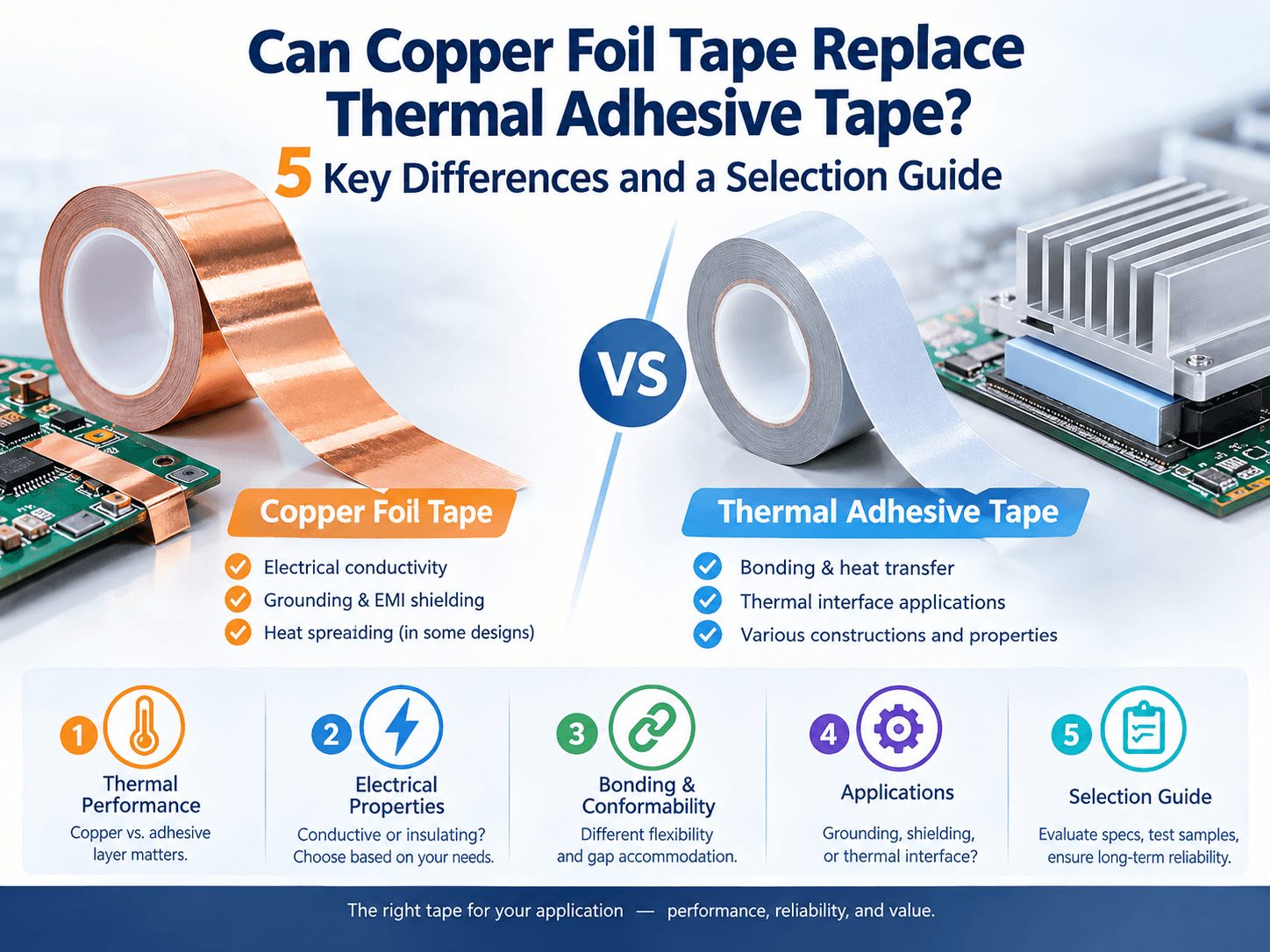
In consumer electronics, automotive electronics, LED lighting, and industrial equipment, adhesive tapes do more than bond and secure components. Depending on their design, they can also provide electrical conductivity, electromagnetic interference (EMI) shielding, heat spreading, or thermal interface bonding.
Copper foil tape and thermal adhesive tape are both used in electronic applications, leading engineers and purchasing professionals to ask an important question: Can copper foil tape replace thermal adhesive tape?
The answer is: In some applications, yes—but copper foil tape is not a universal replacement for thermal adhesive tape. Standard copper foil tape is commonly used for electrical grounding, conductive connections, and EMI shielding. Specialized thermally conductive copper foil tapes may also support heat spreading or the attachment of heat-dissipation components. Thermal adhesive tapes, meanwhile, are available in different constructions designed to combine bonding with heat transfer.
The right choice depends on the tape construction, adhesive properties, heat-transfer direction, electrical safety requirements, and operating environment. This guide explains five key differences between copper foil tape and thermal adhesive tape, their applications, and how to select the right material for your project.
1. What Is Copper Foil Tape?
Copper foil tape typically consists of a copper foil backing, a pressure-sensitive adhesive (PSA), and an optional release liner. Depending on the product design, the adhesive may be electrically conductive or non-conductive. Some products also feature double-sided adhesive construction.
Copper foil tape is commonly used for electrical grounding, electromagnetic interference (EMI) shielding, electrostatic discharge management, conductive connections, and selected thermal management applications.
Key Features of Copper Foil Tape
-
High thermal conductivity of copper: Copper has high intrinsic thermal conductivity, making it useful for spreading heat along the plane of the foil.
-
Electrical conductivity: The copper foil itself is conductive, while the adhesive’s electrical properties depend on its formulation and construction.
-
Grounding and EMI shielding: Suitable copper foil tapes can support grounding and shielding designs when installed with an appropriate electrical connection.
-
Flexibility and convertibility: Depending on the product, copper foil tape can be slit, die-cut, or converted into custom shapes.
-
Multiple constructions: Single-sided, double-sided, conductive-adhesive, and non-conductive-adhesive options are available.
An important distinction is that high thermal conductivity of the copper foil does not automatically mean high thermal performance of the complete tape assembly. The adhesive layer, tape thickness, contact area, and interface conditions can all affect heat transfer.
Specialized thermally conductive copper foil tapes are also available. For example, certain double-sided copper foil tapes are designed to provide electrical and thermal conductivity and may be used to attach heat sinks or heat-dissipation materials. Always check the technical data sheet (TDS) for the exact product before making a selection.
2. What Is Thermal Adhesive Tape?
Thermal adhesive tape is a category of adhesive materials designed to support heat transfer while providing bonding or component attachment. Common constructions include thermally conductive adhesive transfer tapes, tapes with a backing material, and other thermally conductive composite structures.
These tapes are often used between heat-generating components and heat sinks, metal housings, or other heat-dissipation components. Their purpose is to provide an adhesive interface that helps transfer heat under the intended operating and assembly conditions.
Key Features of Thermal Adhesive Tape
-
Designed for thermal management: Many products are developed for specific heat-transfer applications.
-
Combines bonding and heat transfer: Suitable products can provide both attachment and thermal interface functions.
-
Multiple constructions: Products vary in thickness, adhesive composition, thermal performance, and flexibility.
-
Different electrical properties: Some products offer electrical insulation, while others have different electrical characteristics.
-
Broad electronic applications: Common applications include LED modules, power electronics, electronic components, and selected automotive electronic assemblies.
Not every thermal adhesive tape is suitable for high-power thermal management, and not every product is electrically insulating. Always verify the performance data and intended use of the specific product.
3. Copper Foil Tape vs. Thermal Adhesive Tape: 5 Key Differences
Difference 1: Primary Function
Standard copper foil tape is generally used for electrical conductivity, grounding, EMI shielding, and electrostatic management. Specialized thermally conductive copper foil tapes may also support heat spreading or the attachment of heat-dissipation components.
Thermal adhesive tape is primarily used where an adhesive interface is required to help transfer heat between components.
Selection tip: If the main requirement is electrical grounding or shielding, evaluate copper foil tape designed for that purpose. If the application requires bonding a heat-generating component to a heat sink, consider a thermal adhesive tape or a specialized copper foil tape that has been validated for the intended thermal interface.
Difference 2: Overall Thermal Performance
Copper has high intrinsic thermal conductivity, but the thermal performance of a complete tape assembly depends on more than the copper foil alone.
If heat must pass through the adhesive layer before reaching the copper foil or an adjacent component, the adhesive’s thermal properties, layer thickness, contact area, and interface gaps can all affect the result.
Thermal adhesive tapes are generally designed with thermal interface applications in mind, but their performance varies considerably by product. Comparisons should use relevant test data and account for the actual assembly conditions.
Selection tip: Do not choose a tape based only on the thermal conductivity of copper. Evaluate the complete material construction and, where thermal performance is critical, validate the design through thermal resistance or temperature-rise testing.
Difference 3: Electrical Properties
Copper foil itself is electrically conductive. When using copper foil tape, it is therefore important to determine whether the tape could create an unintended electrical path. The adhesive may be conductive or non-conductive, depending on the product.
Thermal adhesive tapes also vary in electrical properties. Some are designed for thermal transfer with electrical insulation, while others have different electrical characteristics.
Selection tip: For PCBs, battery assemblies, exposed electrodes, and other electronic components, clearly define whether the application requires conductivity, grounding, or electrical insulation. Verify the relevant electrical performance data before selecting a replacement. Do not substitute copper foil tape for an insulating material without validation.
Difference 4: Bonding, Conformability, and Gap Accommodation
The conformability of copper foil tape depends on foil thickness, flexibility, adhesive type, and the condition of the bonding surface. Some products work well on flat surfaces or specific curved surfaces but may not be suitable for thermal interfaces with significant gaps.
Certain thermal adhesive tapes have flexible or compliant adhesive layers that can accommodate minor surface irregularities. However, their gap-accommodation capability depends on the product’s thickness, construction, and compression characteristics.
Selection tip: If a gap exists between a heat-generating component and a heat sink, first confirm the gap size and assembly tolerances. Then evaluate thermal adhesive tape, thermal interface pads, or other suitable materials. Standard copper foil tape should not automatically be treated as a gap-filling material.
Difference 5: Applications and Validation Requirements
Copper foil tape is commonly used for grounding, EMI shielding, conductive connections, and selected heat-spreading structures. Thermal adhesive tape is commonly used where bonding and heat transfer are both required at an interface.
Although the two categories may overlap in certain applications, interchangeability must be assessed for the specific product and assembly.
Selection tip: Before replacing an existing tape, evaluate thermal performance, adhesion, and electrical safety requirements. For applications involving elevated temperatures, thermal cycling, vibration, or other demanding conditions, consider long-term reliability and environmental testing.
4. Comparison Table: Copper Foil Tape vs. Thermal Adhesive Tape
| Comparison | Copper Foil Tape | Thermal Adhesive Tape |
|---|---|---|
| Common purpose | Conductivity, grounding, EMI shielding, and selected thermal applications | Bonding and supporting heat transfer |
| Typical construction | Copper foil with adhesive and optional release liner | Thermally conductive adhesive layer or composite construction |
| Intrinsic thermal properties | Copper foil has high intrinsic thermal conductivity | Depends on the specific material and construction |
| Overall heat-transfer performance | Depends on foil, adhesive, and interface conditions | Depends on thermal design, thickness, and interface conditions |
| Adhesive conductivity | May be conductive or non-conductive | Depends on the product |
| Electrical insulation | Copper foil itself is not electrically insulating | Some products offer electrical insulation; verification is required |
| Gap accommodation | Depends on foil and adhesive construction | Some products are suitable for specific thermal interface gaps |
| Key selection criteria | Foil thickness, adhesive properties, bonding, and shielding performance | Thermal performance, thickness, adhesion, electrical properties, and temperature requirements |
Note: This table summarizes common characteristics rather than ranking every product. Actual performance must be confirmed using the manufacturer’s technical data sheet and relevant test results.
5. When Can Copper Foil Tape Replace Thermal Adhesive Tape?
Copper foil tape may be a candidate in the following situations, provided that the selected product meets the application’s requirements.
1. The Primary Requirement Is Conductivity or Grounding
If the main purpose is to establish an electrical connection or grounding path, and the design also benefits from some heat spreading, a suitable copper foil tape may be worth evaluating.
Confirm the adhesive’s electrical properties, contact resistance, operating temperature, and long-term bonding stability.
2. A Specialized Thermally Conductive Copper Foil Tape Is Used
Some copper foil tapes are specifically designed with thermal and electrical performance in mind, including heat transfer through the tape thickness or along its surface. Certain products may also be used to attach heat sinks or heat-dissipation materials.
These products may be relevant candidates for thermal management applications, but they should not be assumed to work in every thermal interface.
3. Testing Confirms That the Tape Meets the Design Requirements
If a copper foil tape meets the required thermal, bonding, and electrical performance criteria in the target assembly, it may be considered as a replacement based on engineering validation.
Depending on the application, testing may include:
-
Temperature difference between the heat source and heat-dissipation component
-
Contact integrity and effective bonding area
-
Adhesion stability at the operating temperature
-
Electrical connection, short-circuit, or insulation risks
-
Performance after thermal cycling and other relevant environmental tests
6. When Should Copper Foil Tape Not Be Used as a Direct Replacement?
1. Reliable Electrical Insulation Is Required
Copper foil is electrically conductive. If the tape is close to exposed circuitry, electrodes, or energized components, it may introduce a short-circuit risk.
In such cases, evaluate a thermal material that meets the required electrical insulation specifications and verify the relevant test data.
2. The Application Requires Filling a Significant Gap
Standard copper foil tape generally cannot replace a material specifically designed to fill a substantial gap between a heat-generating component and a heat sink.
Depending on the gap size, assembly pressure, and thermal requirements, consider thermal interface pads, thermally conductive adhesives, or other purpose-designed materials.
3. The Application Has Strict Thermal Management Requirements
High-power LEDs, power modules, automotive electronics, and other temperature-sensitive applications may require carefully controlled thermal performance.
Do not replace an existing thermal adhesive tape based solely on the product name or the intrinsic thermal conductivity of copper. Evaluate the complete thermal interface, operating temperature, bonding stability, and long-term reliability.
4. The Operating Environment Is Demanding
High temperatures, humidity, vibration, and repeated thermal cycling can affect adhesive performance and material interfaces. Replacement materials should be validated under relevant operating conditions rather than selected based only on initial bonding performance.
7. Applications of Copper Foil Tape and Thermal Adhesive Tape
Consumer Electronics
In smartphones, tablets, laptops, and other compact devices, copper foil tape may be used for grounding and EMI shielding. Thermal adhesive tape may be used for bonding thermal management components where the product meets the required specifications.
The choice depends on available space, electrical design, and thermal management requirements.
Automotive Electronics
Automotive electronic assemblies may be exposed to temperature changes, vibration, humidity, and long service-life requirements. Copper foil tape can support certain grounding or shielding designs, while thermal adhesive tape may be suitable for validated thermal management applications.
Material selection should reflect the actual operating environment and reliability requirements.
LED Lighting and Power Supplies
LED modules and power supplies often require heat to move from heat-generating components to heat-dissipation structures. For these applications, evaluate the performance of the complete thermal interface rather than comparing only the intrinsic thermal properties of individual materials.
PCBs and Electronic Assemblies
Copper foil tape may be used for grounding, shielding, or specific conductive structures. Thermal adhesive tape may be used where bonding and heat transfer are required. Particular attention should be paid to electrical safety, insulation requirements, and assembly gaps.
8. How to Choose the Right Tape
Step 1: Define the Primary Function
Determine whether the main requirement is electrical conductivity, grounding, EMI shielding, heat spreading, or bonding at a thermal interface.
If several functions are required, prioritize them and verify whether the selected material can satisfy all relevant requirements.
Step 2: Review the Technical Specifications
For copper foil tape, check:
-
Copper foil thickness and material construction
-
Adhesive type and electrical conductivity
-
Adhesion performance and substrate compatibility
-
Operating temperature range
-
Shielding and grounding requirements, where applicable
-
Thermal performance data and test conditions, where applicable
For thermal adhesive tape, check:
-
Thermal performance and test method
-
Total thickness and layer construction
-
Electrical insulation or conductivity
-
Adhesion strength and substrate compatibility
-
Continuous operating temperature and short-term temperature limits
-
Requirements for gap size, assembly pressure, and surface preparation
Step 3: Evaluate the Actual Assembly
Review the arrangement of the heat source, tape, and heat-dissipation component. Consider the effective contact area, surface flatness, and assembly tolerances.
If heat must pass through the adhesive layer, the adhesive and interface may be important factors affecting the overall thermal performance.
Step 4: Conduct Sample Testing
Before placing a bulk order, test the material using the actual substrates and assembly configuration. Depending on the application, evaluate temperature rise, bonding stability, electrical performance, and behavior after thermal cycling or other environmental exposure.
For applications with strict safety or reliability requirements, follow the appropriate engineering validation process.
Step 5: Consider Cost and Supply Capability
In addition to unit price, evaluate material utilization, converting waste, die-cutting precision, lead time, quality consistency, and batch stability.
For custom tape projects, providing a drawing, existing material reference, or sample can help the supplier assess compatibility and converting feasibility.
9. Yousan Adhesive Materials and Custom Converting Services
Yousan specializes in industrial adhesive tapes, film products, medical materials, and precision die-cutting. Depending on project requirements, Yousan can help evaluate suitable tape materials and converting options.
For copper foil tape, thermal adhesive tape, and other adhesive materials used in electronic applications, project evaluation may consider:
-
Application requirements and intended functions
-
Tape construction, thickness, and dimensions
-
Conductivity, insulation, or thermal management needs
-
Bonding substrates and assembly conditions
-
Sample testing, die-cutting, and custom converting requirements
For a material replacement assessment, customers are encouraged to provide the application details, drawings, existing material reference, or technical data sheet. This information helps determine whether a proposed material is suitable for further evaluation.
Specific thermal performance, electrical conductivity, insulation properties, temperature limits, and certifications must be confirmed using the technical data sheet and test results for the relevant product.
10. Frequently Asked Questions (FAQ)
1. Can copper foil tape replace thermal adhesive tape?
In some applications, yes, but it is not a universal replacement. Standard copper foil tape is generally used for conductivity, grounding, or shielding. Specialized thermally conductive copper foil tape may be suitable for certain thermal management structures. Suitability depends on thermal performance, electrical safety, and assembly requirements.
2. Does copper foil tape always offer better thermal performance than thermal adhesive tape?
No. Copper has high intrinsic thermal conductivity, but the heat-transfer performance of a complete tape assembly also depends on the adhesive, thickness, contact area, and interface conditions. Compare product-specific data obtained using relevant test methods.
3. Can copper foil tape be used for heat dissipation in electronic devices?
It can support heat spreading or heat transfer in certain structures. The selected product must be suitable for the application, and its thermal and electrical properties should be verified. Actual testing is recommended for critical thermal interfaces.
4. Is the adhesive on copper foil tape always electrically conductive?
No. The copper foil is conductive, but the adhesive may be conductive or non-conductive. If a reliable conductive path between the substrate and copper foil is required, confirm that the product uses conductive adhesive and review the relevant electrical data.
5. Is all thermal adhesive tape electrically insulating?
No. Electrical properties depend on the product’s materials and construction. If electrical insulation is required, verify relevant specifications such as insulation resistance and dielectric strength.
6. What are the most important parameters when selecting thermal adhesive tape?
Key factors typically include thermal performance, thickness, interface thermal resistance, adhesion, operating temperature, electrical properties, and substrate compatibility. The relative importance of each factor depends on the application and design requirements.
7. How can I find a suitable tape for my project?
Provide the application, bonding substrates, required functions, dimensions, operating temperature, assembly configuration, and estimated demand. If available, include the reference product number, drawing, sample, or technical data sheet to support a more accurate material assessment.
Conclusion: Evaluate the Complete Tape Structure, Not Just the Copper
Copper foil tape and thermal adhesive tape may serve different purposes even when they are used in similar electronic assemblies. Standard copper foil tape is commonly used for conductivity, grounding, and EMI shielding, while thermal adhesive tape is often selected for bonding and heat transfer at thermal interfaces. Specialized thermally conductive copper foil tapes may also be suitable for certain thermal management applications.
Whether copper foil tape can replace thermal adhesive tape depends on the performance of the specific product in the intended application—not simply on the material name or the thermal conductivity of copper. Before making a substitution, review thermal performance, adhesive properties, electrical safety, bonding requirements, and operating conditions, then validate the solution through appropriate testing.
If you are looking for copper foil tape, thermal adhesive tape, or custom die-cut adhesive materials for electronics, automotive components, LED modules, or industrial products, contact Yousan with your application requirements and technical documentation to discuss suitable material options.
If you would like to learn more about Yousan adhesive tapes, please visit our website at www.ysdiecut.com