
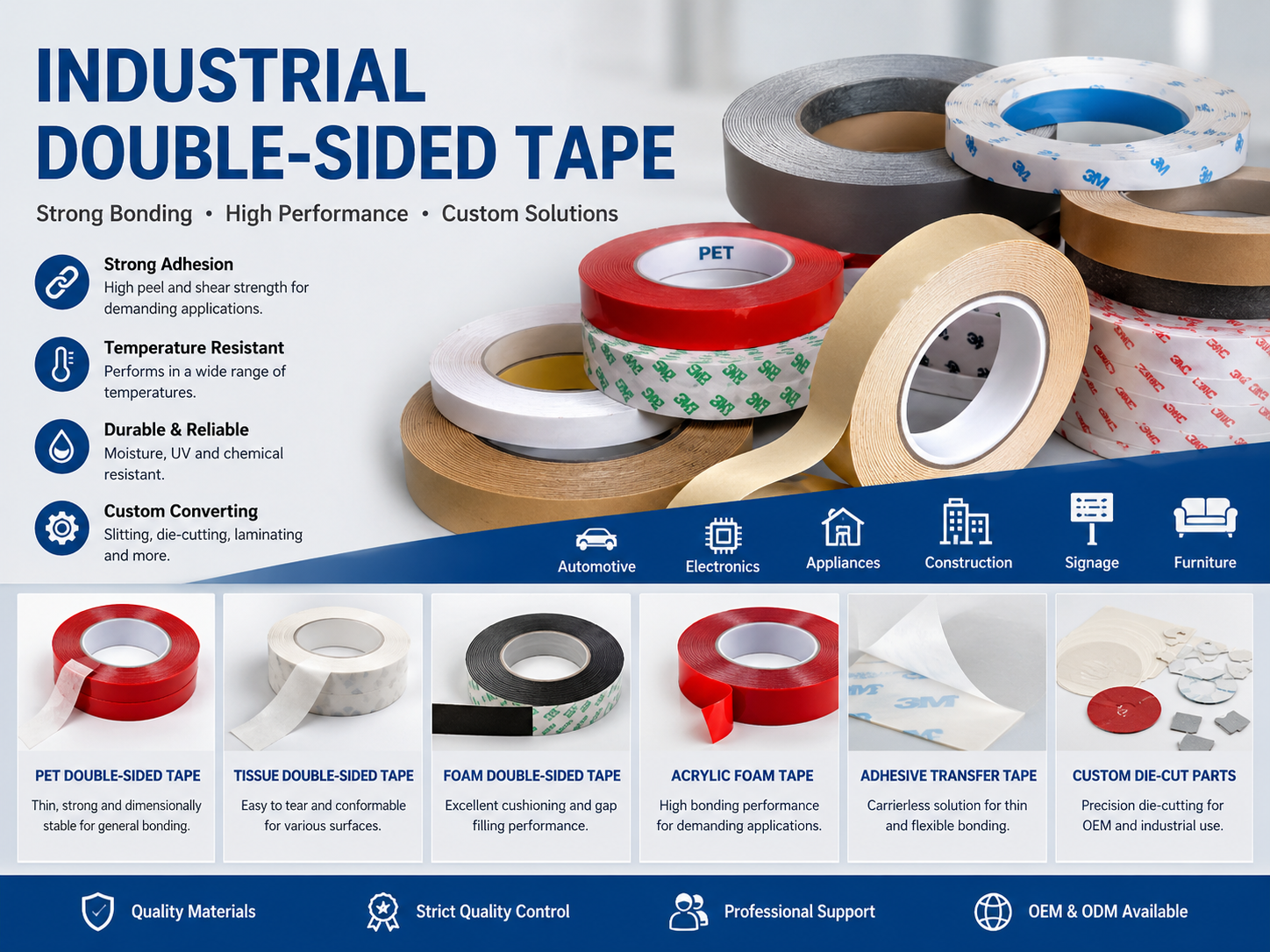
Industrial double-sided tape is a pressure-sensitive adhesive solution designed for permanent or semi-permanent bonding, mounting, laminating and assembly applications. Compared with mechanical fasteners such as screws, rivets and clips, industrial double-sided tape can provide a clean, low-profile bond while helping manufacturers simplify assembly processes.
For OEMs, distributors and industrial buyers, choosing the right double-sided tape requires more than simply selecting a tape thickness. Adhesive chemistry, carrier type, substrate, surface energy, temperature, load, environmental exposure and converting requirements all affect final performance.
This guide explains the major types of industrial double-sided tape, their applications, how to select the right construction, and what manufacturers should consider when sourcing industrial adhesive tape.
What Is Industrial Double-Sided Tape?
Industrial double-sided tape is a tape product coated with adhesive on both sides of a carrier or support layer, or, in the case of adhesive transfer tape, without a traditional carrier.
A typical double-sided tape consists of:
Release Liner → Adhesive → Carrier → Adhesive → Release Liner
The carrier provides dimensional stability and mechanical support, while the adhesive creates the bond between the tape and substrate.
Common carrier materials include:
- PET film
- Tissue
- Nonwoven
- PE foam
- EVA foam
- Acrylic foam
- Fabric
- Polyimide film
- PVC
- Transfer adhesive without a carrier
The correct construction depends heavily on the application.
Types of Industrial Double-Sided Tape
1. PET Double-Sided Tape
PET double-sided tape uses a polyester film carrier coated with adhesive on both sides.
Key advantages
- Excellent dimensional stability
- Thin and uniform construction
- Good tensile strength
- Suitable for precision converting
- Available in different adhesive systems
- Suitable for die-cutting
Typical applications
- Electronics assembly
- Nameplates
- Labels
- Plastic component bonding
- Automotive components
- Appliance assembly
- General industrial bonding
PET double-sided tape is a good choice when thin construction and dimensional stability are important.
2. Tissue Double-Sided Tape
Tissue double-sided tape uses a paper-like tissue carrier between two adhesive layers.
It offers good conformability and is commonly used for:
- Paper bonding
- Packaging
- Printing
- Foam lamination
- Textile bonding
- General mounting
- Consumer products
Compared with PET tape, tissue tape is generally more conformable and easier to tear or process manually.
3. Nonwoven Double-Sided Tape
Nonwoven double-sided tape provides a balance between flexibility, conformability and dimensional stability.
It is commonly used for:
- Foam lamination
- Textile bonding
- Furniture
- Automotive interiors
- Appliance components
- General industrial assembly
The nonwoven carrier can help the tape conform to moderately uneven surfaces.
4. Foam Double-Sided Tape
Foam tape contains a foam carrier between two adhesive layers.
Common foam materials include:
- PE foam
- EVA foam
- PU foam
- PVC foam
- Acrylic foam
- Silicone foam
Foam tape is especially useful when the application requires:
- Gap filling
- Cushioning
- Vibration absorption
- Surface conformability
- Stress distribution
- Bonding to uneven surfaces
Typical applications
- Automotive trim
- Sign mounting
- Mirrors
- Appliances
- Construction
- Electronics
- Solar components
- Industrial equipment
5. Acrylic Foam Tape
Acrylic foam tape is designed for demanding bonding applications where high performance and long-term durability are required.
Its viscoelastic structure can help absorb stress caused by:
- Thermal expansion
- Vibration
- Component movement
- Substrate mismatch
It is widely used for automotive exterior trim, architectural applications, signs, displays and industrial mounting.
6. Adhesive Transfer Tape
Adhesive transfer tape is different from conventional double-sided tape because it has no carrier.
The structure is essentially:
Release Liner → Adhesive → Release Liner
Advantages include:
- Very thin adhesive interface
- Excellent flexibility
- Good conformability
- Suitable for laminating
- Excellent for precision die-cutting
- Suitable for bonding flexible materials
3M™ Adhesive Transfer Tapes are common examples of this product category.
Industrial Double-Sided Tape vs. Adhesive Transfer Tape
| Feature | Double-Sided Tape | Adhesive Transfer Tape |
|---|---|---|
| Carrier | Usually present | No carrier |
| Dimensional stability | Higher | Lower |
| Flexibility | Depends on carrier | Very high |
| Conformability | Depends on construction | Excellent |
| Lamination | Excellent | Excellent |
| Die-cutting | Excellent | Excellent |
| Thin bonding | Available | Particularly suitable |
| Heavy-duty mounting | Foam/acrylic versions | Depends on adhesive |
The choice depends on whether the application needs mechanical support from a carrier or maximum adhesive flexibility.
How to Choose Industrial Double-Sided Tape
Selecting an industrial double-sided tape should begin with the application rather than the tape brand.
1. Identify the Substrate
First determine what materials need to be bonded.
Examples include:
- Metal
- Aluminum
- Stainless steel
- ABS
- PC
- PP
- PE
- PVC
- Glass
- Rubber
- Foam
- Fabric
- Wood
- Painted surfaces
High-surface-energy materials such as metals and glass are generally easier to bond than low-surface-energy plastics such as PP and PE.
2. Consider Surface Energy
Surface energy is one of the most important factors affecting adhesive performance.
High-Surface-Energy Materials
Examples:
- Stainless steel
- Aluminum
- Glass
- Acrylic
- ABS
- PC
These generally provide good adhesive wet-out.
Low-Surface-Energy Materials
Examples:
- Polypropylene
- Polyethylene
- TPO
- Certain silicone-containing materials
These may require a specially formulated adhesive or surface treatment.
3. Determine the Required Tape Thickness
Tape thickness affects both performance and assembly.
Thin Tape
Typical applications:
- Electronics
- Labels
- Nameplates
- Films
- Thin plastic components
Medium-Thickness Tape
Typical applications:
- General industrial assembly
- Foam lamination
- Plastic bonding
- Automotive interiors
Thick Foam Tape
Typical applications:
- Mounting
- Gap filling
- Vibration absorption
- Rough surfaces
- Uneven components
A thicker tape is not automatically stronger. Adhesive chemistry and substrate compatibility are equally important.
4. Consider Temperature
Industrial applications can expose adhesive tape to:
- High temperatures
- Low temperatures
- Thermal cycling
- Short-term temperature peaks
For example, automotive engine compartments and electronics may require high-temperature adhesive systems.
For demanding applications, evaluate:
- Continuous operating temperature
- Short-term temperature resistance
- Heat aging
- Thermal cycling
5. Consider Environmental Exposure
Industrial tape may need to withstand:
- Humidity
- Water
- UV radiation
- Chemicals
- Solvents
- Oils
- Outdoor exposure
- Vibration
For outdoor applications, acrylic adhesive systems are often considered because of their long-term environmental resistance.
6. Determine the Required Bond Strength
Different applications require different adhesive performance.
Important properties include:
- Peel adhesion
- Shear strength
- Tensile strength
- Tack
- Holding power
- Static shear
- Dynamic shear
For a vertical mounting application, shear performance may be particularly important.
For flexible substrates, peel adhesion and conformability may be more important.
Industrial Double-Sided Tape Applications
Automotive
Industrial double-sided tape is widely used in automotive manufacturing.
Applications include:
- Emblems
- Nameplates
- Moldings
- Interior trim
- Door components
- Instrument panels
- Wire harness attachment
- Acoustic components
- Foam gasket attachment
- LED components
Automotive tape must often withstand vibration, temperature cycling, humidity and chemicals.
Electronics
Electronics manufacturers use double-sided tape for:
- Display bonding
- Battery components
- Flexible circuits
- Camera modules
- Speakers
- Sensors
- EMI shielding
- Foam gasket attachment
- Component mounting
Thin PET tape and adhesive transfer tape are particularly useful where available assembly space is limited.
Appliances
Applications include:
- Control panels
- Decorative panels
- Nameplates
- Insulation materials
- Foam components
- Plastic parts
- Glass components
The tape can help reduce the need for screws and mechanical clips.
Construction
Heavy-duty double-sided tape can be used for:
- Sign mounting
- Decorative panels
- Trim attachment
- Architectural components
- Mirrors
- Profiles
For construction applications, temperature, moisture, substrate condition and long-term load must be evaluated carefully.
Signage and Graphics
Double-sided tape is widely used for:
- Signs
- Letters
- Displays
- Graphics
- Nameplates
- POP displays
- Decorative films
Foam and acrylic tapes can be useful when the mounting surface is uneven.
Furniture
Typical applications include:
- Edge trim
- Decorative components
- Foam attachment
- Furniture profiles
- Panel assembly
Industrial Double-Sided Tape for Die-Cutting
One major advantage of industrial double-sided tape is its suitability for precision die-cutting.
A tape converter can manufacture:
- Circles
- Rings
- Squares
- Custom shapes
- Gaskets
- Tabs
- Foam pads
- Protective liners
Custom die-cut adhesive components can improve assembly efficiency by allowing operators to simply peel and apply the finished part.
Common converting processes
- Slitting
- Rewinding
- Laminating
- Sheet cutting
- Kiss cutting
- Rotary die-cutting
- Flatbed die-cutting
For high-volume OEM production, die-cut tape can significantly simplify component assembly.
Industrial Double-Sided Tape for OEM Manufacturing
OEM customers often require more than standard tape rolls.
A supplier may need to provide:
- Custom width
- Custom length
- Jumbo rolls
- Sheets
- Die-cut parts
- Laminated constructions
- Custom packaging
- Private labeling
- Material certificates
- TDS
- SDS
- RoHS
- REACH
- UL-related documentation where applicable
For automotive and electronics projects, customers may also require PPAP, IMDS, automotive OEM specifications or other project-specific documentation.
Common Industrial Double-Sided Tape Problems
Tape Does Not Stick
Possible causes include:
- Dirty substrate
- Oil or grease contamination
- Low surface energy
- Insufficient pressure
- Incorrect adhesive selection
- Application temperature too low
Solution
Clean the substrate, increase application pressure and verify that the adhesive is compatible with the substrate.
Tape Lifts at the Edge
Possible causes:
- Insufficient pressure
- Small bonding area
- Curved substrate
- Excessive peel force
- Incorrect tape thickness
A more conformable tape or wider bonding area may help.
Tape Fails at High Temperature
Possible causes:
- Adhesive chemistry not suitable for the temperature
- Excessive load
- Long exposure time
- Thermal cycling
Select an adhesive specifically designed for the required temperature range.
Tape Does Not Bond to PP or PE
PP and PE are low-surface-energy materials and can be difficult to bond.
Potential solutions include:
- Use an LSE adhesive
- Surface treatment
- Plasma treatment
- Corona treatment
- Primer where appropriate
Industrial Double-Sided Tape: Key Specifications to Compare
When comparing products from different suppliers, look beyond thickness and price.
| Specification | Why It Matters |
|---|---|
| Adhesive type | Determines bonding performance |
| Carrier | Controls strength and conformability |
| Thickness | Affects gap filling and bond line |
| Peel adhesion | Measures resistance to peeling |
| Shear strength | Important for vertical loads |
| Tack | Determines initial bonding |
| Temperature resistance | Critical for high-temperature applications |
| UV resistance | Important for outdoor use |
| Chemical resistance | Important for industrial environments |
| Liner | Affects converting and application |
| Color | Important for appearance |
| Die-cutting capability | Important for OEM production |
| Certifications | Required for regulated industries |
How to Select Between PET, Tissue, Foam and Transfer Tape
A simple selection strategy is:
Choose PET Double-Sided Tape When:
- You need dimensional stability
- The application requires a thin carrier
- Precision die-cutting is important
- The substrates are relatively smooth
Choose Tissue Tape When:
- High conformability is needed
- Paper or fabric needs to be laminated
- Manual application is common
Choose Foam Tape When:
- Gap filling is required
- The surface is irregular
- Vibration absorption is important
- Mounting is the primary application
Choose Adhesive Transfer Tape When:
- A carrierless construction is preferred
- Maximum flexibility is needed
- Thin adhesive bonding is required
- Laminating or precision die-cutting is required
Industrial Double-Sided Tape Supplier: What Should Buyers Look For?
A reliable industrial tape supplier should provide more than a catalog of products.
Look for a supplier that can offer:
Technical Support
A capable supplier should help select adhesive and construction based on:
- Substrate
- Temperature
- Load
- Environment
- Application method
- Required service life
Custom Converting
For OEM applications, look for capabilities including:
- Slitting
- Laminating
- Die-cutting
- Rewinding
- Sheet cutting
- Custom packaging
Quality Documentation
Depending on the application, buyers may require:
- Technical Data Sheets
- Safety Data Sheets
- RoHS
- REACH
- UL documentation
- ISO certifications
- Material declarations
Sample Testing
Before placing a large order, request samples and test the tape under actual production conditions.
Industrial Double-Sided Tape FAQ
What is the strongest industrial double-sided tape?
There is no single strongest tape for every application. Heavy-duty acrylic foam tapes can provide excellent bonding for many mounting applications, while specialized transfer or PET tapes may perform better for thin, high-temperature or precision applications.
What tape is best for metal?
Many industrial acrylic and rubber-based adhesives can bond metals effectively. The best choice depends on the metal surface, temperature, load and environmental conditions.
What industrial tape sticks to plastic?
PET, tissue, foam and transfer tapes can all bond plastics, but the adhesive must be selected according to the plastic type. PP and PE generally require specialized LSE adhesive technology.
Can double-sided tape replace screws?
In some applications, yes. However, the tape must be properly selected and tested for load, temperature, vibration and environmental exposure.
Is industrial double-sided tape waterproof?
Some industrial tapes offer good water and humidity resistance, but not every double-sided tape is waterproof. Outdoor or water-exposed applications should use a tape specifically qualified for those conditions.
Can industrial double-sided tape be used outdoors?
Yes, certain acrylic and foam tape constructions are designed for outdoor applications. UV exposure, temperature cycling, moisture and substrate expansion should be considered during product selection.
Can industrial double-sided tape be die-cut?
Yes. Many industrial double-sided tapes can be converted into custom die-cut shapes for OEM assembly.
What is the difference between double-sided tape and transfer tape?
Double-sided tape normally has a carrier between the adhesive layers. Transfer tape has adhesive without a traditional carrier, providing greater flexibility and conformability.
Why Choose Yousan New Materials for Industrial Double-Sided Tape?
Yousan New Materials provides industrial adhesive tapes, double-sided tapes, foam tapes, adhesive transfer tapes and custom die-cut adhesive solutions for OEM and industrial customers.
Our product portfolio can cover different carrier technologies and adhesive systems for applications across:
- Automotive
- Electronics
- Appliances
- Construction
- Packaging
- Medical
- Industrial manufacturing
- Consumer products
For customers who need more than standard tape rolls, we can also support custom slitting, laminating and precision die-cutting.
The right industrial double-sided tape should be selected according to the actual application—not simply based on thickness or price.
Industrial Double-Sided Tape Selection Checklist
Before requesting a quotation, prepare the following information:
1. Substrate:
What materials need to be bonded?
2. Tape Width:
What width is required?
3. Tape Thickness:
What thickness is preferred?
4. Application:
Mounting, bonding, lamination, sealing or die-cutting?
5. Temperature:
What is the continuous and peak operating temperature?
6. Environment:
Indoor, outdoor, humidity, UV, chemicals or vibration?
7. Load:
Peel, shear, tensile or dynamic load?
8. Quantity:
Monthly, annual or project quantity?
9. Converting:
Roll, sheet, jumbo roll or die-cut parts?
10. Certifications:
RoHS, REACH, UL, automotive or other requirements?
Providing these details allows an industrial tape supplier to recommend a more appropriate construction and reduce the risk of selecting the wrong adhesive.
Conclusion
Industrial double-sided tape has become an important bonding technology across automotive, electronics, appliances, construction, signage and general manufacturing. The right tape can provide strong adhesion while reducing assembly complexity and enabling clean, low-profile product designs.
However, there is no universal industrial double-sided tape. PET, tissue, nonwoven, foam, acrylic foam and adhesive transfer tapes each offer different performance characteristics.
For OEM and industrial applications, the most reliable selection process is to evaluate the substrate, adhesive chemistry, carrier, thickness, temperature, environmental exposure, load and converting requirements together.
If you are sourcing industrial double-sided tape, providing these application details to industrial double-sided tape supplier will make it much easier to identify the right product and obtain accurate samples, technical data and quotations.
If you would like to learn more about Yousan adhesive tapes, please visit our website at www.ysdiecut.com