
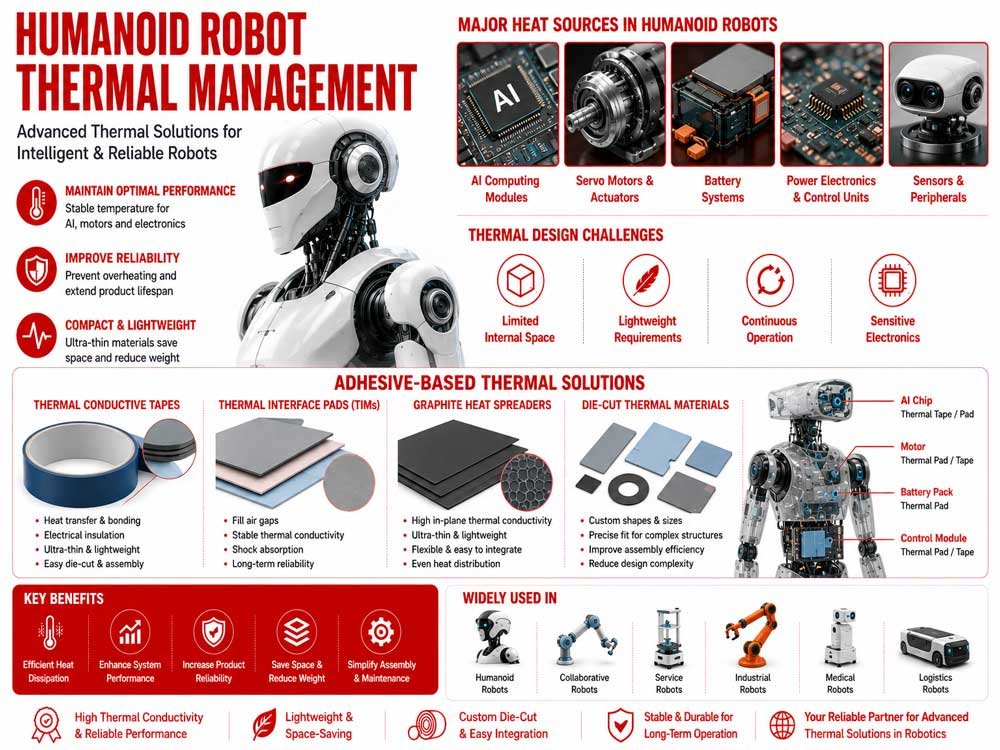
As humanoid robots become more compact, intelligent, and capable of performing complex tasks, thermal management is emerging as one of the most critical engineering challenges in robotics design.
From AI processors and servo motors to battery packs, sensors, and control modules, modern humanoid robots generate significant heat during continuous operation. If this heat is not effectively managed, it can directly impact performance, motion accuracy, system stability, and overall product lifespan.
Today, thermal management is no longer just a supporting function in robotics — it has become a core factor determining reliability, safety, and long-term operational efficiency.
Why Thermal Management Matters in Humanoid Robots
Humanoid robots integrate multiple high-power electronic systems into extremely compact spaces. Unlike traditional industrial equipment, these systems must maintain:
- Lightweight structures
- Flexible movement
- Compact internal architecture
- Continuous real-time computation
- Long operating cycles
As robotic intelligence increases, onboard computing power also rises significantly. AI chips, edge processors, motor drivers, and high-density batteries all contribute to rapid heat accumulation inside robotic systems. Without effective heat dissipation:
- AI processors may throttle performance
- Servo motors can overheat
- Battery efficiency decreases
- Sensors become unstable
- Electronic components age faster
- Mechanical accuracy declines
In extreme cases, thermal stress may even cause unexpected shutdowns or permanent component failure.
Major Heat Sources Inside Humanoid Robots
AI Computing Modules
Modern humanoid robots rely heavily on AI computing for:
- Vision recognition
- Motion planning
- Autonomous navigation
- Human interaction
- Real-time decision making
High-performance AI chips generate large amounts of heat in confined spaces, especially during continuous processing.
Servo Motors & Actuators
Humanoid robots use multiple servo motors and actuators to simulate human movement. During repeated motion cycles, these components generate constant thermal loads.
Key heat-generating areas include:
- Joint motors
- Drive systems
- Motion controllers
- Harmonic reducers
Battery Systems
Lithium battery packs used in robots must deliver:
- High energy density
- Fast response
- Stable output
However, charging and discharging cycles generate heat that can reduce battery lifespan and safety if not properly controlled.
Power Electronics & Control Units
Components such as:
- Power management systems
- Driver ICs
- PCB assemblies
- Sensor modules
all contribute to internal thermal buildup.
Challenges of Thermal Design in Humanoid Robotics
Limited Internal Space
Humanoid robots have highly compact structures, leaving very limited room for traditional cooling methods such as:
- Large heat sinks
- Cooling fans
- Ventilation systems
Thermal solutions must therefore be:
- Thin
- Lightweight
- Flexible
- Highly efficient
Lightweight Requirements
Every additional gram affects robotic movement efficiency and energy consumption.
This means thermal materials must provide:
- Excellent thermal conductivity
- Minimal weight increase
- Compact integration
Continuous Operation
Many robots operate continuously in:
- Manufacturing
- Warehousing
- Medical environments
- Service applications
Continuous motion and AI computation create constant heat accumulation that requires stable long-term thermal control.
Sensitive Electronics
Robotic systems contain highly sensitive electronics that require stable temperatures for:
- Accurate sensing
- Signal integrity
- Motion precision
- AI processing stability
Even moderate overheating can reduce operational reliability.
Advanced Thermal Management Solutions for Humanoid Robots
To address these challenges, adhesive-based thermal materials are becoming increasingly important in next-generation robotic systems.
Thermal Conductive Tapes
Thermal conductive tapes provide:
- Heat transfer
- Component bonding
- Electrical insulation
- Space-saving assembly
all within a single material solution.
These tapes are widely used between:
- AI chips and heat spreaders
- Motor housings and metal frames
- PCB components and cooling plates
- Battery modules and chassis structures
Advantages of Thermal Conductive Tapes
- Ultra-thin structure
- Lightweight integration
- Easy die-cut customization
- Excellent adhesion
- Reduced assembly complexity
- Vibration resistance
- Flexible design compatibility
For compact humanoid robots, thermal tapes help maximize internal space efficiency while simplifying production processes.
Thermal Interface Pads (TIMs)
Thermal pads are commonly applied in robotics to fill microscopic air gaps between heat sources and cooling surfaces. They provide:
- Stable thermal conductivity
- Shock absorption
- Gap filling
- Long-term reliability
Thermal pads are ideal for:
- Battery cooling
- Motor driver modules
- AI computing boards
- Embedded processors
Graphite Heat Spreading Materials
Graphite sheets help distribute heat evenly across compact robotic structures.
Benefits include:
- High in-plane thermal conductivity
- Ultra-thin profiles
- Lightweight performance
- Flexible installation
Graphite materials are increasingly used in:
- AI modules
- Flexible robotic joints
- Compact control systems
Die-Cut Thermal Management Components
Custom die-cut thermal materials allow robotics manufacturers to optimize:
- Assembly speed
- Space utilization
- Precision installation
Die-cut solutions include:
- Custom thermal pads
- Thermal adhesive films
- Insulating spacers
- EMI shielding combinations
These components are tailored specifically for complex robotic geometries.
The Future of Robotics Cooling Technology
As humanoid robots evolve toward:
- Higher intelligence
- Smaller dimensions
- Greater mobility
- Longer operating hours
thermal management requirements will continue to increase.
Future trends include:
- Higher thermal conductivity materials
- Non-silicone thermal solutions
- Multi-functional adhesive systems
- Lightweight cooling architectures
- Integrated EMI + thermal management materials
Thermal design is rapidly becoming a strategic part of robotics engineering rather than a secondary consideration.
Why Thermal Materials Matter in Intelligent Robotics
In advanced robotics, stable temperature control directly affects:
- AI performance
- Motion precision
- Energy efficiency
- Operational safety
- Product reliability
- Service lifespan
This is why thermal conductive tapes, thermal interface pads, graphite materials, and custom die-cut thermal solutions are becoming essential technologies for next-generation humanoid robots.
As robots become increasingly intelligent, effective thermal management will play a key role in enabling safer, smarter, and more reliable robotic systems.
Yousan Thermal Management Solutions for Robotics
Yousan provides advanced thermal management materials for robotics and high-performance electronics applications, including:
- Thermal conductive tapes
- Thermal interface pads
- Non-silicone thermal pads
- Graphite heat spreaders
- EMI shielding materials
- Precision die-cut thermal components
Our solutions help robotics manufacturers improve:
- Heat dissipation efficiency
- Internal space optimization
- Product reliability
- Assembly efficiency
Conclusion
As humanoid robots continue evolving toward higher intelligence, greater mobility, and more compact designs, thermal management is becoming a critical factor in overall system performance and reliability. Efficient heat dissipation is essential for protecting AI processors, servo motors, battery systems, sensors, and control electronics from overheating during continuous operation.
Advanced thermal management materials such as thermal conductive tapes, thermal interface pads, graphite heat spreaders, and precision die-cut thermal components provide lightweight, space-saving, and highly efficient cooling solutions for modern robotic systems. These adhesive-based thermal technologies not only improve heat transfer efficiency but also simplify assembly and support compact internal architectures.
In the future of intelligent robotics, thermal management will play a key role in enabling stable operation, longer service life, improved safety, and higher AI computing performance. As robotics technology advances, innovative thermal solutions will become increasingly important in supporting the next generation of humanoid robots and intelligent machines.
Need help developing your Thermal Conductive Materials solutions? Contact Yousan today to start your custom project.
If you would like to learn more about Yousan adhesive tapes, please visit our website at www.ysdiecut.com