
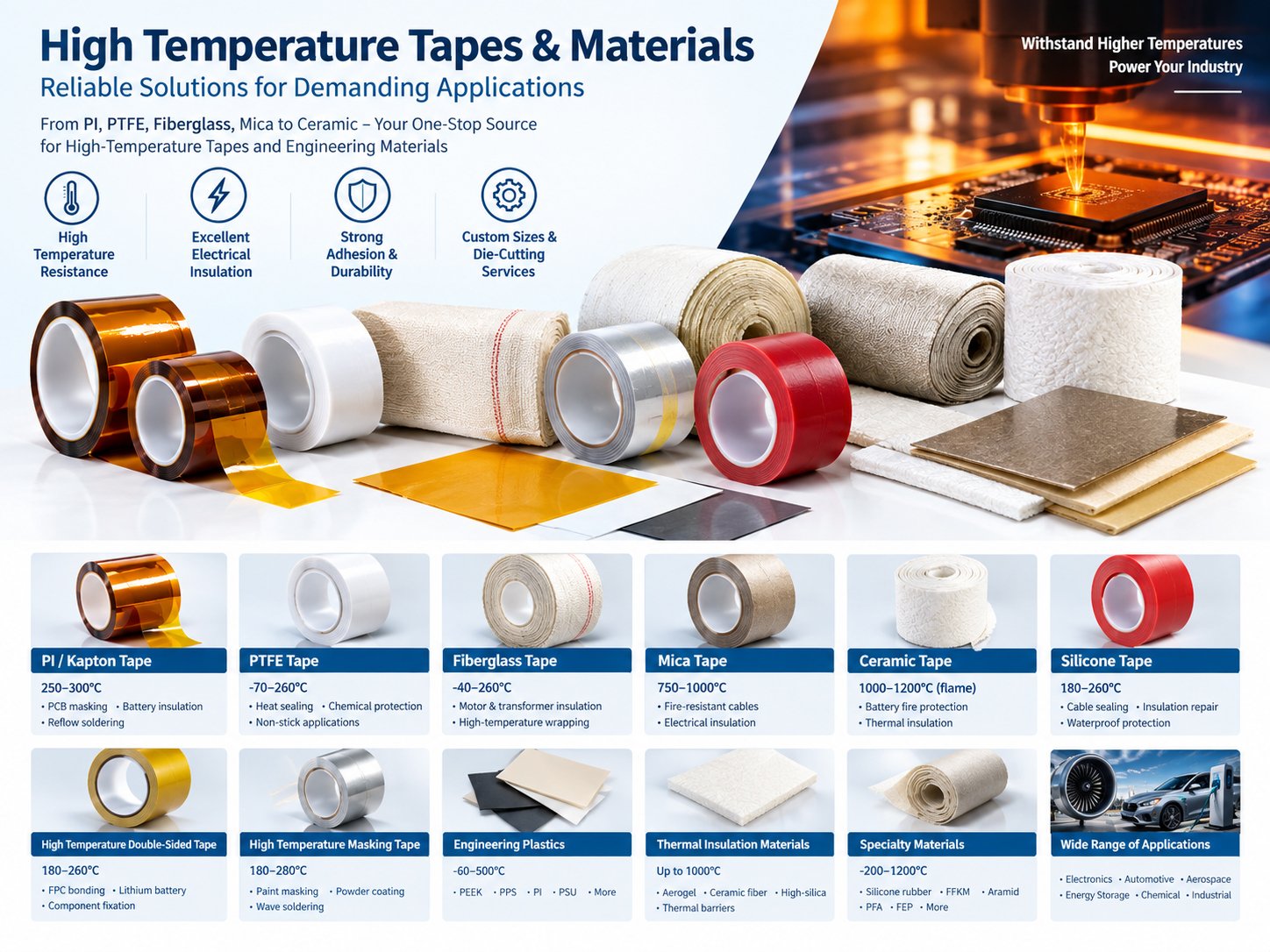
Choosing the right high temperature tape or heat-resistant material depends on more than the maximum temperature rating. The substrate, adhesive system, exposure time, electrical insulation requirements, chemical environment, mechanical stress, and application method all affect material selection.
This guide provides an overview of high temperature tapes and engineering materials used for electronics, PCB manufacturing, lithium-ion batteries, automotive components, aerospace, electrical insulation, chemical processing, high-temperature sealing, and industrial thermal protection.
What Is a High Temperature Tape?
A high temperature tape is an adhesive or self-fusing tape designed to maintain its functional performance when exposed to elevated temperatures.
Depending on construction, high temperature tapes may use:
- Polyimide (PI) film
- PET polyester film
- PTFE film or PTFE-coated fiberglass
- Fiberglass cloth
- Ceramic fiber cloth
- Mica paper reinforced with fiberglass
- Silicone rubber
- High-temperature paper or composite materials
Different adhesive systems are available, including silicone pressure-sensitive adhesives, acrylic adhesives, silicone resins, and self-fusing silicone systems.
The appropriate tape should be selected according to the actual operating temperature, peak temperature, exposure duration, substrate, and application requirements.
High Temperature Tape Product Categories
The following products are included in our high-temperature materials portfolio.
| Product | Backing / Construction | Adhesive | Long-Term Temperature | Short-Term / Peak Temperature | Typical Applications |
|---|---|---|---|---|---|
| PI Kapton Tape | Polyimide film | Silicone PSA | 250–260°C | 280–300°C | PCB gold-finger protection, reflow masking, lithium battery tab insulation |
| PET High Temperature Tape | PET polyester film | Silicone | 150–180°C | 200–220°C | Powder coating, paint masking, tinning masking, electroplating protection |
| PTFE Tape | PTFE film / fiberglass fabric | Silicone PSA | -70–260°C | 300–350°C | Heat-sealing equipment, chemical corrosion protection, high-frequency insulation |
| Fiberglass Tape | Fiberglass cloth | Silicone | -40–260°C | ~300°C | Class H motor and transformer insulation, high-temperature wrapping |
| Ceramicized Silicone Tape | Ceramic fiber cloth + ceramicized silicone | Acrylic | -15–1000°C | 1000–1200°C flame exposure | Battery fire protection, cable fire resistance, exhaust thermal insulation |
| Golden Mica Tape | Mica paper + fiberglass | Silicone resin | 750°C | 900°C | Fire-resistant cable wrapping, motor and transformer insulation |
| Synthetic Mica Tape | Mica paper + fiberglass | Silicone resin | 950°C | 1000°C | Fire-resistant cable wrapping, motor and transformer insulation |
| Calcined Mica Tape | Mica paper + fiberglass | Silicone resin | 950°C | 1000°C | Fire-resistant cable wrapping, motor and transformer insulation |
| High Temperature Masking Tape | Red crepe paper + PET composite | Silicone | 180–200°C | Up to 280°C | Paint masking, color separation, wave soldering masking |
| High Temperature Double-Sided Tape | PI film / fiberglass | Double-sided silicone adhesive | 180–260°C | 260–280°C | Lithium battery fixation, FPC bonding, heat-resistant positioning |
| Self-Fusing Silicone Tape | Silicone rubber | Self-fusing, no adhesive | 180–260°C | — | Electrical insulation repair, cable sealing and waterproofing |
| PI High Temperature Label | PI film | Specialty PSA | 260°C × 10 min | 300°C × 1 min; maximum listed 320°C | SMT traceability, warranty labels, asset identification |
| Thermal Spray Masking Tape | Fiberglass cloth | High-temperature silicone | 200–260°C | 800–1200°C short-term | Aerospace thermal spray masking |
Temperature values above are based on the supplied product table. Actual performance depends on construction, exposure time, substrate, pressure, environmental conditions, and application process.
1. PI Kapton Tape for High Temperature Insulation and Masking
Polyimide tape, commonly known as Kapton tape, is one of the most widely used high-temperature adhesive tapes for electronics and electrical applications.
The supplied material table specifies:
- Backing: Polyimide film
- Adhesive: Silicone pressure-sensitive adhesive
- Long-term temperature: 250–260°C
- Short-term temperature: 280–300°C
- Applications: PCB gold-finger protection, reflow soldering masking, lithium battery tab insulation
Because of its combination of heat resistance, electrical insulation and thin-film construction, PI tape is frequently selected for processes involving elevated temperatures.
Common Applications
- PCB masking
- Reflow soldering
- Wave soldering
- Gold-finger protection
- Battery tab insulation
- Electrical insulation
- High-temperature component masking
2. PTFE High Temperature Tape
PTFE tape combines a very wide temperature range with low surface energy and non-stick characteristics.
According to the supplied table, PTFE tape is available with:
- Construction: PTFE film or fiberglass fabric
- Adhesive: Silicone PSA
- Long-term temperature: -70 to 260°C
- Short-term temperature: 300–350°C
- Applications: Heat-sealing equipment, chemical corrosion protection and high-frequency insulation
PTFE-based tape is particularly useful where heat resistance, chemical resistance and release properties are important.
Typical Applications
- Heat-sealing machines
- Packaging equipment
- Chemical processing
- Anti-stick surfaces
- High-frequency electrical insulation
- Industrial equipment protection
3. Fiberglass High Temperature Tape
Fiberglass tape uses woven fiberglass cloth as its reinforcement layer and silicone adhesive for high-temperature applications.
The supplied table lists:
- Backing: Fiberglass cloth
- Adhesive: Silicone
- Long-term temperature: -40 to 260°C
- Short-term temperature: approximately 300°C
Typical applications include Class H motor and transformer insulation and high-temperature wrapping.
Fiberglass construction provides mechanical reinforcement compared with thin polymer-film tapes, making it useful for applications requiring greater dimensional stability and wrapping strength.
4. Ceramicized Silicone Tape for Extreme Heat and Fire Protection
For applications involving extreme heat or direct flame exposure, ceramicized silicone tape is designed for a substantially different operating environment from conventional polymer tapes.
The supplied table specifies:
- Construction: Ceramic fiber cloth + ceramicized silicone
- Adhesive: Acrylic
- Long-term temperature: -15 to 1000°C
- Flame exposure: 1000–1200°C
- Applications: Battery-pack fire protection, fire-resistant cables and exhaust thermal insulation
Typical applications include:
- EV battery fire protection
- Battery pack thermal protection
- Cable fire protection
- Exhaust systems
- High-temperature insulation
- Industrial thermal barriers
For fire-protection applications, the actual temperature rating should always be evaluated together with exposure duration, flame conditions and system construction.
5. Mica Tape for Fire-Resistant Electrical Insulation
Mica tapes are designed for applications where electrical insulation and fire resistance are critical.
The supplied table identifies three mica tape categories:
Golden Mica Tape
- Long-term temperature: 750°C
- Short-term temperature: 900°C
Synthetic Mica Tape
- Long-term temperature: 950°C
- Short-term temperature: 1000°C
Calcined Mica Tape
- Long-term temperature: 950°C
- Short-term temperature: 1000°C
The listed construction is mica paper reinforced with fiberglass, using a silicone resin system.
Typical applications include:
- Fire-resistant cables
- Motor insulation
- Transformer insulation
- High-temperature electrical systems
6. High Temperature Masking Tape
High-temperature masking tape is used where conventional masking tapes cannot withstand elevated processing temperatures.
The supplied product is described as:
- Backing: Red crepe paper + PET composite
- Adhesive: Silicone
- Long-term temperature: 180–200°C
- Short-term temperature: Up to 280°C
Typical applications include:
- Automotive paint masking
- Color separation
- Powder coating-related masking
- Wave soldering masking
The silicone adhesive system provides the heat resistance required for elevated-temperature processing.
7. High Temperature Double-Sided Tape
High-temperature double-sided tape is used when components must be bonded or positioned while maintaining adhesion under elevated temperatures.
The supplied table identifies:
- Backing: PI film / fiberglass
- Adhesive: Double-sided silicone adhesive
- Long-term temperature: 180–260°C
- Short-term temperature: 260–280°C
Typical applications include:
- Lithium battery component fixation
- FPC bonding
- Heat-resistant positioning
- Electronics assembly
- Industrial component mounting
For double-sided applications, substrate compatibility and bond-area design are especially important because temperature resistance alone does not determine final bonding performance.
8. Self-Fusing Silicone Tape
Self-fusing silicone tape is different from conventional pressure-sensitive adhesive tape.
It uses a self-fusing silicone rubber construction rather than a conventional adhesive layer.
The supplied table lists:
- Material: Silicone rubber
- Bonding mechanism: Self-fusing, no adhesive
- Long-term temperature: 180–260°C
- Applications: Electrical insulation repair, cable sealing and waterproofing
It can be particularly useful for:
- Cable repair
- Electrical insulation
- Waterproof sealing
- Wire and cable protection
- Emergency maintenance
9. PI High Temperature Labels
High-temperature PI labels are designed for identification and traceability during demanding manufacturing processes.
The supplied specifications include:
- Material: PI film
- Adhesive: Specialty pressure-sensitive adhesive
- Temperature: 260°C × 10 minutes
- Short-term: 300°C × 1 minute
- Maximum listed: 320°C
Typical applications include:
- SMT traceability
- PCB identification
- Warranty labels
- Asset identification
- High-temperature process tracking
10. Thermal Spray Masking Tape
Thermal spray processes can expose masking materials to extremely high temperatures for short periods.
The supplied table lists:
- Backing: Fiberglass cloth
- Adhesive: High-temperature silicone
- Long-term temperature: 200–260°C
- Short-term exposure: 800–1200°C
- Application: Aerospace thermal spray masking
This type of product should be selected according to the specific thermal spray process, spray material, distance from the heat source and exposure duration rather than by peak temperature alone.
High Temperature Materials Beyond Adhesive Tapes
High-temperature applications are not limited to adhesive tapes.
The supplied material table also includes engineering plastics, elastomers, insulation materials and thermal insulation products.
| Material | Abbreviation | Long-Term Temperature | Short-Term / Peak | Typical Applications |
|---|---|---|---|---|
| Polyimide | PI | 260°C film / up to 300°C molded | 400°C+ | Aerospace, FPC, semiconductor carriers, motor insulation |
| High-Modulus Polyimide | PI | 400–500°C | 600°C | Flexible circuits |
| PEEK | PEEK | 250°C | 300°C | Semiconductor, medical, aerospace, chemical sealing |
| PPS | PPS | 200–220°C | 260°C | Automotive electronics, connectors, pumps and valves |
| PSU | PSU | 150–170°C | 180°C+ | Medical devices, food equipment, electronic housings |
| PPSU | PPSU | 180°C | 200°C+ | Medical sterilization equipment, bottles |
| PTFE | PTFE | 260°C | 300°C | Chemical lining, non-stick coatings, high-frequency insulation |
| LCP | LCP | 220–240°C | 280–300°C | SMT connectors, 5G high-frequency components, LED applications |
| PEI | PEI / Ultem | 170–180°C | 200°C | Aerospace interiors, medical devices, lighting |
| Silicone Rubber | VMQ | -60–230°C | 250–300°C | Electronic sealing, automotive, food and medical |
| FKM | FKM | 200–250°C | 275–300°C | Automotive fuel systems, chemical sealing |
| FFKM | FFKM | 316–327°C | 350°C | Semiconductor and chemical process sealing |
| PI Foam | PI Foam | 250–300°C | 400–500°C | Aerospace thermal and acoustic insulation |
| PAI | PAI / Torlon | 220–260°C | 280°C+ | Wear-resistant parts, bearings, compressor components |
| PES | PES | 180–200°C | 200–220°C | Medical, water treatment, aerospace |
| Aramid / Nomex | Aramid | 220°C | 300°C | Electrical insulation, protective clothing, aircraft honeycomb |
| PFA | PFA | 260°C | — | Semiconductor high-purity piping |
| FEP | FEP | 200°C | — | High-temperature cable jacketing |
| PPA | PPA | 140–170°C | — | SMT connectors, automotive electronics |
The material values above are taken from the supplied spreadsheet and should be treated as reference selection data rather than guaranteed product specifications. Individual grades can have substantially different thermal limits.
How to Choose the Right High Temperature Tape
When selecting a high temperature adhesive tape, consider the following five factors.
1. What Is the Actual Operating Temperature?
Do not select a tape based only on the highest temperature it can briefly tolerate.
Separate the application into:
- Normal operating temperature
- Continuous exposure temperature
- Short-term peak temperature
- Heating rate
- Exposure duration
- Cooling cycle
A tape exposed to 280°C for several seconds is operating under very different conditions from a tape continuously exposed to 280°C.
2. What Type of Substrate Will Be Bonded?
Common substrates include:
- Aluminum
- Stainless steel
- Copper
- Steel
- Glass
- Polyimide
- PET
- FPC
- PCB
- Painted surfaces
- Plastics
- Silicone rubber
The adhesive must be compatible with the substrate and its surface energy.
3. Is Electrical Insulation Required?
For electrical applications, material selection may depend on:
- Dielectric strength
- Insulation resistance
- Breakdown voltage
- Temperature class
- Thickness
- Flame resistance
PI, fiberglass, mica and silicone-based materials are commonly considered for electrical insulation applications.
4. Is the Application Masking or Permanent Bonding?
The requirements are very different.
For masking applications
Important properties include:
- Clean removal
- Temperature resistance
- Dimensional stability
- Paint compatibility
- Residue control
For permanent bonding
Important properties include:
- Adhesion
- Shear strength
- Peel strength
- Temperature aging
- Substrate compatibility
- Bond-line thickness
5. How Long Will the Material Be Exposed to Heat?
Temperature ratings should always be interpreted together with exposure time.
For example:
260°C continuous exposure ≠ 300°C short-term exposure.
The supplied table itself distinguishes between long-term and short-term/peak temperature ratings, so this distinction should be maintained when selecting a product.
High Temperature Tape Selection by Application
| Application | Recommended Material Category |
|---|---|
| PCB reflow masking | PI / Kapton tape |
| PCB gold-finger protection | PI / Kapton tape |
| Lithium battery tab insulation | PI tape / high-temperature double-sided tape |
| FPC bonding | High-temperature double-sided tape |
| Powder coating masking | PET high-temperature tape / high-temperature masking tape |
| Paint masking | High-temperature masking tape |
| Heat-sealing equipment | PTFE tape |
| Chemical corrosion protection | PTFE-based materials |
| Motor insulation | Fiberglass tape / mica tape / PI |
| Transformer insulation | Fiberglass tape / mica tape / PI |
| Fire-resistant cable | Mica tape / ceramicized silicone tape |
| EV battery fire protection | Ceramicized silicone tape / thermal insulation materials |
| Cable repair | Self-fusing silicone tape |
| Exhaust thermal insulation | Ceramicized silicone tape |
| Aerospace thermal spray masking | Thermal spray masking tape |
| High-temperature identification | PI high-temperature labels |
| High-temperature industrial insulation | Ceramic fiber / aerogel / high-silica materials |
High Temperature Tape vs High Temperature Insulation Material
These products should not always be treated as interchangeable.
High-temperature adhesive tape is generally selected when the product must provide bonding, masking, insulation, wrapping or fixing.
High-temperature insulation materials such as ceramic fiber paper, aerogel felts, PI foam and high-silica fiberglass cloth are more suitable when the primary objective is thermal insulation, fire protection, thermal shielding or high-temperature structural protection.
For example:
- PCB masking → PI tape
- Heat-sealing release → PTFE tape
- Electrical wrapping → fiberglass or mica tape
- Battery fire protection → ceramicized silicone / thermal insulation
- Furnace insulation → ceramic fiber materials
- Battery thermal insulation → aerogel materials
High Temperature Materials for EV Battery Applications
High-temperature materials are increasingly important in electric vehicle and energy-storage systems.
Potential material categories include:
Battery Tab Insulation
PI tape can be used for electrical insulation and high-temperature process protection.
Battery Pack Fire Protection
Ceramicized silicone materials can be considered for applications requiring resistance to high heat and flame exposure.
Battery Thermal Insulation
The supplied table includes:
- Aerogel pre-oxidized fiber felt — up to 450°C
- Aerogel fiberglass surface felt — up to 650°C
- Aerogel ceramic fiber felt — up to 1000°C
These materials are listed for applications including power batteries, new-energy batteries and energy-storage systems.
Why Work With a High Temperature Materials Supplier?
Industrial customers often require more than a standard roll of tape.
A suitable supplier should be able to support:
- Material selection
- Temperature-range matching
- Adhesive selection
- Thickness selection
- Width customization
- Slitting
- Laminating
- Die-cutting
- Custom rolls
- Custom shapes
- Application-specific solutions
For OEM and industrial applications, the correct product should be selected according to the customer’s substrate, temperature profile, application method and required quantity.
FAQ About High Temperature Tapes
What is the best tape for high temperature applications?
There is no single best high-temperature tape for every application. PI, PTFE, fiberglass, mica, ceramicized silicone and high-temperature double-sided tapes are designed for different temperature and performance requirements.
Is Kapton tape a high temperature tape?
Yes. PI/Kapton tape is a high-temperature polyimide film tape. The supplied product table lists a long-term temperature range of 250–260°C and short-term temperatures of 280–300°C.
What tape can withstand 260°C?
According to the supplied table, PI/Kapton tape, PTFE tape, fiberglass tape and certain high-temperature double-sided tapes have temperature ranges reaching approximately 260°C. The appropriate choice depends on the application and exposure conditions.
What tape is suitable for 300°C?
PTFE, fiberglass, PI and selected specialty high-temperature tapes are listed with short-term ratings around or above 300°C. Actual suitability depends on exposure duration and application conditions.
What tape is suitable for very high temperatures or flame exposure?
For extreme heat and flame-related applications, ceramicized silicone tape and mica-based materials are among the categories listed in the supplied material table with significantly higher temperature capabilities.
Is high-temperature tape suitable for electrical insulation?
Yes. PI, fiberglass, mica and silicone-based materials can be used for electrical insulation applications, but dielectric and temperature-class requirements should be verified for the specific product.
Can high-temperature tape be customized?
Industrial high-temperature tapes can often be converted into different widths, roll lengths and die-cut shapes. The exact customization capability depends on the backing, adhesive and product construction.
Conclusion
Selecting a high temperature tape or material requires matching the material to the complete application rather than simply choosing the product with the highest temperature number.
For PCB and electronics, PI/Kapton tape is a common choice.
For heat-sealing and non-stick applications, PTFE-based tape can be considered.
For electrical wrapping and insulation, fiberglass and mica tapes provide high-temperature material options.
For fire protection and extreme thermal exposure, ceramicized silicone and mica materials provide higher-temperature solutions.
For thermal insulation, aerogel, ceramic fiber and high-silica materials serve different roles from adhesive tapes.
If you provide the application temperature, substrate, required thickness, width, exposure time and quantity, a high-temperature tape supplier can recommend a more suitable material and construction.
If you would like to learn more about Yousan adhesive tapes, please visit our website at www.ysdiecut.com