
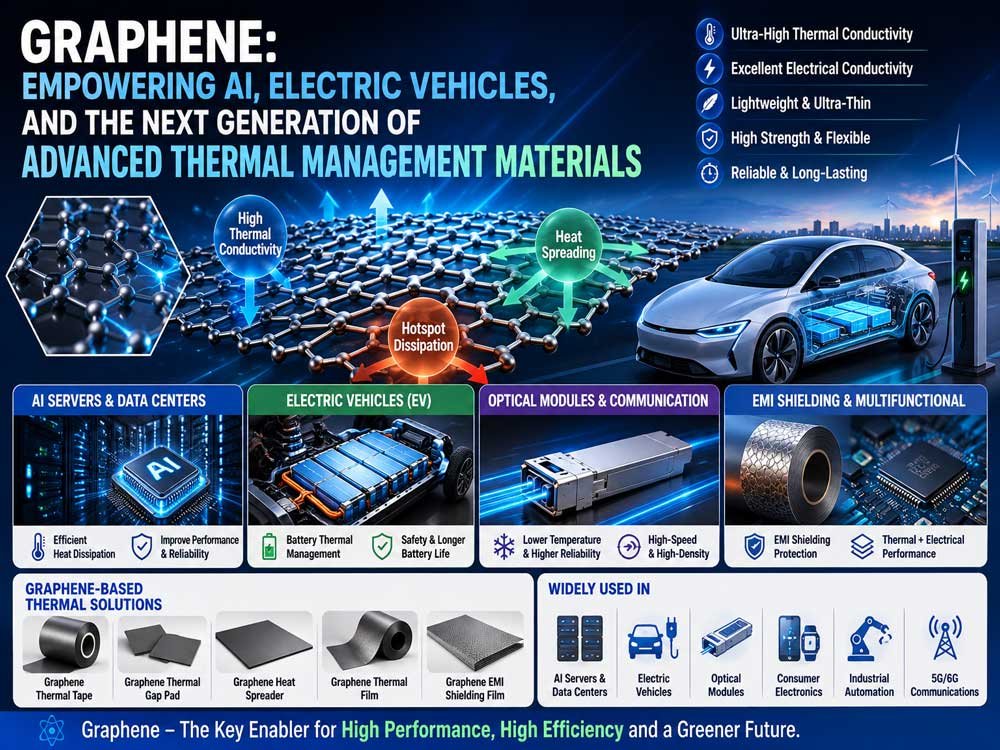
As AI computing, electric vehicles, high-speed optical networking, and advanced electronics continue to evolve, thermal management has become one of the most critical challenges facing modern engineers. Rising power densities, compact device architectures, and continuous operation generate significant heat that can impact performance, reliability, and product lifespan.
Among the emerging materials addressing these challenges, graphene stands out as one of the most promising. With exceptional thermal conductivity, electrical conductivity, mechanical strength, and lightweight flexibility, graphene is rapidly becoming a key enabling material for next-generation thermal management solutions.
Why Graphene Is Revolutionizing Thermal Management
Graphene is a single layer of carbon atoms arranged in a two-dimensional honeycomb lattice. Despite being only one atom thick, it exhibits remarkable properties that make it highly attractive for thermal applications:
Key advantages of graphene
-
Ultra-high thermal conductivity
Graphene can rapidly transfer and spread heat away from hotspots, making it ideal for high-power electronic devices.
-
Excellent electrical conductivity
Useful for applications requiring both thermal and electrical performance.
-
Lightweight and thin
Enables thermal solutions without adding significant weight or bulk.
-
Mechanical flexibility
Suitable for curved surfaces, flexible electronics, and compact assemblies.
-
Chemical and environmental stability
Provides reliable long-term performance under demanding conditions.
Graphene in AI Servers and Data Centers
AI infrastructure is driving unprecedented demand for thermal management. Modern AI servers and GPU clusters operate at extremely high power levels, creating concentrated heat sources that are difficult to cool efficiently.
Graphene-based thermal materials can be used in:
-
Graphene heat spreaders
-
Thermal interface materials (TIMs)
-
Graphene-enhanced thermal pads
-
Thermal conductive films
-
AI server cooling assemblies
By distributing heat more uniformly, graphene helps reduce peak temperatures, improve cooling efficiency, and support the reliable operation of AI accelerators and high-performance computing systems.
Graphene for Electric Vehicles (EVs)
Battery systems are among the most temperature-sensitive components in electric vehicles. Effective heat dissipation is essential for safety, charging performance, and battery lifespan.
Graphene is increasingly being explored for:
-
EV battery thermal management
-
Thermal conductive tapes
-
Heat spreaders and cooling plates
-
Battery insulation and protection materials
-
Graphene-enhanced battery technologies
Because graphene can efficiently transfer heat while remaining lightweight, it is well suited for next-generation EV platforms where energy efficiency and thermal control are both critical.
Optical Modules and High-Speed Communications
The transition from 400G to 800G and 1.6T optical modules is significantly increasing power density inside communication hardware. DSP chips, lasers, and photonic components generate substantial heat within extremely compact spaces.
Graphene-based thermal solutions offer several advantages:
-
Fast heat spreading across module surfaces
-
Reduced hotspot formation
-
Thin and lightweight integration
-
Support for dense optical packaging
These characteristics make graphene an attractive material for future optical communication systems and photonic integrated devices.
EMI Shielding and Multifunctional Materials
Beyond thermal management, graphene also shows strong potential in electromagnetic interference (EMI) shielding. Its conductive nature allows it to be incorporated into:
-
EMI shielding tapes
-
Conductive coatings
-
Shielding films
-
Composite materials
This creates opportunities for multifunctional materials that combine heat dissipation and EMI protection in a single solution, especially valuable in AI servers, EVs, and communication equipment.
Graphene and Advanced Thermal Management Materials
In practical industrial applications, graphene is often combined with other thermal management products, including:
|
Material |
Typical role |
|
Thermal Conductive Tapes |
Bonding and heat transfer |
|
Thermal Gap Pads |
Gap filling and cooling |
|
Graphite Heat Spreaders |
In-plane heat distribution |
|
Phase Change Materials |
Low thermal resistance interfaces |
|
EMI Shielding Materials |
Thermal and electrical protection |
These integrated solutions are widely used in AI infrastructure, data centers, electric vehicles, optical modules, consumer electronics, and industrial automation equipment.
Future Outlook
Graphene is steadily moving from research laboratories into commercial products. As manufacturing processes mature and costs decline, adoption is expected to accelerate across multiple industries.
Key growth drivers include:
-
AI servers and data centers
-
Electric vehicles and battery systems
-
Optical communication networks
-
Wearable electronics
-
Renewable energy and energy storage
The combination of thermal performance, lightweight design, and multifunctionality positions graphene as a strategic material for the next generation of electronic and energy technologies.
Conclusion
Graphene is no longer just a laboratory curiosity—it is becoming a practical engineering material that helps solve some of the most pressing thermal challenges in modern technology. From AI servers and optical modules to EV batteries and advanced electronics, graphene-based thermal management materials are enabling higher performance, better reliability, and more compact designs.
As industries continue to push toward greater power density and energy efficiency, graphene is poised to become an increasingly important foundation for next-generation thermal management solutions.
FAQ
Why is graphene attractive for thermal management?
Graphene offers extremely high thermal conductivity and can rapidly spread heat away from hotspots while remaining thin and lightweight.
Can graphene improve AI server cooling?
Yes. Graphene heat spreaders and thermal interface materials can help distribute heat more efficiently, reducing peak temperatures in high-power AI hardware.
How is graphene used in electric vehicles?
Graphene is used in battery thermal management materials, conductive tapes, heat spreaders, and next-generation energy storage technologies.
Does graphene also help with EMI shielding?
Yes. Graphene’s electrical conductivity allows it to be incorporated into EMI shielding tapes, films, and coatings, creating multifunctional thermal and shielding solutions.
Need help developing your Graphite Thermal Sheet Solutions? Contact Yousan today to start your custom project.
If you would like to learn more about Yousan adhesive tapes, please visit our website at www.ysdiecut.com