
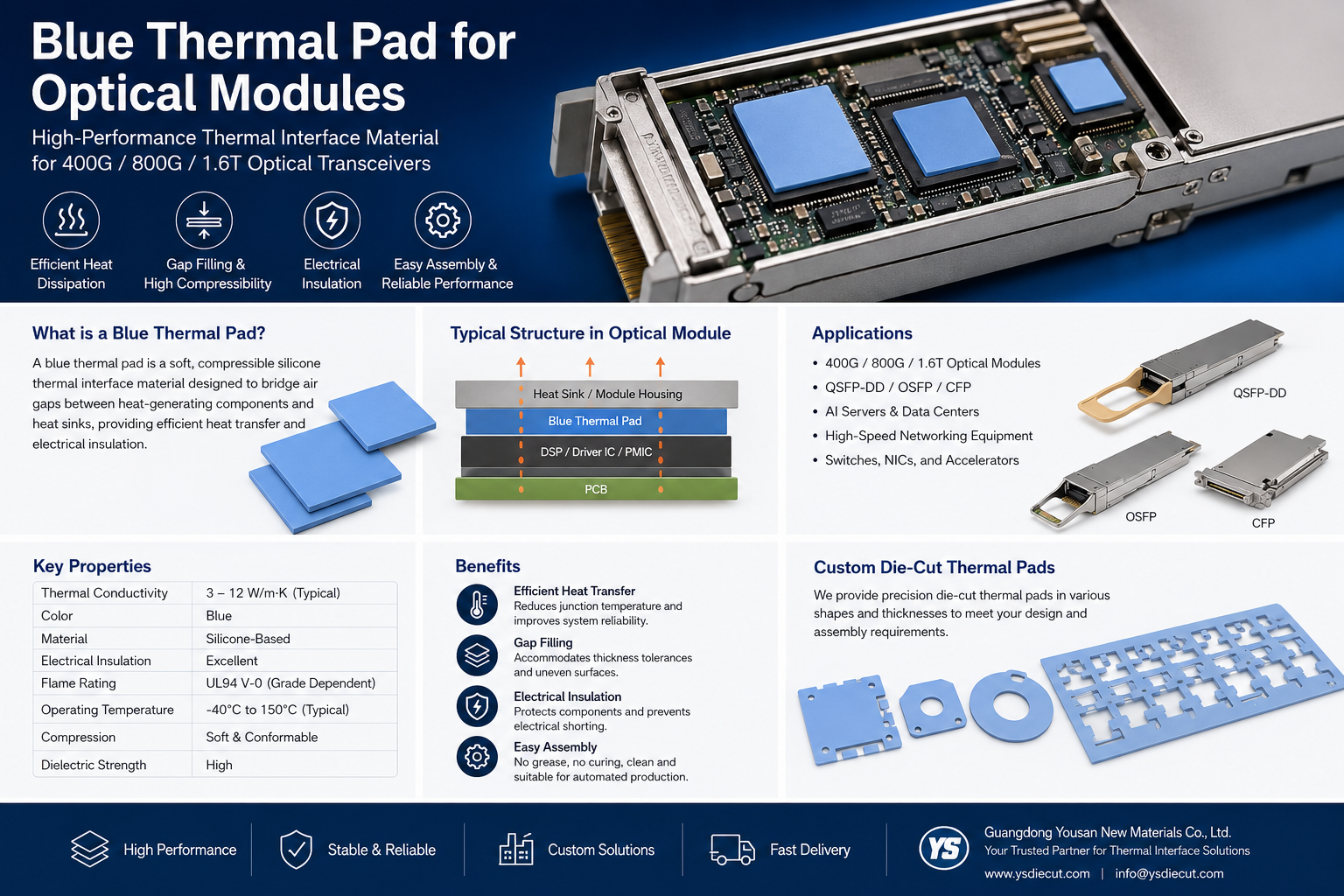
As AI computing, cloud infrastructure, and high-speed networking continue to evolve, optical communication modules are rapidly transitioning from 100G to 400G, 800G, and even 1.6T. Higher transmission speeds significantly increase power consumption and heat generation inside optical modules, making thermal management a critical design challenge.
One component that has attracted increasing attention is the blue thermal pad—a silicone-based thermal interface material (TIM) widely used between heat-generating components and heat sinks. Blue thermal pads help transfer heat efficiently while accommodating mechanical tolerances and protecting delicate electronic components.
Industry teardowns of modern optical modules show that thermal interface materials are extensively used to couple DSP chips, laser drivers, and power management ICs with the module housing or heat sink, improving overall thermal performance and system reliability.
What Is a Blue Thermal Pad?
A blue thermal pad is a soft, compressible silicone thermal gap filler designed to bridge air gaps between electronic components and cooling structures.
Unlike thermal grease, thermal pads provide:
- Clean installation
- Consistent thickness
- Excellent electrical insulation
- Long-term reliability
- Easy automated assembly
Because of its distinctive blue appearance, this type of thermal interface material is commonly referred to as a Blue Thermal Pad throughout the electronics industry.
Why Optical Modules Need Thermal Pads
Modern optical transceivers integrate numerous high-power devices inside an extremely compact enclosure.
Typical heat sources include:
- DSP (Digital Signal Processor)
- Laser Driver IC
- TIA (Transimpedance Amplifier)
- PAM4 Retimer
- PMIC
- Clock IC
- Optical Engine
These components generate considerable heat during continuous high-speed operation.
Without an efficient thermal interface material:
- Junction temperature increases
- Signal integrity degrades
- Optical power becomes unstable
- Module lifetime decreases
- Power consumption rises
A properly selected thermal gap pad minimizes thermal resistance and transfers heat from these components to the module shell or heat sink.
Typical Structure Inside an Optical Module
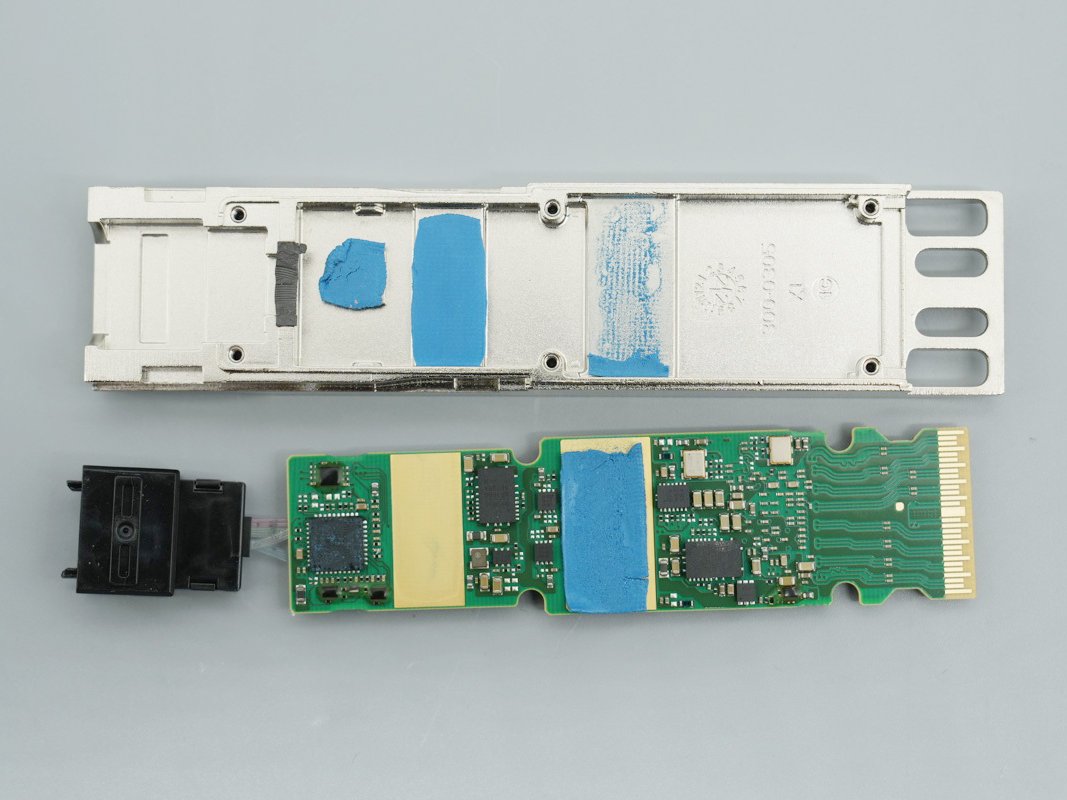
The thermal pad compensates for height differences between components while maintaining continuous thermal contact.
Key Properties of Blue Thermal Pads
An ideal thermal pad for optical modules should provide the following characteristics:
| Property | Typical Requirement |
|---|---|
| Thermal Conductivity | 3–12 W/m·K (depending on design) |
| Color | Blue |
| Material | Silicone-Based Gap Filler |
| Compression | Soft and conformable |
| Electrical Insulation | Excellent |
| Flame Rating | UL94 V-0 (grade dependent) |
| Operating Temperature | Wide operating range (depends on material grade) |
| Dielectric Strength | High |
Different applications require different thermal conductivity levels, so the appropriate grade should be selected based on the system’s thermal design.
Advantages of Blue Thermal Pads
Excellent Heat Transfer
Thermal pads efficiently transfer heat from semiconductor devices to metal heat spreaders.
Compensates for Manufacturing Tolerances
Electronic assemblies often contain uneven component heights.
The soft silicone material compresses easily and fills air gaps without excessive mechanical stress.
Protects Sensitive Components
Compared with rigid materials, thermal pads reduce mechanical loading on:
- BGA packages
- Optical chips
- Ceramic substrates
- High-density PCBs
Electrical Insulation
Most silicone thermal pads provide excellent electrical insulation while simultaneously conducting heat.
This makes them suitable for densely populated electronic assemblies.
Easy Automated Assembly
Unlike thermal grease:
- No dispensing equipment required
- No curing process
- Cleaner manufacturing
- Improved production consistency
Applications in Optical Communication
Blue thermal pads are widely used in:
400G Optical Modules
- QSFP-DD
- OSFP
- CFP
800G Optical Modules
- AI Servers
- Cloud Computing
- High-Speed Switches
1.6T Optical Modules
Next-generation optical communication systems require increasingly efficient thermal management due to higher chip power density.
Data Center Equipment
Thermal pads are also used in:
- Switch ASICs
- Network Interface Cards
- Smart NICs
- AI Accelerators
Selecting the Right Thermal Pad
Choosing the correct thermal pad depends on several engineering factors.
Thermal Conductivity
Higher thermal conductivity generally improves heat transfer but should be balanced with cost, softness, and application requirements.
Thickness
Common thicknesses include:
- 0.5 mm thermal pad
- 1.0 mm thermal pad
- 1.5 mm thermal pad
- 2.0 mm thermal pad
- 3.0 mm thermal pad
The thickness should compensate for assembly tolerances while maintaining sufficient compression.
Hardness
A softer thermal pad provides:
- Better surface conformity
- Lower assembly stress
- Improved contact area
Compression Ratio
Proper compression improves thermal contact without damaging electronic components.
Blue Thermal Pad vs Thermal Grease
| Feature | Blue Thermal Pad | Thermal Grease |
|---|---|---|
| Clean Installation | ✓ | No |
| Rework | Easy | Difficult |
| Gap Filling | Excellent | Poor |
| Thickness Control | Excellent | Difficult |
| Automated Production | Excellent | Moderate |
| Mechanical Stability | High | Moderate |
For optical modules, thermal pads are generally preferred where controlled gap filling and reliable assembly are required.
Custom Die-Cut Thermal Pads
Many optical module manufacturers require customized thermal pads instead of standard sheets.
Typical customizations include:
- Precision die-cut shapes
- Different thicknesses
- Dual-sided protective films
- Kiss-cut processing
- Roll format
- Sheet format
Die-cut thermal pads simplify assembly while reducing production time.
Industries Using Blue Thermal Pads
- Optical Communications
- AI Servers
- Data Centers
- 5G Equipment
- Industrial Computing
- Automotive Electronics
- Medical Electronics
- Consumer Electronics
Installation Tips
To maximize thermal performance:
- Clean all contact surfaces before installation.
- Remove protective liners carefully.
- Avoid stretching the thermal pad.
- Apply uniform assembly pressure.
- Verify full surface contact after assembly.
- Select the appropriate thickness to avoid excessive compression.
Frequently Asked Questions
Why are many thermal pads blue?
Blue has become a common industry color for silicone thermal interface materials, making identification during manufacturing and maintenance easier. Color itself does not determine thermal performance.
What thermal conductivity is suitable for optical modules?
The required thermal conductivity depends on component power density, allowable temperature rise, and overall thermal design. Higher-power modules generally require higher-performance thermal interface materials.
Can thermal pads replace thermal grease?
In many optical module applications, yes. Thermal pads provide cleaner assembly, controlled thickness, and better gap-filling capability.
Are thermal pads electrically conductive?
Most silicone thermal pads used in electronics are electrically insulating while remaining thermally conductive. Always verify the specific material specification before use.
Can blue thermal pads be die-cut?
Yes. Thermal pads are commonly converted into custom shapes using precision die-cutting to match optical module layouts.
Custom Thermal Interface Solutions from Guangdong Yousan New Materials
Guangdong Yousan New Materials provides high-performance thermal interface materials for demanding electronic applications, including:
- Blue thermal gap pads
- High thermal conductivity silicone pads
- Custom die-cut thermal pads
- Graphite thermal sheets
- Phase change materials
- Thermal conductive tapes
Our converting capabilities include:
- Precision die-cutting
- Laminating
- Slitting
- Kiss-cutting
- Custom sheet sizes
- OEM and ODM manufacturing
Whether you’re developing AI servers, optical transceivers, or high-speed networking equipment, our engineering team can help you select the right thermal interface material for your application.
Conclusion
As optical communication technology advances toward 800G and 1.6T, thermal management is becoming one of the key factors affecting module performance and reliability. Blue thermal pads provide an efficient, clean, and reliable solution for transferring heat away from high-power components while accommodating assembly tolerances.
For manufacturers of optical modules, data center equipment, and AI hardware, selecting the right thermal interface material is essential to ensuring long-term performance, stability, and product lifespan.
Need help developing your Blue Thermal Pad Solutions? Contact Yousan today to start your custom project.
If you would like to learn more about Yousan adhesive tapes, please visit our website at www.ysdiecut.com