
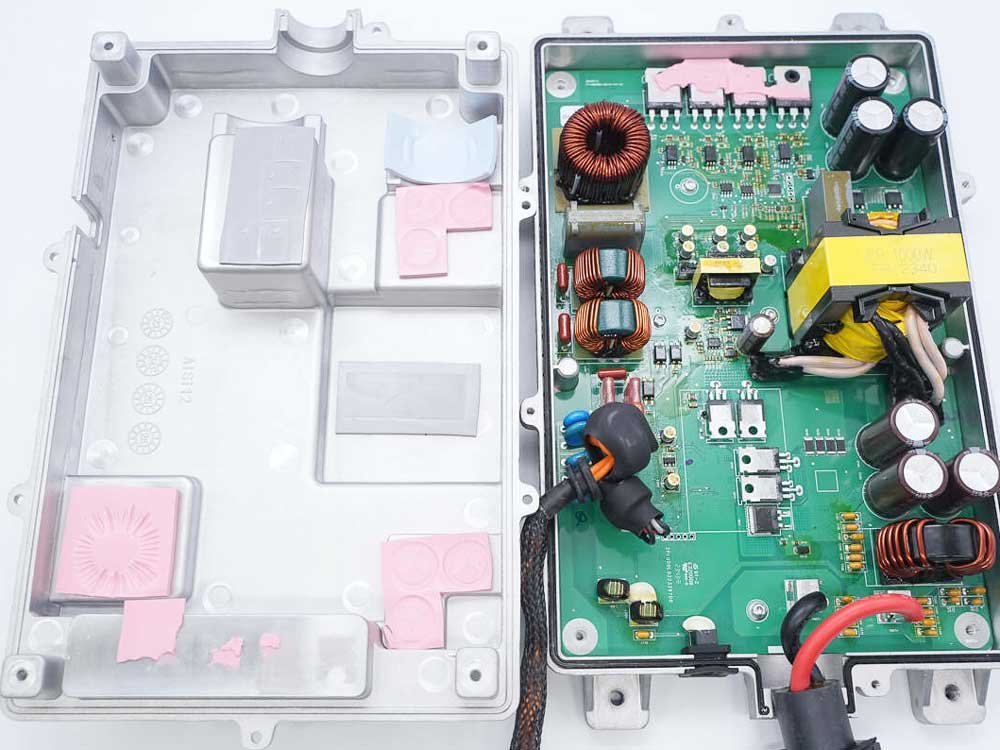
With the rapid development of commercial vehicles and new energy systems, efficient thermal management has become critical for power electronics. In applications such as the FAW Jiefang 1000W onboard inverter module, thermal conductive silicone pads play a key role in ensuring system stability, efficiency, and long-term reliability.
This article explores how thermal interface materials (TIMs), especially silicone thermal pads, are used in automotive inverter modules and why they are essential for OEM applications.
Why Thermal Management Is Critical in 1000W Inverter Modules
A 1000W inverter typically converts DC power into AC power for vehicle systems. During operation, power devices such as MOSFETs and IGBTs generate significant heat due to switching losses and high current flow.
Even with high efficiency, a portion of energy is dissipated as heat, requiring effective cooling solutions to maintain safe operating temperatures. Without proper heat dissipation:
- Component temperatures rise rapidly
- Electrical performance degrades
- System lifespan is shortened
- Risk of failure increases
Role of Thermal Conductive Silicone Pads in Inverter Modules
Thermal conductive silicone pads act as a bridge between heat-generating components and heat sinks. Key Functions:
- Fill Air Gaps: Improve thermal contact between uneven surfaces
- Reduce Thermal Resistance: Enhance heat transfer efficiency
- Provide Electrical Insulation: Ensure safety in high-voltage systems
- Absorb Mechanical Stress: Compensate for thermal expansion
These pads are widely used between:
- Power modules and aluminum heat sinks
- PCB and metal housing
- Inductors and structural frames
Key Features of Automotive-Grade Thermal Pads
For OEM applications like FAW Jiefang inverter modules, thermal pads must meet strict automotive standards. Typical Features:
- High thermal conductivity (1–12 W/m·K or higher)
- Excellent compressibility for uneven surfaces
- Strong electrical insulation performance
- Wide operating temperature range (-40°C to 200°C)
- Long-term aging resistance and durability
- Vibration and shock resistance for automotive environments
Design Challenges in Vehicle Inverter Thermal Management
Modern vehicle inverters integrate multiple functions (OBC, DC/DC, BMS), resulting in high power density and limited space.
Main Challenges:
- High heat flux density
- Limited airflow inside compact modules
- Repeated thermal cycling
- Need for both insulation and conductivity
Thermal pads must therefore balance:
👉 thermal conductivity + mechanical compliance + electrical safety
Application in FAW Jiefang 1000W OEM Inverter Modules
In FAW Jiefang truck applications, thermal silicone pads are typically used in:
- Power semiconductor cooling (IGBT / MOSFET)
- PCB-to-housing heat transfer
- Heat sink interface optimization
- Structural gap filling
These applications ensure:
- ✔ Stable performance under high load
- ✔ Improved system efficiency
- ✔ Extended service life
- ✔ Reduced maintenance costs
Customization Options for OEM Projects
For automotive OEM and Tier 1 suppliers, thermal pads can be customized based on:
- Thickness (0.5mm – 5mm+)
- Thermal conductivity levels
- Hardness and compressibility
- Die-cut shapes for module integration
- Adhesive or non-adhesive versions
Why Choose Silicone Thermal Pads Over Other TIMs
Compared to thermal grease or phase change materials:
| Property | Silicone Thermal Pad | Thermal Grease |
|---|---|---|
| Installation | Easy | Messy |
| Stability | Long-term | Dry-out risk |
| Reworkability | High | Low |
| Thickness control | Precise | Difficult |
👉 Silicone pads are ideal for automated assembly and mass production
FAW Jiefang 1000W OEM Inverter Thermal Conductive Silicone Pad – Description
This thermal conductive silicone pad is specially designed for FAW Jiefang 1000W onboard inverter modules, providing efficient heat transfer between power components and heat sinks. It effectively fills microscopic air gaps, reduces thermal resistance, and ensures stable performance of high-power electronic systems under demanding automotive conditions.
Made from high-quality silicone with thermally conductive fillers, the pad offers excellent thermal conductivity, electrical insulation, and mechanical flexibility, making it ideal for applications involving MOSFETs, IGBTs, and PCB assemblies. Its soft and compressible structure allows it to conform to uneven surfaces, improving overall heat dissipation efficiency.
Engineered for automotive-grade reliability, the pad performs consistently across a wide temperature range and withstands vibration, thermal cycling, and long-term aging. It is an ideal solution for OEM and Tier 1 suppliers seeking stable, clean, and efficient thermal management in inverter systems. Key Advantages:
- Efficient heat transfer for 1000W inverter modules
- Excellent gap-filling and surface conformity
- Reliable electrical insulation performance
- Stable under high temperature and vibration
- Suitable for automated assembly and die-cut customization
Conclusion
For high-power automotive applications such as FAW Jiefang 1000W inverter modules, thermal conductive silicone pads are not optional—they are essential.
They ensure:
- Efficient heat dissipation
- Electrical safety
- Mechanical reliability
- Long-term durability
As vehicle electrification continues to evolve, advanced thermal interface materials will play an even more critical role in system performance and reliability.
Need help developing your thermal interface material solutions? Contact Yousan today to start your custom project.
If you would like to learn more about Yousan adhesive tapes, please visit our website at www.ysdiecut.com