
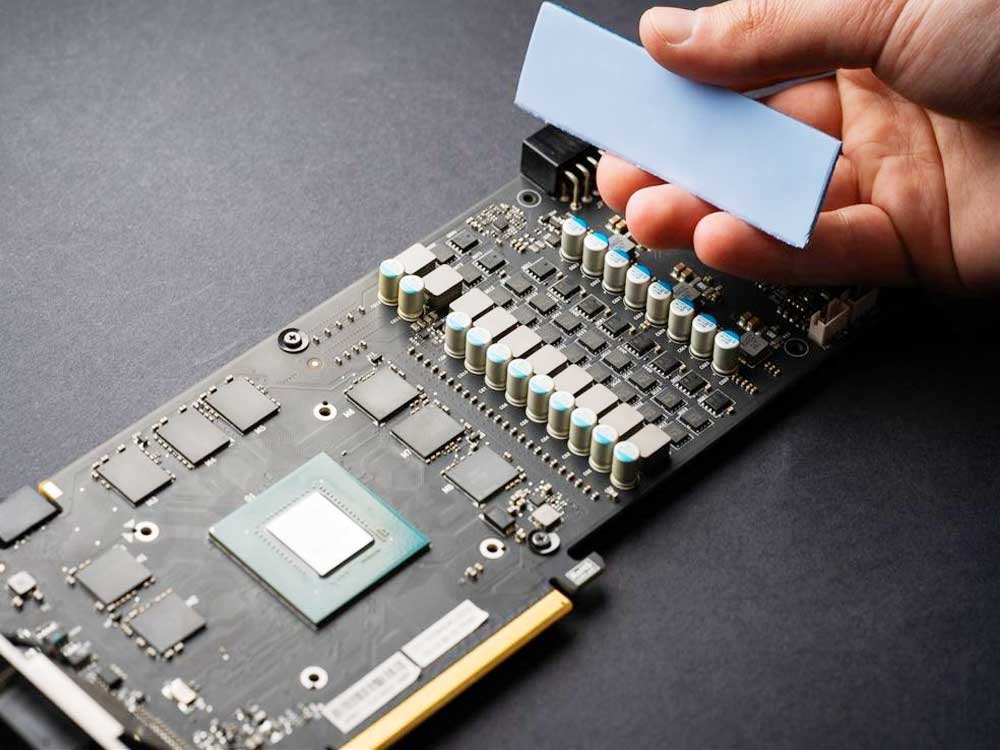
As GPUs continue to deliver higher performance for gaming, AI computing, and data centers, effective thermal management has become more critical than ever. One of the most reliable solutions widely used in GPU cooling systems is the thermal conductive silicone pad.
In this article, we’ll explain what thermal silicone pads are, why they are ideal for GPU heat sinks, and how to choose the right one for your application.
What Are Thermal Conductive Silicone Pads?
Thermal conductive silicone pads are soft, elastomer-based thermal interface materials (TIMs) designed to transfer heat efficiently between heat-generating components and heat sinks.
They are typically made of:
- Silicone rubber matrix
- Thermally conductive fillers (ceramic, aluminum oxide, etc.)
Unlike thermal grease or liquid compounds, silicone pads are solid, clean, and easy to apply, making them ideal for mass production and long-term use.
Why Use Thermal Silicone Pads for GPU Heat Sinks?
GPUs generate significant heat during operation, especially under high loads. Thermal conductive silicone pads offer several advantages for GPU cooling:
1. Excellent Thermal Conductivity
Modern silicone pads provide thermal conductivity ranging from 1.0 to 15.0 W/m·K, enabling efficient heat transfer from GPU chips, memory modules, and VRMs to heat sinks.
2. Gap Filling Capability
GPU assemblies often have uneven surfaces or height differences between components. Silicone pads:
- Compress easily
- Fill air gaps
- Maintain stable thermal contact
This ensures consistent heat dissipation, even in complex GPU layouts.
3. Electrical Insulation
Thermal silicone pads are naturally electrically insulating, protecting sensitive GPU circuits from short circuits while managing heat.
4. Long-Term Reliability
Compared to thermal paste, silicone pads:
- Do not dry out
- Do not pump out
- Maintain performance over time
This makes them ideal for gaming GPUs, workstation GPUs, and server-grade accelerators.
Typical Applications in GPU Assemblies
Thermal conductive silicone pads are widely used on:
- GPU core to heat sink interfaces
- GDDR memory chips
- VRM modules
- Power management ICs
- Backplate thermal coupling
They are commonly found in:
- Gaming graphics cards
- AI and machine learning accelerators
- Cryptocurrency mining GPUs
- Data center and cloud GPUs
Key Performance Parameters to Consider
When selecting thermal silicone pads for GPU heat sinks, focus on the following factors:
Thermal Conductivity (W/m·K)
Higher conductivity improves heat transfer, but must be balanced with compressibility and cost.
Typical ranges:
- Entry-level: 1.0 – 3.0 W/m·K
- Mid-range: 3.0 – 6.0 W/m·K
- High-performance: 8.0 – 15.0 W/m·K
Thickness
Common thickness options include:
- 0.25 mm
- 1.0 mm
- 1.5 mm
- 2.0 mm
Correct thickness ensures proper compression without excessive stress on GPU components.
Hardness (Shore 00)
Softer pads provide better surface contact, especially for uneven GPU assemblies.
Operating Temperature Range
Most silicone pads support -40°C to +200°C, suitable for extreme GPU workloads.
Silicone Pads vs Thermal Paste for GPUs
| Feature | Silicone Pads | Thermal Paste |
|---|---|---|
| Clean Installation | ✅ Yes | ❌ No |
| Gap Filling | ✅ Excellent | ❌ Limited |
| Long-Term Stability | ✅ High | ❌ Medium |
| Rework Convenience | ✅ Easy | ❌ Difficult |
| Mass Production | ✅ Ideal | ❌ Less suitable |
For GPUs with multiple heat sources and complex tolerances, thermal conductive silicone pads are often the preferred solution.
Customization Options for GPU Manufacturers
Professional thermal pad suppliers can offer:
- Custom thermal conductivity
- Die-cut shapes for GPU layouts
- Adhesive or non-adhesive options
- OEM and private labeling
- Cleanroom die-cutting and lamination
These options help GPU manufacturers optimize performance while simplifying assembly.
Conclusion
Thermal conductive silicone pads play a vital role in GPU thermal management, ensuring efficient heat transfer, electrical insulation, and long-term reliability.
Whether you are designing gaming GPUs, AI accelerators, or data center graphics cards, choosing the right thermal silicone pad can significantly improve performance and lifespan.
If you are looking for high-performance thermal conductive silicone pads for GPU heat sinks, working with an experienced manufacturer ensures optimal material selection and customization for your application.
Need help developing your thermal pads material or thermal interface material solutions? Contact Yousan today to start your custom project.
If you would like to learn more about Yousan adhesive tapes, please visit our website at www.ysdiecut.com